Sunday, March 30, 2008

Bear Sterns

I started this post last Monday and then got distracted. Looking at it now, I think the fragment is worth preserving.
I’ve spent the past week being pissed off at all the people who were pissed off about the so-called “bailout” of Bear Stearns. In the light of this morning’s [Monday the 24th] news, I’m starting to half agree with them.

Earlier, I was going to write a post about what a lucky accident it was that the current Fed Chairman is also one of the world’s foremost experts on the problems of the early 1930’s. Now I’m beginning to wonder if it would have been better to have someone with a less well-matched academic background and more poker skills.
In retrospect, it appears that the $2/share price in the original version of the Bear deal was not a real price, just a piece of propaganda, intended to give the impression that it wasn't a bailout. But it's now clear that, whether or not one calls it a bailout, Bernanke offered a lot more in loan guarantees than was really required to get J.P. Morgan to do the deal. (The $1 billion deductible on the new version of the deal is not very convincing as a concession by Morgan, and in any case, it only makes it more obvious that the Fed's original offer was much higher than it needed to be, if Morgan is willing to take a hit both on the special financing and on the purchase price.)

I don't think that's exactly a moral hazard problem, but it's the same general idea. The next time the Fed wants somebody's help to keep the financial system afloat, that somebody will know to charge dearly for that help.


UPDATE: And another thing. What the hell were Ben's priorities? If he wanted to reassure the financial markets, he shouldn't have pushed for a price that made Bear Stearns appear to be in much worse shape than it actually was. (Did that just not occur to him? Did it not occur to Tim Geithner? Did it not occur to anybody at the Fed?) If he wanted to make the Fed look tough, he shouldn't have offered way better financing terms than were really needed to get the deal done. (As noted above, both the price and the financing terms got worse for Morgan subsequently, and they were still willing to play.) Did it not occur to him that being tough with winners was important for the Fed's reputation too, as well as being tough with losers? This was a major screw-up.

Labels: , , , ,

Friday, March 21, 2008

What's going on?

In Paul Krugman’s latest column (hat tip: Mark Thoma), he compares the current financial crisis to the bank runs of 1930 and 1931:
The financial crisis currently under way is basically an updated version of the wave of bank runs that swept the nation three generations ago. People aren’t pulling cash out of banks to put it in their mattresses — but they’re doing the modern equivalent, pulling their money out of the shadow banking system and putting into Treasury bills. And the result, now as then, is a vicious circle of financial contraction.
That sounds like a pretty good description of what’s going on, but there’s something missing. Thinking about this as a regular person rather than an economist, I have to ask, “Who are these ‘people’ that are pulling their money out of the shadow banking system and putting it into treasury bills?” Because it sure isn’t me. I have my cash in a prime money market fund; I deliberately passed up the “treasury-only” option, and I see no reason to change my mind now. My fund hasn’t broken the buck. In fact, I haven’t heard of any money market fund that has broken the buck recently. (Possibly something escaped my attention, with all the news that’s come out lately, but even if there have been one or two cases, there haven’t been many, and they haven’t been big ones.)

I don’t know exactly what my fund manager is doing; I imagine they’ve probably increased the proportion of treasuries in their portfolio, and I guess, technically, it was “people” that made that decision, but it wasn’t any people that I know personally. If anything, I’d like my fund to skate closer to the edge. It would not drive me into bankruptcy if the share price went from $1.00 to $0.99. In fact, I probably wouldn’t even notice, except for the fact that I’d read about it in the newspaper, and the fund would probably send me all kinds of stuff in the mail about how something went terribly wrong and the employee has been fired and this will never ever happen again in a million years and they’re completely changing all their control procedures and they’re changing their name just to show that they aren’t really the ones who lost that one cent.

So I guess the point is, it’s not really “people,” in the sense of retail investors, who have lost confidence; it’s institutions. Maybe that’s why so many “people” have a hard time seeing what the big deal is and why the Fed needs to help “bail out” Bear Stearns. As for me, when I see the TED spread approaching 200 basis points and the treasury bill rate approaching zero, I know that something is very wrong and that the Fed has good reason to be taking drastic measures, but I’m still a little confused as to why all this is happening. I understand that the consequences of the failure of a major investment bank under these conditions would be disastrous, but I still have trouble seeing why J.P. Morgan needed $30 billion in non-recourse financing to convince it to buy Bear Stearns for a tiny fraction of what the market seemed to think it was worth.

Labels: , , , , ,

Monday, March 17, 2008

Capital Flight is Good

Some people (Yves Smith and Tim Duy, to name two, but I’m sure there are many others that I haven’t gotten around to reading yet) are worried that concern about capital flight is going to have to be a constraint on the Fed’s ability to deal with this crisis. I disagree. I don’t think the Fed will or should be concerned about capital flight. In fact, I think capital flight is part of the solution, not part of the problem.

In general, capital flight is a problem if you care about quantities that are not denominated in your own currency. If all the quantities you care about are (or can be) denominated in your own currency, then you can just print as much currency as you need to replace the foreign capital. There are basically 4 situations where capital flight is a problem, which I will call the 4 Fs:
  1. Full employment. If all your real domestic resources are being used, then the withdrawal of foreign capital will mean the withdrawal of real resources, which will reduce your growth potential. This was an issue for the US in the late 90s. But today the US is not at full employment. And if you still think it is, just wait a few months.

  2. Fixed exchange rate. If you need to defend an exchange rate, the government will effectively have to supply exiting capital out of limited official reserves. This was a large part of the problem in the early 30s. But today the US does not have an obligation to defend its currency, nor does it have (about which see the rest of this post) and interest in maintaining its currency’s value.

  3. Foreign currency-denominated debts. If you have to pay back foreign currency, you’ll be in trouble if capital flight weakens your own currency and thereby makes foreign currency harder for you to get. This has been a problem in various places, particularly Latin America, in the past, but it’s not an issue for the US today: almost all our debts are denominated in dollars.

  4. (in)Flation. If your country is experiencing, or on the verge of experiencing, an unwelcome inflation, capital flight will exacerbate the problem by weakening your currency and thereby raising import prices. As of 8:29 AM on Friday, I still thought this was an issue for the US today. I no longer do.
For the US today, the real problem would be if foreigners insisted on continuing to purchase US assets. That would support the dollar, making it that much harder to sell US goods and services and contributing to the weakening of the economy, thereby exacerbating the positive feedback between a weak economy and a weak financial system.

As long as inflation was a major issue, there were limits to what the Fed could do to stabilize the domestic financial system. It could only take on mortgage securities, for example, up to the point where it used up all its assets. In that situation, an absence of foreign demand for US securities might be a big problem.

If, as now appears to be the case, the risk of deflation is a bigger issue than the risk of inflation, then there is no limit to what the Fed can do. If it runs out of assets, it just prints more money to buy assets with. If foreigners refuse to buy US assets, the Fed prints money for Americans to buy them. If Americans refuse to buy risky assets, then the Fed can trade its own assets for risky assets through programs like the TSLF. Or lend money directly against risky assets. If foreigners withdraw capital, the Fed can replace it with newly created money. (Actually, it won’t need to, because when the proceeds from the withdrawn capital are converted out of dollars, the counterparty to that conversion will have dollars to invest.)

If the dollar weakens, so much the better. $2/Euro. $3/Euro. In the words of Chico Marx, “I got plenty higher numbers.” It might be a problem for Europe, but not for the US (and for Europe it would be a self-inflicted wound, since there is plenty of room to expand the supply of euros if there were a will to do so).

There is no limit to the potential magnitude of the Fed’s actions, but there could conceivably be limits to the effectiveness of those actions even as the magnitude becomes infinitely large. That situation is exactly one where capital flight would be a good thing. If the Fed can’t manage to stimulate the economy sufficiently by printing money, the stimulus has to come from somewhere else. Increased demand for US exports, due to a weak dollar, due to capital flight, is one of the chief candidates.

Labels: , , , , , , , , ,

Sunday, March 16, 2008

Moral Hazard

[Hypothetical future investor]: I own a major stake in an investment bank, and I’m getting concerned about their risk management. Should I bring this up at the shareholders’ meeting?

[Hypothetical friend]: I don’t see why. What’s the worst that can happen? The bank will go sour, the Fed will arrange a bailout, and you’ll only lose 95 percent of the money you invested, 96 tops. What’s the big deal?

[Hypothetical future investor]: You’re right. Isn’t the [Hypothetical future Fed chairman] put great?

Labels: , , ,

Friday, February 15, 2008

Not a Bubble

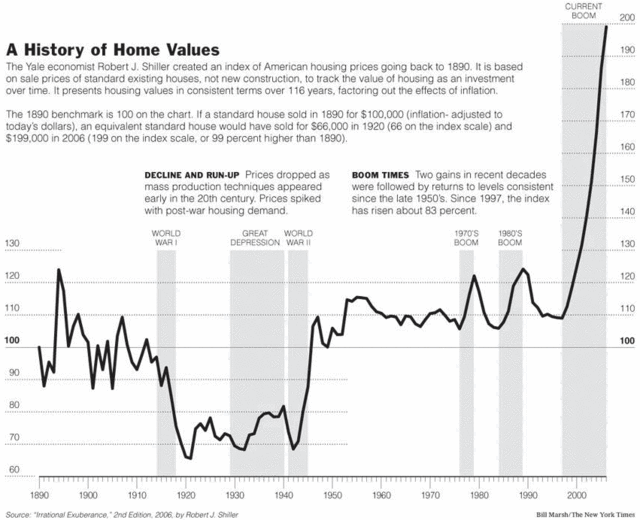
Alex Tabarrok of Marginal Revolution has gotten a lot of (mostly dissenting) attention for his argument that there was no housing bubble (hat tip: hmm, I don't even remember, but I'll cite Paul Krugman, Jane Galt Megan McArdle, and Battlepanda, among the many who have pointed to the post). Alex Tabarrok reproduces Shiller's now-famous chart of housing prices over the past 100 years and comments:
The clear implication of the chart is that normal prices are around an index value of 110, the value that reigned for nearly fifty years (circa 1950-1997). So if the massive run-up in house prices since 1997 [culminating at an index value around 200] was a bubble and if the bubble has now been popped we should see a massive drop in prices.

But what has actually happened? House prices have certainly stopped increasing and they have dropped but they have not dropped to anywhere near the historic average. Since the peak in the second quarter of 2006 prices have dropped by about 5% at the national level (third quarter 2007). Prices have fallen more in the hottest markets but the run-up was much larger in those markets as well.

Prices will probably drop some more but personally I don't expect to ever again see index values around 110. Do you?
As Battlepanda points out, "Do you?" is not a very convincing argument unless you already agree with him. But I think I can make it a little bit more convincing:
Prices will probably drop some more, but personally, given the likely effect that an additional 40% drop in home prices would have on the already weak economy, I don't expect that the Fed will allow index values to fall to anywhere near 110 in the foreseeable future. Do you?
Some people will respond with something like, "OK, I don't either, but that doesn't mean it wasn't a bubble; that just means there's a Bernanke put on home prices: there was a bubble, and the Fed is now going to ratify the results of the bubble." But that's not right. The Fed is not actively causing inflation in order to bail out homeowners and their creditors. The vast majority of professional forecasts call for the inflation rate to fall over the next few years. The Fed is just doing its job -- trying to keep inflation at a low but positive rate while maximizing employment subject to that constraint. The ultimate concern of the Fed is to avoid deflation, which becomes a serious risk if the US housing market has a total meltdown. It's very much as if the Fed were passively defending a commodity standard, with the core CPI basket as the commodity.

The ultimate source of the housing boom is the global surplus of savings over investment. That surplus is what pushed global interest rates down and thereby made buying a house more attractive than renting. And that surplus is still with us. If anything, it appears to be getting worse, as US households begin to reject the role of "borrower of last resort." And it is that now aggravated surplus that threatens us with weak aggregate demand and the risk of economic depression in the immediate future -- a risk to which the Fed and other central banks will respond appropriately. Until the world finds something else in which to invest besides American houses, the fundamentals for house prices are strong -- not strong enough, probably, to keep house prices from falling further, but strong enough to keep them well above historically typical levels.

Labels: , , , , , , , ,

Monday, October 29, 2007

125 Basis Points

Is it time for another Fed meeting already? How time flies when you’re watching CDO tranches get downgraded from top quality to junk!

I just want to point out that the Taylor rule is still calling for a federal funds rate of 3.5%, and there are 125 basis points left to get there, so by this measure, the FOMC’s job has barely begun. Since the last meeting, the (12-month market-based core PCE) inflation rate has fallen (from 1.7% to 1.6%, rounded) and the unemployment rate has risen (from 4.6% to 4.7%, rounded, but mostly due to rounding), so if anything, the target would be even lower. But with quarter-point rounding in the funds rate target, the combined effect of these changes is not enough to change the result.

As to what the FOMC will actually do this week, I’ll go with the consensus of 25 basis points. As Mark Shivers suggests, there are persuasive arguments to be made for either 0 or 50, and the arguments are sufficiently persuasive that neither of these options can be chosen, because either one would imply a strong rejection of the other. Although the financial crisis has clearly diminished, it may not have diminished as much or as quickly as the Fed had hoped, and part of the reason for its diminishing is the expectation of another rate cut. Depending on how you read the beige book, there either are or aren’t indications that the crisis is affecting the real economy, so the appropriate rate cut is either 50 basis points (to nip this trend in the bud) or 0. An individual might make the choice by flipping a coin, but a committee makes it by splitting the difference.

As for my serious opinion of what the FOMC should do, I think I would go with 50. A 75 basis point cut would risk too much financial market (and foreign exchange market) instability, but even a more conservative Taylor rule would call for at least 50. (Say, for example, we reduced the target inflation rate from 2% to 1.5% and increased the natural real federal funds rate from 2% to 2.5%. That would increase the target funds rate by 75 basis points, leaving 50 still to go. Personally, I’d rather stick with the original rule if we’re going to use Taylor rules at all, but I’m open to choosing a higher inflation reading than my 1.6%.) Some of the arguments I made in September no longer apply (e.g. the temporarily robust dollar, falling employment), but most of them still do, and the bottom line is that even 4.5% qualifies as a slightly restrictive policy, not appropriate when the core inflation rate is still low and 65% of Americans expect a recession (hat tip: Barry Ritholtz).

I could also point out that, while the financial crisis has diminished, the underlying housing problem has gotten worse (and by worse I mean worse relative to expectations). Here in eastern Massachusetts (home of the world champion Boston Red Sox!), where a year ago it was difficult to find anecdotal evidence to support the statistical finding that house prices were declining, it is now difficult to avoid the anecdotal evidence. At dinner Saturday evening, for example, the waitress told my wife about how she and her husband were planning to move but underwater on their mortgage and hoping the bank would accept a short sale. With the personal savings rate still near zero, declining house prices are likely to be a drag on consumer spending for quite a while, and the risk that the we could discover a nonlinearity in the response sometime soon – particularly with oil prices making new record highs and credit conditions fairly tight – is palpable. When and if we hit that nonlinearity, it will be too late to prevent a recession.

Labels: , , , , ,

Monday, September 24, 2007

Shorter Case for Labor Cost Targeting

Look, there’s a good chance the s___ is going to hit the fan in the next few years, if not in the next few weeks**, with a crash in the dollar and a takeoff by commodity prices, especially oil. The Fed has 3 choices:
  1. It can wait for the s___ to hit the fan and then do nothing.* Bond markets, product markets, and labor markets will lose confidence in the Fed’s resolve for price stability, and the result will be stagflation (a concept with which readers my age and older will be familiar from experience, but younger readers may have to use their imaginations).

  2. It can wait for the s___ to hit the fan and then tighten aggressively. The result will be a major recession.

  3. It can “announce” as soon as possible that it intends to target labor costs, and when the s___ hits the fan, do nothing.* The result, with any luck, will be a couple of years of high inflation rates, with normal economic growth, followed by more normal economic growth along with low inflation rates.
I’m just saying, choose what’s behind door number 3. It doesn't really matter if you're a capitalist or a worker or a rentier or a financial technocrat or what. It's just the best choice.


*That is, nothing except for a mild tightening to offset the economic stimulus from the weaker dollar.

**UPDATE: Let's say quite possibly in the next few weeks, if not in the next few days. The following item appears in my email this morning:
Venezuela’s state-run oil company has demanded payment for all future sales of crude and products to be in euros rather than US dollars, according to a letter to customers on September 21.

Labels: , , , , , , ,

Saturday, September 22, 2007

Target Unit Labor Costs

Last year (here and here, with related posts here, here, here, here, here, here, and here – or just read the August 2006 archives and my post from yesterday) I suggested that the Fed should target unit labor costs. Upon additional thought, I still think so. I won’t go through the whole argument again, but I want to note a few important points:

  1. I’m referring to targeting a forecast of labor costs (using a “price rule” that would correct for the failures of earlier forecasts), not trying to react to every wiggle in the reported series, which is reported with a lag, quite volatile and subject sometimes to fairly dramatic revisions. The idea is for the Fed to have a long-run stable growth rate of unit labor costs as its ultimate objective, upon which it could be judged after several years of hindsight, when the final revisions come in and the trends become clear.

  2. The main purpose of this approach is to have a simple and easily understood (by the market) answer to the question of how to react to supply shocks. The appropriate response to supply shocks is a matter of great controversy in macroeconomics: should a central bank accommodate supply shocks and let the inflation rate rise temporarily in order to avoid a recession or a slowing of growth (or a boom, in the case of a favorable supply shock), or should it lean heavily against the inflationary impact (or the deflationary impact) of supply shocks in order to pursue an unchanged target inflation rate? The labor cost target settles the question: if the shock is to domestic productivity or to the labor market, then lean against the inflationary impact; if the shock is entirely outside the domestic labor market and production process, then accommodate (except to the extent that you expect the shock to have indirect effects on productivity and the labor market, such as might arise, for example, from sticky real wages).

  3. If the Fed is going to adopt such a policy, now is the time to announce it – or rather, to let the idea of prioritizing unit labor costs find its way into the speeches of Fed officials, since that’s the way the Fed operates. All indications today are that we are heading directly into an unfavorable import price shock. How will the Fed react? The market shouldn’t have to make random guesses. Moreover, there is great uncertainty about the intensity of the shock, and to some extent, the direction (because oil is something of a wild card and could have a big drop in price just as easily as a big increase). We want to know now what reactions to expect when these uncertainties are resolved.

  4. When today’s incipient shocks are fully realized, Fed credibility is going to be a big issue, especially with a relatively short-tenured Chairman and given the market’s response to this week’s Fed action. In the case of a severe adverse shock, if the Fed hasn’t specified in advance how it intends to react, it will face a choice between recession and loss of credibility. That’s not a situation that anyone will enjoy.

  5. As the following updated chart indicates, the Fed can make a pretty good case that it has already been targeting unit labor costs since the early 1990s. (The old talk about a preferred inflation rate between 1% and 2% rings a bit hollow – in addition to being, in my opinion, a less than optimal target range for inflation. But unit labor costs have stayed pretty nicely in that range – although, in my opinion, it’s a less than optimal target for unit labor costs as well, and I would hope the Fed would go maybe for something like 2%.)


From the chart, it looks like we need a slowing of unit labor costs now to continue keeping in line with the target. But given the recent weakness in the labor market and simultaneous recovery in output growth, as well as various factors suggesting a high risk of recession, I think the central tendency of the Fed’s forecasts will be for slower labor cost growth anyhow. All in all, labor costs are still very close to the presumed target, so the priority at this point should be for maintaining stable growth rather than attacking a bulge in labor costs. (And if the Fed were to do as I prefer, and raise the target to 2%, there wouldn’t be any question.)

Labels: , , , , , , , ,

Wednesday, September 19, 2007

Unanimous

The Fed didn't quite give me the 175 basis point cut that I was calling for, but depending on how you look at things, it kind of almost did. You can divide the conceivable Fed actions into those that I thought might actually happen and those that were merely my fantasies. If you had asked me before the meeting about the possibility of a unanimous vote for a 50 basis points cut, I would have assigned it to the latter category. So at least things came out on the right side of the reality/fantasy divide.

The disappointing part, though, is that, now that the meeting is over, I won't get a chance to do a post on why the cut should be 200 basis points.

Labels: , , ,

Monday, September 17, 2007

175 Basis Points

At the Open Market Committee meeting tomorrow (today if not yesterday or a month ago, by the time anyone is likely to read this), I recommend that the Fed cut its federal funds rate target to 3.5%. This recommendation is based on a direct application of the rule presented in John Taylor’s 1993 paper:

   r = p + .5y + .5(p – 2) + 2

where p is the inflation rate
and y is the deviation of output from potential

Today, the unemployment rate (if you divide the number of unemployed by the number in the labor force instead of using the one-decimal-place figure reported by the BLS) is within 0.01% of the Phili Fed SPF median NAIRU estimate of 4.65%, so y is zero.

The best price index we have is the market-based core personal consumption deflator, which gives an inflation rate of 1.7% (the very last number in this report) over the most recent 12-month period.

Plug in 1.7 for p and zero for y.

   r  =  1.7 + .5(0) + .5(1.7-2) + 2  =  3.55


which rounds down to 3.5


How on earth is Allan Meltzer (hat tip: Greg Mankiw) able to reach the conclusion that the target should remain at 5.25%?

Labels: , , , ,

Friday, September 14, 2007

Fire and Ice*

Marc Shivers of The Talking Fed notes the following new material from Ben Bernanke’s speech on Tuesday (referring to the way that current global imbalances might end, given Bernanke’s argument that they are caused by a global savings glut):
What implications would a gradual rebalancing have for long-term real interest rates? The logic of the global saving glut suggests that, as the glut dissipates over the next few decades and thereby reduces the net supply of financial capital from emerging-market countries, real interest rates should rise
Upon which the blogger comments:
He presumably leaves it as an exercise for the reader to figure out what implications a sudden rebalancing would have on long-term interest rates, like might happen, for example, if U.S. consumers collectively decided tomorrow that they no longer wanted to be the consumers of last resort for the rest of the world. I'm guessing this is what the FOMC was referring to on Aug 17 when they said "the FOMC judges that the downside risks to growth have increased appreciably."
Despite Bernanke’s research linking the two, though, I think we should be careful to separate conceptually the issue of the savings glut from that of the international imbalance. In principle it is possible to have either one without the other. One might ask separately the questions, “How (and when) will the savings glut end (and will it ever end)?” and, “How (and when) will the international imbalance end (and will it ever end)?”

In my own mind, I have an easier time imagining a more-or-less “permanent” savings glut than I do imagining a “permanent” international imbalance. The case that comes to my mind is the 1930s, when the world had a prolonged savings glut. Indeed the glut might have gone on indefinitely if the brilliant economists in Nazi Germany and Imperial Japan had not hit on an ingenious method for coordinating international policies.** During the course of the savings glut in the 1930s, however, there were some successful attempts to alter the international balance.

Ben Bernanke imagines that the global rebalancing will be the result of the elimination of the savings glut (just as – in his view, anyhow – the original imbalance was itself the result of the savings glut). Marc Shivers, on the other hand, imagines what might happen if the global rebalancing resulted from an intensification of the savings glut – that is, if the US joined the glut instead of the rest of the world ending the glut. He imagines that scenario as a sudden change, but it could also happen gradually.

In the sudden scenario, I think long-term interest rates would go down, but there is some ambiguity, because the inflationary impact of sudden weakness in the dollar might lead the bond market to anticipate tight money. In the gradual scenario, there isn’t much ambiguity: a gradually weakening dollar would not have a dramatic inflationary impact, so the bond market should anticipate easy money to stimulate an economy weakened by slowing consumer spending.

I see at least one reason to expect that “gradual widening of the savings glut” scenario: demographics. The children of the baby-boomers are now at the point of graduating from college or otherwise experiencing full emancipation. Without the expenses of caring for their children, baby-boomers – that bulge in the US age distribution – will have surplus income at a time when it is becoming increasingly difficult to ignore the specter of retirement. That realization isn’t something that happens overnight to everyone at once, but I imagine it will happen faster than the matter of decades over which Ben Bernanke sees the rest of the world regaining its appetite for real investment.


*The title is an allusion to Robert Frost, but frankly, I like Pat Benatar’s version better

**UPDATE: I guess the US has tried something similar recently, but the international coordination doesn't work unless you attack a country that has allies. Just like George W to screw things up ;)

Labels: , , , ,

Sunday, September 09, 2007

50 Basis Points

I don’t expect that the Fed will cut the federal funds rate target by 50 basis points at its next meeting, but I do think that would be a good idea. (This conversation started on William Polley’s blog, but it’s going to get too long for a comment.) I see every reason to prefer erring on the side of too much stimulus rather than too little:
  1. With the release of the payroll employment figures for August, as well as the revisions for June and July, not to mention the widely expected prospect of additional downward revisions when the real data on births and deaths come in, we face the serious possibility that the US was already in a recession when August’s financial crisis hit. (That’s in addition to the possibility that we went into a recession in August, and the possibility that the effects of the financial crisis will tip us into recession over the coming months.) If it turns out that the recession began before the financial crisis, we will be experiencing a deepening recession over the coming months, and

  2. that recession could get really ugly. Although I made optimistic noises last year about the tractability of any possible recession, I am becoming increasingly worried about the possibility of a policy-resistant recession. Consider that

    • the international savings glut is still with us, and, if anything, it’s about time for the US to join the glut rather than playing the hero, as

      • American households have had a negative personal savings rate for two years, and this is unlikely to continue given the now more limited prospects for capital gains on assets and more restricted access to low-priced credit.

      • America’s children are about to graduate from college, which puts Mr. and Mrs. America at the point where it’s time to stop worrying about the kids and start panicking about inadequate retirement savings.

      • tax cuts are going to expire soon, and the Democratic congress is unlikely to extend them.

    • If the international savings glut should disappear, then we face the prospect of a potentially stagflationary fall in the dollar, which would inhibit the use of policy to end the recession.

    • A conventional monetary stimulus may in any case prove ineffective, given the “once bitten” status of the housing market and the unresponsiveness of capital spending. I don’t think Ben Bernanke wants to be in the position of having to use his helicopter.

  3. By the standards of the last 50 years, the inflation rate is damn low. The 12-month growth rate of the core consumption deflator is within the target range. Inflation expectations are well-contained by almost any reasonable measure – with median expected 10-year CPI inflation (according to the Philadelphia Fed’s Survey of Professional Forecasters) recently falling below the 2.5 percent level where it has spent almost all of the past 10 years. The weight of risks is overwhelmingly on the side of too little growth rather than too much inflation.

  4. From an economic point of view, monetary policy will still be tight, even after a 50 basis point cut. If you take the rule of thumb that the neutral real overnight interest rate is 2%, and add that 2% to the core PCE inflation rate, you get 3.9%. OK, maybe you don’t buy that – so make it 4.2%, or even 4.5%. But 4.75%? No way is that a stimulus policy.

  5. The longer-term prospects for the dollar are dismal, but at this moment, everyone wants dollars – probably because so many foreigners are trying (or being forced) to unwind levered positions in dollar-denominated assets. Instead of saying, “Let them eat euros!” why not give them the dollars now, and you can take them away later if necessary. If the stimulus turns out to be ”too much” from a business cycle point of view, so much the better from an “orderly foreign exchange markets” point of view. When the world has had its fill of dollars and the thought of the dismal US international investment position starts to cause indigestion, it will be just in time for the Fed to prevent a free fall by raising interest rates in the face of an overheating economy. I’m not advocating exchange-rate targeting, and under normal circumstances, I would say that the Fed should ignore the value of the dollar (except to the extent that it alters the picture for expected employment and inflation). But after so many years of huge and growing current account deficits, these are not normal circumstances; the Fed needs to worry about how potential exchange market instability might constrain its future actions.

  6. History will forgive a recently appointed central banker for overreacting to a financial crisis. (It surely forgave the former Chairman when he overreacted to the stock market crash.) History will not deal so kindly with a central banker who allows the economy to fall into an intractable recession. When the Emperor smells smoke, even if the odor is rather faint at first, he had best put down his fiddle.

  7. One of the mistakes of the last easing cycle was not to cut aggressively enough in the beginning. Ultimately (we can say with hindsight) the easing cycle went too far, but it definitely started too slowly. The Fed was also too slow to ease in 1990-91. The Fed has a lot of inflation-fighting credibility today, and should the economy seem to move in the direction of overheating, the Fed can take back any easing moves without having lost much ground. But you don’t get a second chance to prevent a recession.

  8. All the reasons that I have given already are things the financial markets can figure out for themselves. If the Fed only cuts by 25 basis points this month, markets will have good reason to expect another cut in October. If the Fed cuts by 50 basis points, it can credibly avow a reasonable hope that no further cuts will be necessary.

Labels: , , , , , , ,

Thursday, August 30, 2007

Time to Do the Wrong Thing

Something is wrong here. Even though the Fed and its chairman (not to mention anyone who has studied the evidence rigorously) believe that there was never a Greenspan put, the Fed seems to feel that it has to be very careful not to create the impression that the Greenspan put exists. In other words, to some (hopefully not very large, but I'm not sure) extent, the appearance of bailing out Wall Street is now an argument to the Fed's objective function. Which means that, under some circumstances, the Fed will deliberately follow bad policy -- bad meaning suboptimal with respect to the balance of growth and inflation risks -- because the better policy would have the appearance of being too Wall Street friendly.

In fact, since the history of the Greenspan era suggests that following an ex ante optimal policy for growth and inflation does create the impression that there is a Greenspan put, the Fed can expect that it will occasionally have to make a deliberate mistake. Something is wrong.

If the Fed doesn't cut the federal funds rate target in September -- barring a truly dramatic improvement in credit conditions or a series of economic reports that are either stronger or more inflationary than expected -- I will, as I said a few days ago, be puzzled, but perhaps not all that puzzled after all. By such inaction in the face of widening spreads and credit rationing, I argued then, the Fed would be "either making a mistake or acknowledging that they made a mistake earlier by not having raised the rate higher in the first place." But I hadn't considered the possibility of a deliberate mistake. Does one need to sacrifice a virgin on the altar of Moral Hazard Avoidance, not because it will in fact result in a better harvest, but because the people think so, and they won't bother planting unless you do?

Labels: , , , , ,

Tuesday, August 28, 2007

Punch at Caesar's Funeral

Contrarian that I am, Daniel Gross’ latest Moneybox commentary in Slate (hat tip: Mark Thoma) has all but convinced me that a drastic easing of Fed policy will be necessary to avoid a major recession. The main thrust of his commentary seems to be that, because a lot of rich people and conservatives want the Fed to cut interest rates, therefore anyone who is not rich or conservative should regard such a cut as a bad idea. (He doesn’t make that logic explicit, but since the commentary contains little explicit logic, I feel entitled to read between the lines.) To me, as a non-conservative* who is not (yet) rich (certainly not in the same league as Mr. Gross’ “motley collection of gazillionaires”), the observation that such people are “begging the Fed to cut interest rates” tends to reflect well on them rather than reflecting badly on the possibility of interest rate cuts.

At the end of the commentary, Mr. Gross does attempt to make an actual argument against interest rate cuts, but I fear he has confused metaphor with reality:
College students don't alleviate the after-effects of an evening spent at the punch bowl by returning to lap up the dregs. Just so, finance types should know that cheap money, credit on demand, and endless leverage aren't the cure for a hangover caused by too much cheap money, leverage, and credit on demand.
Or perhaps he has merely forgotten some relevant history. Unlike me, Mr. Gross does have a degree in history, so perhaps he will be able to find historical examples to buttress his case. (There were none in this particular commentary.) But to my own sparsely tutored ear, his analogy bears an unpleasant resemblance to the type of argument that was often heard in policy circles during the period 1929-1932.

As a matter of macroeconomics, I would say that “cheap money, leverage, and credit on demand” are precisely the cure “for a hangover caused by too much cheap money, leverage, and credit on demand” – at least to the extent that said hangover carries a risk of recession or deflation. If only the Fed had provided cheap money and credit on demand in late 1929 and 1930 (or, for that matter, 1931 and 1932), history might have turned out quite differently (and, I dare say, better). Perhaps Mr. Gross can cite some recent history – the 1998 experience – as an example of what’s wrong with easing monetary policy in response to a mass deleveraging. I have to ask, though: If the choice is between risking another 1999 and risking another 1931, which one should we be more concerned about? I pause for reply....


Not that we really have to worry about a repeat of the 1930s. Ben Bernanke is an economic historian – and an expert on the Great Depression, at that. As soon as he gets a strong whiff of recession, he will do anything but repeat the mistakes of the early 1930s. But it’s also clear that Chairman Bernanke is bending over backward to avoid repeating 1998. The last three weeks have been a case study in how to loosen monetary policy without loosening monetary policy. And it’s worth noting that the US economy was a lot stronger going into 1998 than it was going into 2007.

The classic “punch bowl” metaphor adopted by Mr. Gross has (at least) one major limitation: unlike alcohol, money is pretty much essential to the functioning of a modern economy. Certainly the Fed should take away the ice cream before our waistlines start to inflate. But when our bulimic economy realizes it has eaten too much, there are healthier approaches than encouraging vomiting and fasting.


* I hesitate to use the word “conservative” in any substantive context, however. The fact that “conservatives” are calling for easy money is yet one more small contribution to the mounting evidence that such words have little left in the way of meaning.

Labels: , , , , , , ,

Sunday, August 26, 2007

Long and Variable Lags

I wrote this in a comment to a post on Economist’s View, but it’s sufficiently critical to my world-view to deserve a post of its own in my blog. The launching point is a Vox EU piece by Tito Boeri and Luigi Guiso, in which they denominate three causes underlying the current financial crisis:
  • The low financial literacy of US households;
  • The financial innovation that has resulted in the massive securitisation of illiquid assets; and
  • The low interest rate policy followed by Alan Greenspan’s Fed from 2001 to 2004,
of which the third is “by far the most important.”

So far I don’t particularly disagree, but Boeri and Guiso are then quick to paint Alan Greenspan, along with “the Keynesian sirens” whose song he chose to follow, as the villains in this matter. In my own view,
If there was a monetary policy mistake in 2002-2003, the mistake was a failure to anticipate the lag between policy action and results. When a monetary stimulus is transmitted through the housing market, the lags are apparently longer than the typical lags associated with monetary policy historically. Greenspan kept easing because he wasn’t seeing results from his earlier easing, and in retrospect, it appears that he just wasn’t waiting long enough for those results.

If that was the mistake, then Bernanke may have made the same mistake in the other direction (and if so, he is apparently still making it). The housing bust that is taking place today is more or less a deliberate result of policy: the Fed wanted to slow down the economy, and the only way they could do it was to put the brakes on the housing market. Bernanke kept tightening in the first half of 2006 because he wasn’t seeing results from Greenspan’s earlier tightening (because the housing market was still booming, or it had just begun to slow down, and the macroeconomic effects weren’t yet apparent). Starting in the second half of 2006, Bernanke got what he was looking for: the monetary tightening from 2004 and 2005 finally was affecting economic growth.

If we look at the time lag from the beginning of the tightening (June 2004) to the point where the effect was first apparent (July 2006), it suggests that about half the impact of the tightening has yet to be felt. (Apply the same time lag to the end of the tightening, June 2006, and it suggests a peak effect starting in July 2008.) The hope, I suppose, is that we haven’t yet, even now, seen the full effect of Greenspan's original loosening outside the housing market, and that the residual effect of the loosening will counterbalance the effect of the tightening via the housing market. (For example, the dollar seems to have weakened very slowly, and we are beginning to see the effects on the trade balance.) When I think about it, that scenario seems pretty optimistic. It seems more likely that Bernanke has indeed repeated Greenspan’s mistake in reverse.
From this passage, it may begin to become clear what I meant when I said, “The Fed should encourage the continuation of a housing boom (or something of that nature).” I realize that, at the peak of the boom, the stimulus was stronger than what the US economy needed, but the policy today seems to be one of keeping interest rates high enough to erase, ultimately, a large part of the boom, perhaps bringing the US economy back to where it was in mid-2004. (Even that is only if we assume no overshoot on the downside. And the current financial crisis is already laying the groundwork for just such an overshoot.).

I guess some economists were perfectly happy with 2004, but I certainly wasn’t: the unemployment rate was 5.6% in June 2004; by a typical recent estimate, that’s almost a full percentage point above the natural rate. (The Philadelphia Fed’s most recent Survey of Professional Forecasters puts the median natural rate estimate at 4.65%. Anyone who has been following this blog since the beginning will know that I put the natural rate even lower.) So, while I don’t think the Fed should try to bring back the boom conditions of early 2006, I also don’t think it should deliberately “puncture” the “bubble.” Scrape off the froth, but don’t pour half the beverage down the drain.

Labels: , , , , ,

Tuesday, August 21, 2007

I come to bury the Housing Boom, not to praise it.

OK, I lied: I come to praise it. Basic macroeconomics is leading me to some unpopular conclusions:

  1. The housing boom was a good thing; therefore
  2. Far from worrying about moral hazard, the Fed should be deliberately rewarding those who participated; and
  3. (At least according to my reading of the macroeconomy) The Fed should encourage the continuation of a housing boom (or something of that nature).

My basic argument is quite simple: without the housing boom, there would have been no economic recovery, and…recovery is good.

It’s not very controversial that the housing boom was the main reason for the economic recovery, so let’s do a thought experiment in which we re-run the years since 2001 without a housing boom. Would something else have happened instead to produce a recovery? Let’s line up the candidates.

First, fiscal policy. We did have a war, two large tax cuts, and a large new entitlement benefiting the age group with the highest marginal propensity to spend. The consensus is that all these were not enough. Perhaps they would have prevented the recession from getting worse, but without the direct and indirect effects of the housing boom, any recovery would have been meager at best. OK, how about a big public works program? Not a bad idea, if you ask me, but this is where we have to begin distinguishing between thought experiment and fantasy. If your conception has a public works program that dwarfs the New Deal being passed by a Republican Congress and signed by George W. Bush, I recommend you get in touch with George Lucas about the special effects.

What about an export boom (and/or substitution of domestic products for imports) supported by a weak dollar? That is, after all, the traditional mechanism by which monetary policy is supposed to operate in an open economy with a flexible exchange rate. The first problem that arises is that the US exchange rate against many countries isn’t (and, most emphatically, wasn’t) flexible, and even when it is nominally flexible, the competing products are often effectively priced in dollars. One could imagine a mildly successful beggar-thy-neighbor policy against Europe (supposing that, in the absence of a housing boom, the dollar would have crashed against the Euro in 2002 instead of falling gradually over 5 years). At best, that gives us a mild (and somewhat stagflationary) recovery in the US and a severe recession in Europe (which, as you may recall, had its own problems in the early years of this decade). All in all, the possibilities created by a falling dollar (in place of the housing boom) are not impressive.

So what’s left? An investment boom supported by low interest rates? If it didn’t happen when the federal funds rate was at 1%, would it have happened if the rate had fallen to 0%? I tend to doubt it. An investment boom supported by “quantitative easing”? Possibly, but it took Japan years even to hit on that possibility, and the jury is still out on whether quantitative easing was the real reason for Japan’s recovery. The premise that such a policy would have been tried successfully in the US during this decade is speculative at best. Other ideas? Money dropping from the sky? Maybe, but remember, “Helicopter Ben” didn’t take over the Fed until 2006. And so on….Rather than going from the bizarre to the more bizarre, I’m just going to reassert my premise and suggest that the burden of proof is now on anyone who disagrees: Without the housing boom, there would have been no economic recovery.

The implication of having no economic recovery is that we would have slack resources the whole time – the sort of event that used to be called a depression before the term fell victim to political correctness. Thus, comparing my counterfactual world to the actual world, all the extra production that we got out of the US economy was done with resources that would otherwise have been wasted. From a macroeconomic point of view, all those extra houses and such were free – a free lunch, if you will. (I won’t abide any more TANSTAAFL: in Keynesian economics there has always been a free lunch; that was the main point of the General Theory.) So those who say that the housing boom was a bad thing are saying that we should have turned down that free lunch when it was offered.

And what of those who participated in the boom? To my mind, they are in the same category as the Iraqi Shiite rebels in 1991. They helped US policymakers accomplish their laudable goals. (I won’t apologize for being a supporter of both Desert Storm and this decade’s economic recovery.) Sir Alan even flew a mission over their region to drop leaflets touting the virtues of ARMs. And now should we leave them to be massacred? I’m not saying we should invade the mortgage derivatives market and set up a democratic regime by force. But at the very least, don’t we have a humanitarian moral duty to declare a no fly zone?

This post is already too long, and I have to get back to my real job. I haven’t even finished arguing my second point, and the third point is clearly going to be the hardest to defend. For now I’m going to have to abort, hoping to continue tomorrow. Have patience, gentle friends….


But Dean Baker says the Housing Boom was an obvious bubble:
And Dean Baker is an honorable man;
So are they all, all honorable men*…


* Yeah, OK, some of them are honorable women, I guess. Sorry, but the ART is doing Julius Caesar this season, and Shakespeare's lines already glide silently but pervasively through the New England air.

Labels: , , , , ,

Monday, August 20, 2007

A September Cut would Make Sense

I’m not saying the Fed necessarily will ease in September, or even that it necessarily should*, but if it doesn’t (barring a dramatic improvement in credit conditions between now and then) I will be somewhat puzzled.

The Fed’s mandate is to pursue price stability and maximum employment. It pursues these objectives by influencing macroeconomic conditions in the real economy, but it influences those conditions using only financial instruments. In particular, it tries to hold the federal funds rate at a level that will produce the best macroeconomic results.

However, the federal funds rate has no direct influence on the real economy. It has indirect influence through a number of channels, and it also acts as an indicator of other indirect influences that Fed policy has on the real economy. I won’t attempt an exhaustive list of these channels and influences, but among them are: corporate bond yields, which help determine capital spending choices by corporations; commercial loan rates, which also help determine capital spending by businesses; commercial paper rates, which help determine the cost of holding inventories; consumer interest rates, which help determine spending by consumers; mortgage interest rates, which help determine housing demand and consumers’ ability to draw on home equity; housing values, which help determine consumer spending through a so-called wealth effect; and the availability of credit, which influences all these things by determining consumers’ and businesses’ ability to take advantage of whatever rates are offered.

One thing all the mechanisms I listed, and undoubtedly some others that I didn’t list, have in common is that they have all deteriorated recently even as the federal funds rate target has remained constant. As far as financial influences on the real economy are concerned, the Fed is effectively (if unintentionally) following a tighter policy today than it was a few months ago. So if the Fed believed a month ago that a 5.25% federal funds rate would produce the optimal set of consequences for the real economy, it would not make much sense to believe today that 5.25% will still produce optimal consequences, unless, of course, the Fed thought that the condition of the real economy had strengthened.

But from the recent inter-meeting policy statement, it is readily apparent that the Fed does not believe the condition of the real economy has strengthened. If anything, it has gotten worse. Therefore, it seems to me, if the Fed governors choose to leave the federal funds rate target at 5.25% in the September meeting (again, barring dramatic improvements between now and then), they are either making a mistake or acknowledging that they made a mistake earlier by not having raised the rate higher in the first place.


* Just for the record, I do think that the Fed should ease, but that’s not the topic of this post.

Labels: , , , , , ,

Friday, August 17, 2007

To Put or Not To Put

Pardon my language, but enough with the God damn Greenspan put! There never was a Greenspan put!

Let me be more precise. There was, and is (and ever more shall be, if the Fed does its job well), a put on the general price level. So if you’re speculating directly on the general price level, you can expect some degree of protection from the Fed. For example, if you buy TIPS and short nominal Treasury notes, and if you maintain enough capital to meet a reasonable range of margin calls, Ben Bernanke will make sure you don’t go broke. (He will also try his damnedest to make sure you don’t make any money out of the deal either, but that’s another story.) If you are following this strategy, consider yourself protected. If your enemies are following this strategy, and it pisses you off that they are being protected by the Fed, go ahead and send hate mail to Ben Bernanke. He welcomes your hatred. (Not that I have inside information on this point; it’s just that any reasonable central banker should welcome the hatred of those who think deflation is acceptable.)

The impression that there is a put on certain other assets arises from the fact that various assets are correlated with the general price level in complicated ways. So if you bought stock during 1998, when the general price level in the US was fairly stable and there were deflationary forces afoot in the world, you could be confident that Greenspan would bale you out. You have to recognize, though, that when he bails you out, it doesn’t mean he likes you. It just means he dislikes deflation. On the other hand, if you bought stock during early 2000, when the inflation rate was showing signs of acceleration, you couldn’t count on Greenspan to protect you. Those who did somehow found themselves unable to exercise that protective put that they thought they owned.

In retrospect, it seems clear that the Fed reacted too quickly and too aggressively in 1998, and not quickly enough in 2000-2001. Ben Bernanke has the benefit of hindsight on both of those episodes, and he will presumably try to steer and intermediate path. A lot of people (more than in 1998, one might imagine) will end up bankrupt, and certain pundits will watch them and curse the Fed for risking a meltdown. A lot of people (more than in 2001-2002, one might hope) will find that their perhaps ill-advised investments recover enough to avoid bankruptcy, and certain pundits will watch them and curse the Fed for encouraging inappropriate risk-taking. And those who make their living by writing straddles on general price indexes (if there are any such people) will, in all likelihood, keep on happily collecting premiums as if nothing were happening.

Labels: , , , , , , ,

Tuesday, April 24, 2007

Party Like It’s 1999

No, I’m not talking about a NASDAQ party; I’m talking about a disinflation party. The Philadelphia Fed’s Survey of Professional Forecasters reports, for the first time since the first quarter of 1999, that the median long-term (10-year) CPI inflation forecast has broken out of the 2.45% to 2.55% range – and the breakout is on the downside. (Thanks to Dave Altig of Macroblog for bringing this to my attention, whether or not that was his intention.) For the first quarter of 2007, the median is reported at 2.35% – only the second time in the history of the survey that it has been below 2.45%. (It was 2.3% in Q1 1999.) I guess the survey’s participants have come to agree with me that the Chairman’s fondness for helicopters makes him more a hawk than a dove.

The chart below shows how dramatic this breakout looks in the context of the last 8 years. (Naturally, it wouldn’t look quite so dramatic if I included the earlier data, as in this post from last August.) So break out your party hats and let’s get rip-roaring sober!

Labels: , , , , ,

Saturday, September 16, 2006

Bernanke vs. Baum

Fed Chairman Ben Bernanke argues that targeting core inflation is appropriate because, otherwise, the Fed would have to “force down wages and other prices quite dramatically to keep the overall price level from rising” in the face of rising energy prices. Bloomberg columnist Caroline Baum (hat tip: Mark Thoma) objects:
In order to offset the immediate effect of a rise in energy prices, the Fed wouldn't have to do anything. The price of something else would fall, all things equal, as consumers adapt to the constraints on their budgets (paying more for gas means less money for other goods).
I have (at least) four problems with Ms. Baum’s argument.

First, I have a basic philosophical problem with clauses like “the Fed wouldn't have to do anything.” What exactly is meant by not doing anything? I suppose they could hang “Gone Fishing” signs on the doors of all the Federal Reserve Banks and tell all the employees to go home and be with their families for a few months. No doubt this would succeed in getting prices down, but I don’t think it’s what Ms. Baum has in mind. It’s really quite arbitrary what course of Fed action is defined as being passive. Keep the monetary base constant? Keep the interest rate constant? Increase the monetary base at a 2% annual rate? At a 10% annual rate? Follow a Taylor rule? Ms. Baum’s whole argument is premised on the idea that there is some “default” course for the Fed. But who gets to define that default? No doubt she can define the default in a way that will produce, on average, the results she imagines, but someone else will define the default differently.

Second, let’s accept the default that she perhaps has in mind, maybe some ideal constant money growth rule, and let’s assume away all the uncertainties about velocity of money and potential output. Increases in the average price level are caused, according to the cliché, by “too much money chasing too few goods.” Ms. Baum assumes that “too much money” is the problem. In the case of energy, however, it is more likely “too few goods.” In other words, if the Fed were following a passive money supply rule, an adverse oil shock would cause the average price level to increase anyhow. If oil becomes scarcer but money remains equally plentiful, the value of money – in terms of some basket that includes oil and products made with oil – will go down.

Third, even if my first two objections didn’t apply, let’s just imagine that Bernanke is using imprecise language by casting the Fed’s behavior as active rather than passive. Let’s say it is not the Fed but the market that has to “force down wages and other prices quite dramatically to keep the overall price level from rising.” That’s still a bad thing, because most wages and prices don’t go down without a fight, and the fight usually takes the form of a recession. The Fed is willing – actively or passively, depending on your economic theory and your semantic preferences – to accept temporary increases in the headline inflation rate in order to avoid unnecessary recessions. That strikes me as not only good judgment, but also the clear duty of the Fed under its current mandate.

Finally, let me make a basic point about the nature of oil as a commodity: oil is storable. If the price of is expected to rise, there will be strong incentive (provided that storage costs and interest rates are not too high) to hold large inventories in anticipation of higher prices. In practice, we never observe huge inventories, because producers, facing expected price increases, choose to delay production, which causes prices to increase immediately. In any case, the nature of the oil market is such that, normally, the most knowledgeable people will never, on average, be expecting large price increases. Otherwise, those price increases would already have happened. If the Fed’s objective is to stabilize prices going forward, then the Fed is operating well within reason to assume that oil prices will not rise dramatically. It is taking the market’s judgment, effectively outsourcing the task of forecasting oil prices. Past increases in oil prices are irrelevant, and it is rational for the Fed to ignore them by using core inflation as its measure of past price growth.

Labels: , , , , , ,