Thursday, September 18, 2008

WSJ Factual Error

From the top story in today’s Wall Street Journal:
At one point during the day, investors were willing to pay more for one-month Treasurys than they could expect to get back when the bonds matured....That’s never happened before.
Actually it has happened before, not in the easily available data, but it has happened – in 1938 (and apparently several other times between 1935 and 1941).

My only source is a talk by Paul Samuelson, for which I cannot even point to a transcript, but I’m confident that primary sources will bear me out. I’m too lazy to go check old copies of The Wall Street Journal on microfilm, but take my word for it.

It’s actually pretty obvious if you look at the monthly data from the Fed. For example, in February 1941, the average yield on 3-month T-bills was 0.03 percent. Considering how the yield fluctuates from day to day and from hour to hour, it’s impossible to believe that it was not negative at certain points during that month. (Technically the Journal was referring to one-month bills, but it’s a safe assumption that, if 3-month bills were selling above maturity value, so were one-month bills for at least part of the time.)


UPDATE: Paul Krugman makes the same claim (hat tip: anonymous commenter)....and I continue to believe it is wrong. I'm not sure his claim is independent: he may have gotten his information from the Journal, or they may have gotten it from the same source, which I hope they will cite so we can follow it up and judge its reliability.

UPDATE2: Reuters and the AP, both citing Los Angeles-based Global Financial Data, report that the last time the 3-month T-bill was at or below zero was January 1940. (Could it merely have been "at" zero? It seems unlikely that the bid would have stopped at exactly zero.) Another AP report says that demand sent "the yield on the 3-month Treasury bill briefly into negative territory for the first time since 1940." Friedman and Jacobson, in A Monetary History of the United States, 1867-1960, say in a footnote that "yields on Treasury bills were occasionally negative in 1940." (Apparently my "obvious" conclusion about 1941 was not correct, buy my main point stands.)

Labels: , , , , ,

How many people have lost their jobs?

According to Barack Obama, 600 thousand Americans have lost their jobs since January. Actually, he's wrong: something like 20 million Americans have lost their jobs since January. It's just that most of them found new jobs. Probably the new jobs generally weren't as good as the ones they lost. And almost certainly, more than 600 thousand of them were unable to find new jobs, because many of the new jobs created were filled by new entrants to the labor force or by people who were already unemployed when the year began.

Like almost everyone else I've ever heard, Senator Obama is making the mistake of using a net job loss figure with language that, if taken in its plain sense, clearly implies he is talking about gross job loss. And it seems to me that gross job loss is the appropriate concept: losing your job is a pretty serious bummer, even if you are able to find a new one after a few months.

There has been a lot of talk about Senator McCain and how he has been saying things that aren't true in order benefit himself politically. It turns out that Senator Obama is also (obviously unintentionally) saying things that aren't true, but in this case they benefit his opponent.

Labels: , , , , ,

Wednesday, September 17, 2008

Moral Hazard for Corporations, part 2

I agree with Mark Kleiman's main points here, but this one, as my previous post would suggest, I think is a mistake:
Why shouldn't the government bail out a private company that isn't a regulated bank? Moral hazard. You don't want to protect AIG shareholders from the consequences of the bad bets made by the management, or you offer every big firm the chance to gamble on a "heads I win, tails you cover my losses" basis.
(Just to be clear, he isn't defending his own overall position with that statement; he's just discussing one consideration to be weighed.) As I argued in my previous post, whether or not any "bailout" is attempted, the shareholders are automatically bailed out by the limited liability that is part of the definition of a corporation. In a failure, their stock might become entirely worthless; in a bailout it just becomes almost worthless -- not an important distinction. Prudent stockholders have portfolios of stock, so it's not like a stockholder is someone who will personally be left with nothing in the case of a failure but still have a little bit to keep in the case of a bailout. Typical stockholders will just see changes in the values of their portfolios, and the difference between a 90% drop and a 100% drop in one stock will make only a tiny difference to the value of the portfolio.

Mark Kleiman goes on to discuss the role of moral hazard for creditors, and of course that is the real story. Since stockholders have limited liability, they always have an incentive to take excessive risks, unless the creditors prevent them from doing so (usually by threatening to withdraw credit). The real reason for avoiding bailouts is that the prospect of a bailout takes away the creditors' incentive to provide discipline. OK, I'm not going to repeat more of what I've said like three times already, and I'm not going to quibble with the subsequent wording of the post that I cited. It's worth reading for itself, although the argument is not too different from what I've been saying in recent posts.

Labels: , ,

Tuesday, September 16, 2008

Moral Hazard for Corporations

With all the talk about “moral hazard” lately, I have realized something: there is a basic flaw in the way the subject is typically discussed with respect to financial corporations. I’m not saying that the people discussing it are necessarily misunderstanding, but the terms in which it’s typically discussed will tend to lead the unwary into sloppy thinking or confusion.

Take, for example, the aphorism (regarding deposit insurance), “Heads stockholders win, tails taxpayers lose.” (This aphorism was recently used by, and may have been coined by, Paul Krugman. To be fair, if you read his whole entry, the language is more precise when he discusses the matter explicitly. But he also uses the misleading expression – which he did not coin – “FDIC put.”) This makes it sound as if deposit insurance were somehow protecting stockholders from the consequences of risky actions taken on their behalf. But what if there were no deposit insurance and the same risky actions were taken? What would happen to stockholders if those risks turned out badly? The stockholders would lose what they put into the corporation but no more – exactly the same as when there is deposit insurance. The moral hazard problem exists in general with stockholders, whether or not the assets are insured, because of the limited liability inherent in the corporate form of ownership. There is no “FDIC put” for stockholders; there is merely the “corporate put” that exists for all corporations.

When we talk about corporations whose assets are insured, either explicitly or implicitly, the special moral hazard problem is not with stockholders but with creditors. In the case of commercial banks, the creditors are known as depositors. The problem with deposit insurance is that it takes away the incentive that depositors would have to select and police their banks in such a way as to prevent excessive risk-taking. Overall, in the case of commercial banks, removing this incentive is a good thing, because depositors – with limited information and resources – aren’t able to do a very good job of policing and selecting banks. Their attempts to identify “bad banks” often result in “false positives” that precipitate bank runs. It makes much more sense to have regulators – who have more resources and better information – do the policing.

So I’ll repeat the point I’ve made several times before. When we talk about the implicit insurance that is (apparently not, as of yesterday) offered to investment banks and the like, the issue is not whether the stockholders are being protected – they’re always protected by the rules of corporate ownership – but whether the creditors are being protected. Are creditors being encouraged to make rash decisions about where to lend their money? Is the process of avoiding those rash decisions (as in the case of commercial banks) an inefficient one that could be done better by someone else (regulators, presumably)?

I have argued that, in the case of major investment banks, the moral hazard for creditors should not be a major concern. The comments have convinced me that I may have overstated my case, but I stand behind the policy recommendation. (Well, a “recommendation” after the fact is known as a “criticism,” but I would have recommended the same thing before the fact. The main reason I didn’t talk about it before the fact is that I expected officials to do what I would have recommended anyhow.) Large investment banks can, and perhaps should, be allowed to fail sometimes, but not when the country is already in the midst of an ongoing financial crisis and interest rates are low enough to limit the potential for using monetary policy to blunt the economic effects. Creditors should perhaps take the risk of losing their investment during generally good times, when the effect on the economy would not be potentially disastrous. I’ll reserve judgment as to whether creditors should be (implicitly or explicitly) insured (and I will certainly agree that such insurance should come with additional regulation), but I will not retract my opinion that the financial system as a whole should be insured. Sometimes implementing insurance for the system as a whole requires that individual institutions be bailed out.

Labels: , ,

Monday, September 15, 2008

Third Rant of the Day

When it rains, it pours. This one is really sort of a repeat of my first rant, but with more explanation and less sarcasm. Well, more explanation, anyhow.

Here’s Treasury Secretary Paulson at a press briefing this afternoon:
I never once considered that it was appropriate to put taxpayer money on the line in resolving Lehman Brothers.
When I first read this, I interpreted it to mean, “I never once considered the possibility that it was appropriate...,” and I was ready to write a somewhat more obnoxious rant about how Paulson was either a liar or irresponsible, and I hoped he was a liar. But a more careful parsing reveals that he is neither lying nor being irresponsible; he is just engaging in doubletalk. I don’t fault him for that, since it’s pretty much part of the treasury secretary’s job description. He never considered it to be the case that it was appropriate to put taxpayer money on the line.

Secretary Paulson is drawing his macho line in the sand and saying, “See, Mr. and Mrs. Average American, who faithfully pay your taxes, I’m protecting your money from the whining Wall Street plutocrats. So never think that just because I came from Wall Street, I will put Wall Street’s interests above those of Main Street. And never say that Republicans always help the rich.”

Which is fine if you believe that financial events have no impact on the nonfinancial economy. But most economists (and, I would guess, Secretary Paulson himself) don’t believe that. Let me assert – and see whether I get broad disagreement – that the failure of the 4th largest investment bank in the country can be expected to increase significantly the risks faced by participants in the nonfinancial economy. In particular, when the financial system is strained and interest rates on Treasury securities are already quite low, there is an increased risk that a weak economy will turn into a serious recession which the Fed will have little power to combat. If you depend on your job to earn a living, that’s a pretty serious risk.

So instead of putting “taxpayer money” on the line, Secretary Paulson is putting taxpayers on the line.

But then there is also the question of whether even “taxpayer money” is really less on the line than it would be if the Treasury had provided loan guarantees. I’ve addressed this question before in connection with the Fed’s Term Securities Lending Facility. Each individual taxpayer who benefits from public services depends on the taxes collected from all the other taxpayers to help pay for those services. If the other taxpayers start losing their jobs, tax receipts will go down, and this taxpayer will eventually have to pay more taxes, or give up more public services, to make up for that loss. If you risk the potential economic effects of a major investment bank failure, you are risking that taxpayers will have to pay higher taxes. That’s just the same as if you had provided loan guarantees, which risk that the loans will go sour and require an increase in taxes to make up the difference. In which case is the risk bigger? Not obvious to me, but if I had to guess, I would say that the investment bank failure risks taxpayer money more than would the loan guarantees. So I would say that Secretary Paulson’s stance on “taxpayer money” is either politically disingenuous or economically naïve.

Let’s consider the possibility that it is politically disingenuous and that his motivation is actually something different than protecting taxpayer money. I’m not suggesting anything sinister; I’m just suggesting that there is a (slightly) more reasonable, but harder to explain, argument for avoiding a bailout. As Secretary Paulson says elsewhere in the briefing:
Moral hazard is something I don't take lightly.
Rather than trying to define moral hazard, I’ll go with the definition used by the AP in the report about the briefing: “the belief that when the government steps in to rescue a private financial firm it encourages other firms to engage in risky behavior.”

But does it? When the government steps in to rescue a firm by facilitating its sale at a small fraction of the price that it fetched a year or two ago, does that really encourage other firms to engage in risky behavior? It’s kind of like when your health insurer requires only a $950 co-payment for a $1000 procedure. Does that give you an incentive to make excessive use of the health care system? If I were a financial firm contemplating engaging in risky behavior, I wouldn’t find the prospect of a fire-sale rescue to be very encouraging.

It’s really not the firm that would be bailed out, but the firm’s creditors. Were the creditors engaging in risky behavior that needs to be discouraged? There isn’t much I can say about that that I didn’t already say this morning. In general, I think that doing business with major investment banks is something that we should encourage. A financial system doesn’t work very well when everyone is afraid to do business with everyone else. Should counterparties really be expected to do extensive due diligence on the 4th largest investment bank in the country before they engage in credit swaps with it? It seems to me that would not be a very efficient use of resources. And in any case, it’s not clear that even extensive due diligence would have uncovered the depth of Lehman’s problems.

End of rant. Executive summary: They should have bailed out Lehman.

Labels: , ,

Careless, Disingenuous, or Just Ignorant?

Donald Luskin in the Washington Post:
Obama is flat-out wrong when he frets on his campaign Web site that "the personal savings rate is now the lowest it's been since the Great Depression." The latest rate, for the second quarter of 2008, is 2.6 percent -- higher than the 1.9 percent rate that prevailed in the last quarter of Bill Clinton's presidency.
That sounded a little strange to me, so I checked the national accounts. It's quite true that the savings rate is 2.6 percent in the second quarter of 2008, but the average of the last 4 quarters is less than 1 percent, and in most of the recent quarters it has been 0.5% or less -- which certainly qualifies as "the lowest...since the Great Depression."

Have US households suddenly seen the light and started saving again? A slightly closer look at the national accounts shows where that light shined from. The only thing unusual about the second quarter of 2008 was a sudden drop in "personal current taxes," which resulted in an increase in "disposable personal income," the denominator for the savings rate. Ah, yes, that's what had slipped my mind (and perhaps Mr. Luskin's as well) about the 2nd quarter. (If the reason for the drop in taxes isn't immediately apparent, you might want to check the headlines for January 24. But I'm guessing that rebate check didn't come as a surprise.)

Apparently Americans thought it might be better to save some of of the "stimulus" money for, say, the 3rd quarter or the 4th quarter...or even next year? So, yes, the savings rate did go up. That's one of the usual results of a fiscal stimulus. In fact, a fiscal stimulus is exactly how Franklin Roosevelt managed to get the savings rate back into positive territory during....what was it?...oh, yeah, the Great Depression.

Perhaps Mr. Luskin was in a hurry and didn't notice what the savings rate was in other recent quarters. Or perhaps he was deliberately using a true but misleading fact. Or perhaps he just didn't understand why the savings rate had suddenly risen. Based on past experience with Donald Luskin, I tend to go with the last explanation. I have no particular reason to question his diligence or his intellectual honesty, but his understanding of economics often seems weak, even when the points in question are fairly basic.

Apparently Mr. Luskin now hopes to have some political influence:
I'm an adviser to John McCain's campaign, though as far as I know, the senator has never taken one word of my advice.
If John McCain has indeed never taken any of Donald Luskin's advice, that speaks well for the senator's judgment.

Labels: , ,

Thursday, May 01, 2008

Supply Response and Self-Unfulfilling Recession Prophecies

In a post last year, I argued that one reason economists have not successfully forecast recessions is that recession forecasts, or near-recession forecasts, prompt policymakers (usually the Fed) to act so as to prevent a recession. Only when the recession is unexpected (i.e. not forecast) will policymakers fail to act.

Spencer, an occasional blogger at Angry Bear and a frequent commenter on many different economics-oriented blogs, suggested (in a comment somewhere; I don’t remember where or when) another mechanism that operates through inventories. When manufacturers expect a recession, they reduce their inventories in anticipation, thus inducing themselves to increase production later, thereby preventing the recession they had expected. So again, a recession only occurs when it is unexpected, when manufacturers are caught with excess inventories because they hadn’t anticipated weaker demand.

Here I’m going to suggest a third mechanism whereby forecast recessions may tend to prevent themselves. The idea comes from this YouTube video, in which a model* discusses, among other things, her concerns about the weakening economy. Her response to those concerns: “I’m trying to book up as much work as I possibly can and get some savings cushions built up.”

This phenomenon may be specific to the modeling industry. Indeed, it may be specific to the particular model in the video. But I see no reason not to expect it to be more general. Intertemporally optimizing businesses, and self-employed individuals, in many service-producing industries (and for that matter, workers in all industries) may have a general incentive to shift their supply curves outward in response to the expectation of a future inward shift in demand curves. Thus the expectation of a recession would result in an immediate increase in economic activity.

I’m not sure what the full implications of this hypothesis are for the business cycle. It’s kind of the opposite of Spencer’s idea, in that here the expectation of a recession causes agents to produce more in the immediate time frame rather than less. I suspect, though, that manufacturers are better at planning at quarterly or longer horizons than are service-producing industries (and certainly individuals), so I suspect that the paring down of inventories happens well in advance of the expected recession, whereas the supply curve shift happens at about the time the recession is supposed to start. (The video example, one may note, took place in mid-April of this year, by which time many people believed that the US was already in a recession.) If the supply response is tardy enough, it could surely have the effect of preventing (or at least delaying) the recession to whose forecast it is responding.


*UPDATE: It occurs to me that I should identify the model, instead of just exploiting her as an example of a concept. Her name is Isobel Wren. She has a nice portfolio on One Model Place, and she also has her own Web site (Adults only. Not work safe.). She calls herself "the thinking man's nympho" and prides herself on being a nerd when she's not in front of the camera.

Labels: ,

Sunday, March 30, 2008

Bear Sterns

I started this post last Monday and then got distracted. Looking at it now, I think the fragment is worth preserving.
I’ve spent the past week being pissed off at all the people who were pissed off about the so-called “bailout” of Bear Stearns. In the light of this morning’s [Monday the 24th] news, I’m starting to half agree with them.

Earlier, I was going to write a post about what a lucky accident it was that the current Fed Chairman is also one of the world’s foremost experts on the problems of the early 1930’s. Now I’m beginning to wonder if it would have been better to have someone with a less well-matched academic background and more poker skills.
In retrospect, it appears that the $2/share price in the original version of the Bear deal was not a real price, just a piece of propaganda, intended to give the impression that it wasn't a bailout. But it's now clear that, whether or not one calls it a bailout, Bernanke offered a lot more in loan guarantees than was really required to get J.P. Morgan to do the deal. (The $1 billion deductible on the new version of the deal is not very convincing as a concession by Morgan, and in any case, it only makes it more obvious that the Fed's original offer was much higher than it needed to be, if Morgan is willing to take a hit both on the special financing and on the purchase price.)

I don't think that's exactly a moral hazard problem, but it's the same general idea. The next time the Fed wants somebody's help to keep the financial system afloat, that somebody will know to charge dearly for that help.


UPDATE: And another thing. What the hell were Ben's priorities? If he wanted to reassure the financial markets, he shouldn't have pushed for a price that made Bear Stearns appear to be in much worse shape than it actually was. (Did that just not occur to him? Did it not occur to Tim Geithner? Did it not occur to anybody at the Fed?) If he wanted to make the Fed look tough, he shouldn't have offered way better financing terms than were really needed to get the deal done. (As noted above, both the price and the financing terms got worse for Morgan subsequently, and they were still willing to play.) Did it not occur to him that being tough with winners was important for the Fed's reputation too, as well as being tough with losers? This was a major screw-up.

Labels: , , , ,

Friday, March 21, 2008

What's going on?

In Paul Krugman’s latest column (hat tip: Mark Thoma), he compares the current financial crisis to the bank runs of 1930 and 1931:
The financial crisis currently under way is basically an updated version of the wave of bank runs that swept the nation three generations ago. People aren’t pulling cash out of banks to put it in their mattresses — but they’re doing the modern equivalent, pulling their money out of the shadow banking system and putting into Treasury bills. And the result, now as then, is a vicious circle of financial contraction.
That sounds like a pretty good description of what’s going on, but there’s something missing. Thinking about this as a regular person rather than an economist, I have to ask, “Who are these ‘people’ that are pulling their money out of the shadow banking system and putting it into treasury bills?” Because it sure isn’t me. I have my cash in a prime money market fund; I deliberately passed up the “treasury-only” option, and I see no reason to change my mind now. My fund hasn’t broken the buck. In fact, I haven’t heard of any money market fund that has broken the buck recently. (Possibly something escaped my attention, with all the news that’s come out lately, but even if there have been one or two cases, there haven’t been many, and they haven’t been big ones.)

I don’t know exactly what my fund manager is doing; I imagine they’ve probably increased the proportion of treasuries in their portfolio, and I guess, technically, it was “people” that made that decision, but it wasn’t any people that I know personally. If anything, I’d like my fund to skate closer to the edge. It would not drive me into bankruptcy if the share price went from $1.00 to $0.99. In fact, I probably wouldn’t even notice, except for the fact that I’d read about it in the newspaper, and the fund would probably send me all kinds of stuff in the mail about how something went terribly wrong and the employee has been fired and this will never ever happen again in a million years and they’re completely changing all their control procedures and they’re changing their name just to show that they aren’t really the ones who lost that one cent.

So I guess the point is, it’s not really “people,” in the sense of retail investors, who have lost confidence; it’s institutions. Maybe that’s why so many “people” have a hard time seeing what the big deal is and why the Fed needs to help “bail out” Bear Stearns. As for me, when I see the TED spread approaching 200 basis points and the treasury bill rate approaching zero, I know that something is very wrong and that the Fed has good reason to be taking drastic measures, but I’m still a little confused as to why all this is happening. I understand that the consequences of the failure of a major investment bank under these conditions would be disastrous, but I still have trouble seeing why J.P. Morgan needed $30 billion in non-recourse financing to convince it to buy Bear Stearns for a tiny fraction of what the market seemed to think it was worth.

Labels: , , , , ,

Monday, March 17, 2008

Capital Flight is Good

Some people (Yves Smith and Tim Duy, to name two, but I’m sure there are many others that I haven’t gotten around to reading yet) are worried that concern about capital flight is going to have to be a constraint on the Fed’s ability to deal with this crisis. I disagree. I don’t think the Fed will or should be concerned about capital flight. In fact, I think capital flight is part of the solution, not part of the problem.

In general, capital flight is a problem if you care about quantities that are not denominated in your own currency. If all the quantities you care about are (or can be) denominated in your own currency, then you can just print as much currency as you need to replace the foreign capital. There are basically 4 situations where capital flight is a problem, which I will call the 4 Fs:
  1. Full employment. If all your real domestic resources are being used, then the withdrawal of foreign capital will mean the withdrawal of real resources, which will reduce your growth potential. This was an issue for the US in the late 90s. But today the US is not at full employment. And if you still think it is, just wait a few months.

  2. Fixed exchange rate. If you need to defend an exchange rate, the government will effectively have to supply exiting capital out of limited official reserves. This was a large part of the problem in the early 30s. But today the US does not have an obligation to defend its currency, nor does it have (about which see the rest of this post) and interest in maintaining its currency’s value.

  3. Foreign currency-denominated debts. If you have to pay back foreign currency, you’ll be in trouble if capital flight weakens your own currency and thereby makes foreign currency harder for you to get. This has been a problem in various places, particularly Latin America, in the past, but it’s not an issue for the US today: almost all our debts are denominated in dollars.

  4. (in)Flation. If your country is experiencing, or on the verge of experiencing, an unwelcome inflation, capital flight will exacerbate the problem by weakening your currency and thereby raising import prices. As of 8:29 AM on Friday, I still thought this was an issue for the US today. I no longer do.
For the US today, the real problem would be if foreigners insisted on continuing to purchase US assets. That would support the dollar, making it that much harder to sell US goods and services and contributing to the weakening of the economy, thereby exacerbating the positive feedback between a weak economy and a weak financial system.

As long as inflation was a major issue, there were limits to what the Fed could do to stabilize the domestic financial system. It could only take on mortgage securities, for example, up to the point where it used up all its assets. In that situation, an absence of foreign demand for US securities might be a big problem.

If, as now appears to be the case, the risk of deflation is a bigger issue than the risk of inflation, then there is no limit to what the Fed can do. If it runs out of assets, it just prints more money to buy assets with. If foreigners refuse to buy US assets, the Fed prints money for Americans to buy them. If Americans refuse to buy risky assets, then the Fed can trade its own assets for risky assets through programs like the TSLF. Or lend money directly against risky assets. If foreigners withdraw capital, the Fed can replace it with newly created money. (Actually, it won’t need to, because when the proceeds from the withdrawn capital are converted out of dollars, the counterparty to that conversion will have dollars to invest.)

If the dollar weakens, so much the better. $2/Euro. $3/Euro. In the words of Chico Marx, “I got plenty higher numbers.” It might be a problem for Europe, but not for the US (and for Europe it would be a self-inflicted wound, since there is plenty of room to expand the supply of euros if there were a will to do so).

There is no limit to the potential magnitude of the Fed’s actions, but there could conceivably be limits to the effectiveness of those actions even as the magnitude becomes infinitely large. That situation is exactly one where capital flight would be a good thing. If the Fed can’t manage to stimulate the economy sufficiently by printing money, the stimulus has to come from somewhere else. Increased demand for US exports, due to a weak dollar, due to capital flight, is one of the chief candidates.

Labels: , , , , , , , , ,

Sunday, March 16, 2008

Moral Hazard

[Hypothetical future investor]: I own a major stake in an investment bank, and I’m getting concerned about their risk management. Should I bring this up at the shareholders’ meeting?

[Hypothetical friend]: I don’t see why. What’s the worst that can happen? The bank will go sour, the Fed will arrange a bailout, and you’ll only lose 95 percent of the money you invested, 96 tops. What’s the big deal?

[Hypothetical future investor]: You’re right. Isn’t the [Hypothetical future Fed chairman] put great?

Labels: , , ,

TSLF: Is the government taking a risk?

In one of the latest blogospheric analyses of the Fed’s plans to accept private-label mortgage backed securities as collateral, James Hamilton concludes that the government is taking on a definite risk (specifically, although the Fed is the agent, it is really the Treasury’s risk, since the Fed’s profits are received by the Treasury) but that the risk is not a very large one. I wonder, though, if it’s appropriate to view the risk characteristics of the specific transactions in isolation without considering how they influence the Treasury’s other risks.

Modern portfolio theory teaches us that an asset that looks risky in isolation can actually decrease the risk of a portfolio. For example, if you have a portfolio that consists entirely of government bonds, and you take out some of the bonds and replace them with stocks, you have replaced a safer asset with a riskier one, and yet your portfolio overall is now less risky. In that context it is the correlation (or rather, lack thereof) between asset returns that is the issue, but in the case of the government itself, a more important issue is how transactions in one set of assets affect the value of other assets and liabilities.

In particular, the government’s most important asset, in real economic terms, is the expectation of tax revenues. Tax revenues depend mostly on incomes. In particular, revenues depend not on potential incomes but on actual incomes, so any expected gap between the two reduces the value of the government’s most important asset. The government’s most important liabilities are the securities it issues, most of which are denominated in nominal dollars and most of which do not contain a call provision. A worst case scenario for the government is a Japanese-style deflationary depression, in which the value of the government’s liabilities rises in real terms, while the value of its most important asset is eroded by an ongoing output gap.

Deflation might not have seemed like an issue before Friday’s CPI report, but now the risk cannot be so easily dismissed. Most of the positive inflation in recent months appears to be the result of rapidly rising commodity prices, which are volatile and could easily reverse direction. Meanwhile, the US labor market is weak, and the financial system – what’s left of it – is fragile. If, by taking on certain (relatively small, in the grand scheme of things) financial risks, the government is able to materially reduce the risk of a financial collapse and thereby reduce the risk of a deflationary depression, there is probably a net decline in the government’s total risk.

To put it a little differently, as James Hamilton says, “you don’t get something for nothing,” but, it seems to me, if the something that you get is clearly worth more to you than the something that you gave up, you kind of do get something for nothing. Don’t you?

Labels: , , , , , , , ,

Friday, March 14, 2008

This inflaiton report scares me.

Quoting myself from the comments section of my last post:
...Japan had plenty of missed opportunities in the early to mid 90s to prevent the depression from getting out of hand. It was only when the inflation rate went to zero...that it really became intractable.
Speak of the devil, and he shall arrive appear. I'm pretty sure we'll get positive core inflation in March (and there's no question that we'll get positive headline inflation), but seeing zero even in one month (as in today's February CPI report), while commodity prices are rising at unprecedented rates, is pretty disturbing. Both the 12-month CPI inflation rate and the 3-month annualized rate are 2.3%, which is right in the middle of the normal range. This is disturbing because it seems to indicate that business don't even have enough pricing power to pass on part of the huge cost increases they are facing in energy and materials. What happens when commodity prices stop rising? I don't think I want to find out.

Labels: , , , ,

Sunday, March 09, 2008

Rising Inflation Expectations: Bad News or Good News?

Suppose that Greg Mankiw and others are correct in suggesting that inflation expectations have risen dramatically. Is this bad news or good news?

By way of full disclosure, I should note that it’s clearly good news for me, since I’m short nominal Treasury notes. If you follow the logic, that means it’s in my interest to convince other investors that conditions are more inflationary than I really think they are, so while the main point of my last post still stands, you should probably take the caveats (“There's little question that the expected inflation rate has risen...”) with a grain of salt. (Rising inflation expectations are clearly good news for me, but if this is what the good news looks like, I’d hate to see what happens to nominal yields when inflation expectations are falling!)

As to the “general interest,” however, the most obvious interpretation is that rising inflation expectations are bad news, because they mean that markets have lost confidence in the Fed’s willingness to keep inflation within its perceived target range. Or, as Greg puts it (quoting the Cleveland Fed’s Web server and adding a double entendre), “the system ‘has experienced an unexpected error.’” If the market loses confidence in the Fed’s inflation target, then, theoretically, the change in the expectations term in the Phillips curve causes it to shift upward, and we can anticipate both higher unemployment rates (in the short run) and higher inflation rates (in both the short run and the long run, unless confidence is eventually restored) than we would otherwise experience at any given level of aggregate demand.

Under that interpretation, the higher unemployment rates in the short run are clearly bad news. As for the higher inflation rates, I’m not so sure. A slightly different, but related, interpretation is that the market correctly perceives that the Fed has finally come to its senses and raised its inflation target from an unreasonably low level. Indeed, the current crisis, in which reasonable people are worried both about inflation becoming unhinged and about a potential deflationary collapse, is a good demonstration of why the target should be higher. It is kind of hard to believe that the Fed has come to its senses, though, since the rest of the world’s major central banks have been even further from their senses than the Fed.

Even if you think the Fed’s perceived* inflation target (between 1.75% and 2% on the personal consumption deflator, which is maybe about 2.25% to 2.5% on the CPI) is reasonable, you might think there are certain situations where the target should be raised. One of those situations might be a “safety trap” – where investors shun all but ultra-safe assets, even when the expected returns become much lower than those on risky assets. Arguably (though the argument becomes much weaker when you look at the stock market instead of the credit markets) the US is experiencing a safety trap now, and one solution is to take away the safety of the supposed safe asset by promising to inflate away the returns to be earned by government bondholders. Another situation where raising the target might be a good idea is when the uncertainty around the expected inflation rate increases, so that pursuing the original target would produce a significant risk of deflation. There might be a fairly strong case (as I suggest in the previous paragraph) that the US is in that situation right now. Obviously if you think that current circumstances call for an increase in the inflation target, then it is good news to learn that (in the judgment of the market) the target has actually increased.

But all these interpretations assume that the general shape of the distribution of inflation possibilities remains roughly the same. Moreover, casual talk of “expected inflation” suggests that we think the mean and the median of the distribution are roughly the same, since “expected inflation” could refer to either one. But perhaps what has happened is that the mean of the distribution has risen but the median has not. I would interpret the Fed’s target more as a median than as a mean. I would certainly hope that it isn’t the mean, and that the Fed would be more willing to tolerate inflation rates 3% above its target (high by recent standards but far from disastrous) than rates 3% below its target (deflation, which could be disastrous). Under this interpretation, the market still has confidence in the Fed’s target as a median, but the market is reassured that extremely low inflation rates will not be tolerated, so that the distribution has become more skewed to the right, and the mean has risen. In that case, the increase in mean (but not median) inflation expectations is good news.

[UPDATE: Paul Krugman, using what seems to be another species of the "in this situation, the inflation target should be raised" argument, makes the case that high inflation expectations are good news.]


*The Fed has actually announced a 3-year-ahead forecast, which can perhaps be reasonably interpreted as a target.

Labels: , , , , , ,

Inflation Expectations

This chart is showing up in too many places. The latest, to which I link, is Greg Mankiw's blog.

The implication is that the expected CPI inflation rate over the next ten years has risen from its typical value of around 2.5% to around 3.4% recently. There's little question that the expected inflation rate has risen over the past couple of months, with commodity prices rallying like never before (literally), and that is certainly an issue that the Fed has to be concerned about, but do we really believe that the expected inflation rate has risen quite so dramatically?

I don't. If you look at the raw breakeven inflation rate from the 10-year tips-to-nominals spread, it has only risen by about 20 basis points in the past couple of months, and it still hasn't taken out the highs that it made in 2005 and 2006. We can reasonably surmise that this understates the increase in expected inflation, since we also know that liquidity has gone to a premium over the past 6 months and that TIPS are less liquid than nominal Treasury notes. We can't quite be sure, though, because inflation uncertainty has also increased, so the increased risk premium for inflation uncertainty (which applies to nominal Treasuries) may be offsetting the increased liquidity premium (which applies to TIPS).

The 3.4 percent figure comes from a very specific way of estimating the liquidity premium. IIRC the Cleveland Fed does a regression on the spread between on-the-run (recently auctioned and therefore highly liquid) and off-the-run (slightly less liquid) Treasury notes. Recently that spread has increased dramatically, so the methodology is adding a large liquidity premium onto the expected inflation rate. But how large, exactly, should it be? Given that liquidity conditions are outside the range of the data prior to August 2007, and given that I think there are omitted variables (specifically, a time trend over the period during which TIPS were becoming more available and gaining more market acceptance, as well as a reverse time trend at the very beginning, when TIPS were new and exciting and therefore didn't need to offer high yields) in the specification, and given that I'm not sure that the on-the-run-to-off-the-run spread is the best measure of the liquidity premium anyhow, and given that there are issues about the inflation risk premium, I'm not at all comfortable accepting the Cleveland Fed's estimate.

Labels: , , ,

Monday, February 18, 2008

St. Augustine

I guess I was a little early with the Augustine reference back in August 2006, and maybe I should have translated it into English, but it looks like it's finally catching on.

Labels: , , , ,

Friday, February 15, 2008

Not a Bubble

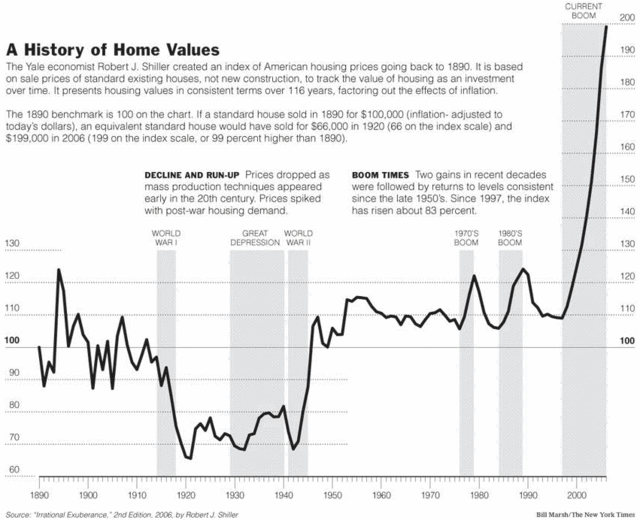
Alex Tabarrok of Marginal Revolution has gotten a lot of (mostly dissenting) attention for his argument that there was no housing bubble (hat tip: hmm, I don't even remember, but I'll cite Paul Krugman, Jane Galt Megan McArdle, and Battlepanda, among the many who have pointed to the post). Alex Tabarrok reproduces Shiller's now-famous chart of housing prices over the past 100 years and comments:
The clear implication of the chart is that normal prices are around an index value of 110, the value that reigned for nearly fifty years (circa 1950-1997). So if the massive run-up in house prices since 1997 [culminating at an index value around 200] was a bubble and if the bubble has now been popped we should see a massive drop in prices.

But what has actually happened? House prices have certainly stopped increasing and they have dropped but they have not dropped to anywhere near the historic average. Since the peak in the second quarter of 2006 prices have dropped by about 5% at the national level (third quarter 2007). Prices have fallen more in the hottest markets but the run-up was much larger in those markets as well.

Prices will probably drop some more but personally I don't expect to ever again see index values around 110. Do you?
As Battlepanda points out, "Do you?" is not a very convincing argument unless you already agree with him. But I think I can make it a little bit more convincing:
Prices will probably drop some more, but personally, given the likely effect that an additional 40% drop in home prices would have on the already weak economy, I don't expect that the Fed will allow index values to fall to anywhere near 110 in the foreseeable future. Do you?
Some people will respond with something like, "OK, I don't either, but that doesn't mean it wasn't a bubble; that just means there's a Bernanke put on home prices: there was a bubble, and the Fed is now going to ratify the results of the bubble." But that's not right. The Fed is not actively causing inflation in order to bail out homeowners and their creditors. The vast majority of professional forecasts call for the inflation rate to fall over the next few years. The Fed is just doing its job -- trying to keep inflation at a low but positive rate while maximizing employment subject to that constraint. The ultimate concern of the Fed is to avoid deflation, which becomes a serious risk if the US housing market has a total meltdown. It's very much as if the Fed were passively defending a commodity standard, with the core CPI basket as the commodity.

The ultimate source of the housing boom is the global surplus of savings over investment. That surplus is what pushed global interest rates down and thereby made buying a house more attractive than renting. And that surplus is still with us. If anything, it appears to be getting worse, as US households begin to reject the role of "borrower of last resort." And it is that now aggravated surplus that threatens us with weak aggregate demand and the risk of economic depression in the immediate future -- a risk to which the Fed and other central banks will respond appropriately. Until the world finds something else in which to invest besides American houses, the fundamentals for house prices are strong -- not strong enough, probably, to keep house prices from falling further, but strong enough to keep them well above historically typical levels.

Labels: , , , , , , , ,

Thursday, January 31, 2008

Monster Really Scares Me

Just as I finished leaving a comment (not yet accepted as of this writing) on Paul Krugman's blog arguing that UI claims for January remain on balance in the "good news" column and that the personal consumption report is not bad news given what we already knew about retail sales, I learned that the Monster Employment Index (which measures online help wanted advertising) fell by a whopping 9 points (from 169 to 160) in January, after falling an even more whopping (but less surprising given the usual seasonal pattern) 14 points in December and a not so whopping (but still significant because the index has never dropped 3 months in a row before) 5 points in November. That makes a total drop of 28 points, or about 15%, over 3 months. Before December 2007, the index had never fallen by more than 3% over any 3 month period (since it began in October 2003). And note that the 15% drop comes as newspaper help wanted advertising is scraping against an all time low (since 1951, when the Conference Board's index began, but note that in December, it rose slightly from the all-time low in November). Over the past week or two, I had been starting to think that the odds were shifting against recession. Now I'm not so sure. In any case I think we can rule out the possibility that 2008 will turn out unexpectedly to be a year of normal growth. And I'm not so worried about import prices now; I think they'll be offset by a slowing of domestic inflation.


[UPDATE3: OK, now I found the post on Paul Krugman's blog where he said that someone else edits the comments. (I missed it the first time, because it was in an update that I didn't read.) And I notice that one of my comments on an earlier post has suddenly appeared. I guess they decided I was a respectable commenter after all.]

[UPDATE2: I removed the previous update, because Paul Krugman (or whoever approves comments for his blog) did approve my comment. (See link at the top.) I had assumed it wasn't going to be approved, because there were later comments comments already approved, but I guess these things don't necessarily go in order.]

[UPDATE: [removed] ]

Labels: , , , , , ,

Wednesday, January 30, 2008

Not Such a Weak Report

Reading between the lines of the 4th quarter advance GDP report, I estimate that nonresidential final sales rose at about a 3% annual rate, which is about where I see the potential growth rate (and faster than the potential growth rate that the Fed sees). It thus appears that, in the 4th quarter, fundamental weakness was still localized in the residential construction industry, which will eventually get as small as it's going to get and stop bringing down GDP. While this report doesn't allow one to rule out the possibility that a recession began during the quarter, and it certainly doesn't foreclose the possibility of a recession beginning in 2008, it does, in my opinion, line up on balance as evidence against the likelihood of one.

Labels: , ,

Tuesday, January 29, 2008

When does monetary policy become ineffective?

Mark Thoma* leaves a succinct comment on my previous post:
Where we differ is the point at which monetary policy loses its effectiveness - I think that happens way before i-rates hit zero.
It’s an interesting point, because it is a position that many economists (including Keynes himself) seem to have held over the years, but one which, as far as I can tell, has never made much sense.**

I should be more specific: It may make sense if you measure monetary policy in certain ways, but not if you measure monetary policy in the way that is reasonable given how today’s central banks set policy. One might be (but in my opinion shouldn’t be) inclined to measure monetary policy in terms of the volume of open market operations, or some similar measure. In that case, it is quite true that a volume of operations that was effective when the interest rate was 5% is no longer likely to be effective when the interest rate is 1%. And certainly the people responsible for conducting those operations do need to be concerned with the volume. But for us, as economists and such, who can and should view monetary policy with some degree of abstraction, it makes little sense to concern ourselves with the volume of such operations. The transaction costs associated with open market operations are tiny (and not proportional to volume anyhow); the market for Treasury bills to be purchased is vast and quite liquid; the absolute size of an open market operation is of little importance, except inasmuch as it affects other variables, such as interest rates. Moreover, the same argument applies to other “quantitative” measures of monetary policy, such as changes in bank reserves and changes in monetary aggregates.

Since today’s central banks (and the Fed in particular) generally define their policy stance in terms of an interest rate, the reasonable way to measure that stance is in terms of an interest rate. Now one might argue (but again, I don’t think one should) that a proportional change in the interest rate that was effective when the interest rate was high will no longer be effective when the interest rate is low. For example, if the interest rate is 8% and you lop off one fourth of it, making the interest rate 6%, that could be quite an effective policy move; but if the interest rate is 1% and you lop off one fourth of that, making the interest rate 0.75%, that is not likely to be very effective at all by comparison. But central banks don’t measure interest rates proportionally, they measure them in…usually 25 basis point increments. And a 75 basis point cut by the Fed, for example, is considered a big move whether the interest rate starts at 8% or at 3%. The sensible question, it seems to me, is whether the effect of a given cut – defined in basis points – will be diminished when interest rates are already low.

If anything, I would argue, the exact opposite should be true. Monetary policy works largely by affecting the discounted value of expected returns on capital assets. When the Fed cuts interest rates, all other things being equal, stocks are worth more, houses are worth more, factories are worth more, machines are worth more, contemplated investment projects are worth more, and so on. The more the value of an asset rises relative to the cost of producing it, the more it becomes profitable to employ people in producing that asset. And theory says this effect should get stronger the lower are interest rates to begin with.

To see the point, consider a world where the risk premium is not an issue and where the Fed sets long-term interest rates. And just to make it clear, consider the extreme case where “long-term” means perpetual. In that case, the value of an asset that produces a fixed stream of returns equals the value of the periodic return divided by the interest rate. Thus if the Fed were to reduce the interest rate from 5% to 4%, it would increase the value of such an asset by 20%. But if the Fed were to reduce the interest rate from 1% to 0%, it would increase the value of the asset by…well, you do the math. In the enterprise of producing an infinitely valuable asset, it is of course profitable to employ as many people as you possibly can, at whatever wage they might require. In the real world, where the Fed controls only short-term rates, and where there is a risk premium associated with most assets, the effect is not so dramatic, but the difference in the effectiveness of policy when interest rates are low vs. high should certainly be in the same direction.

If, therefore, we may define “monetary policy” as the manipulation of an interest rate by a central bank, then we should expect that monetary policy gains more effectiveness the closer the interest rate comes to zero. And indeed, technically, there is no point at which monetary policy, thus defined, “loses its effectiveness.” There is, of course, a point at which additional stimulative monetary policy becomes impossible to practice, namely, the precise point when the interest rate reaches zero.***


* As far as I know, this is the real Mark Thoma – by which I mean the one that writes Economist’s View – not someone else of the same name. As an aside, though, it occurs to me that there is no shared authentication between Blogger and Typepad, so one doesn’t really know such things for sure. If I wanted to, I could probably post comments on other people’s blogs while pretending to be Brad DeLong or Barry Ritholtz. Or one of them could pretend to be me – though it's hard to think of any reason why they might want to.

** Please do not fear, Gentle Reader, that I have entertained for even a brief moment the abominable heresy that St. Maynard may have held a view that was in any way unreasonable. (Indeed, at the very thought, I must ask you to excuse me while I make the sign of the Keynesian cross over my chest.) Rather, I merely posit that there are certain inherent difficulties in communication between the Truly Awakened and ordinary sentient beings such as we. Interpreting the words of our lord**** in accordance with the mere shadows that form our limited experience, it is we who may have fallen into error. I’m personally intrigued by an alternative exegesis preached to me once by radical political economist Stephen Marglin, who suggests that Keynes was referring not to a lack of effectiveness per se but to the political difficulties in implementing a very low interest rate policy in an economy where the rentier class is loath to give up the income it receives in the form of interest.

***Strictly speaking, this is not quite true. Interest rates on some Treasury bills went below zero in 1938. Apparently, there are some people out there who like their Treasury bills so much that they won’t give them up even if you offer a premium to redemption value.

****I trust that the lower case L keeps me safe from the charge of blasphemy. Surely the lord I have in mind was indeed ours. To whom, after all, could Keynes belong***** if not to the Keynesians.

*****Actually, I have nothing to say down here, but I got so fascinated with the idea of nested footnotes that I decided to push the concept one level further.

Labels: , , , ,