Monday, March 17, 2008

Capital Flight is Good

Some people (Yves Smith and Tim Duy, to name two, but I’m sure there are many others that I haven’t gotten around to reading yet) are worried that concern about capital flight is going to have to be a constraint on the Fed’s ability to deal with this crisis. I disagree. I don’t think the Fed will or should be concerned about capital flight. In fact, I think capital flight is part of the solution, not part of the problem.

In general, capital flight is a problem if you care about quantities that are not denominated in your own currency. If all the quantities you care about are (or can be) denominated in your own currency, then you can just print as much currency as you need to replace the foreign capital. There are basically 4 situations where capital flight is a problem, which I will call the 4 Fs:
  1. Full employment. If all your real domestic resources are being used, then the withdrawal of foreign capital will mean the withdrawal of real resources, which will reduce your growth potential. This was an issue for the US in the late 90s. But today the US is not at full employment. And if you still think it is, just wait a few months.

  2. Fixed exchange rate. If you need to defend an exchange rate, the government will effectively have to supply exiting capital out of limited official reserves. This was a large part of the problem in the early 30s. But today the US does not have an obligation to defend its currency, nor does it have (about which see the rest of this post) and interest in maintaining its currency’s value.

  3. Foreign currency-denominated debts. If you have to pay back foreign currency, you’ll be in trouble if capital flight weakens your own currency and thereby makes foreign currency harder for you to get. This has been a problem in various places, particularly Latin America, in the past, but it’s not an issue for the US today: almost all our debts are denominated in dollars.

  4. (in)Flation. If your country is experiencing, or on the verge of experiencing, an unwelcome inflation, capital flight will exacerbate the problem by weakening your currency and thereby raising import prices. As of 8:29 AM on Friday, I still thought this was an issue for the US today. I no longer do.
For the US today, the real problem would be if foreigners insisted on continuing to purchase US assets. That would support the dollar, making it that much harder to sell US goods and services and contributing to the weakening of the economy, thereby exacerbating the positive feedback between a weak economy and a weak financial system.

As long as inflation was a major issue, there were limits to what the Fed could do to stabilize the domestic financial system. It could only take on mortgage securities, for example, up to the point where it used up all its assets. In that situation, an absence of foreign demand for US securities might be a big problem.

If, as now appears to be the case, the risk of deflation is a bigger issue than the risk of inflation, then there is no limit to what the Fed can do. If it runs out of assets, it just prints more money to buy assets with. If foreigners refuse to buy US assets, the Fed prints money for Americans to buy them. If Americans refuse to buy risky assets, then the Fed can trade its own assets for risky assets through programs like the TSLF. Or lend money directly against risky assets. If foreigners withdraw capital, the Fed can replace it with newly created money. (Actually, it won’t need to, because when the proceeds from the withdrawn capital are converted out of dollars, the counterparty to that conversion will have dollars to invest.)

If the dollar weakens, so much the better. $2/Euro. $3/Euro. In the words of Chico Marx, “I got plenty higher numbers.” It might be a problem for Europe, but not for the US (and for Europe it would be a self-inflicted wound, since there is plenty of room to expand the supply of euros if there were a will to do so).

There is no limit to the potential magnitude of the Fed’s actions, but there could conceivably be limits to the effectiveness of those actions even as the magnitude becomes infinitely large. That situation is exactly one where capital flight would be a good thing. If the Fed can’t manage to stimulate the economy sufficiently by printing money, the stimulus has to come from somewhere else. Increased demand for US exports, due to a weak dollar, due to capital flight, is one of the chief candidates.

Labels: , , , , , , , , ,

Friday, March 14, 2008

This inflaiton report scares me.

Quoting myself from the comments section of my last post:
...Japan had plenty of missed opportunities in the early to mid 90s to prevent the depression from getting out of hand. It was only when the inflation rate went to zero...that it really became intractable.
Speak of the devil, and he shall arrive appear. I'm pretty sure we'll get positive core inflation in March (and there's no question that we'll get positive headline inflation), but seeing zero even in one month (as in today's February CPI report), while commodity prices are rising at unprecedented rates, is pretty disturbing. Both the 12-month CPI inflation rate and the 3-month annualized rate are 2.3%, which is right in the middle of the normal range. This is disturbing because it seems to indicate that business don't even have enough pricing power to pass on part of the huge cost increases they are facing in energy and materials. What happens when commodity prices stop rising? I don't think I want to find out.

Labels: , , , ,

Sunday, March 09, 2008

Rising Inflation Expectations: Bad News or Good News?

Suppose that Greg Mankiw and others are correct in suggesting that inflation expectations have risen dramatically. Is this bad news or good news?

By way of full disclosure, I should note that it’s clearly good news for me, since I’m short nominal Treasury notes. If you follow the logic, that means it’s in my interest to convince other investors that conditions are more inflationary than I really think they are, so while the main point of my last post still stands, you should probably take the caveats (“There's little question that the expected inflation rate has risen...”) with a grain of salt. (Rising inflation expectations are clearly good news for me, but if this is what the good news looks like, I’d hate to see what happens to nominal yields when inflation expectations are falling!)

As to the “general interest,” however, the most obvious interpretation is that rising inflation expectations are bad news, because they mean that markets have lost confidence in the Fed’s willingness to keep inflation within its perceived target range. Or, as Greg puts it (quoting the Cleveland Fed’s Web server and adding a double entendre), “the system ‘has experienced an unexpected error.’” If the market loses confidence in the Fed’s inflation target, then, theoretically, the change in the expectations term in the Phillips curve causes it to shift upward, and we can anticipate both higher unemployment rates (in the short run) and higher inflation rates (in both the short run and the long run, unless confidence is eventually restored) than we would otherwise experience at any given level of aggregate demand.

Under that interpretation, the higher unemployment rates in the short run are clearly bad news. As for the higher inflation rates, I’m not so sure. A slightly different, but related, interpretation is that the market correctly perceives that the Fed has finally come to its senses and raised its inflation target from an unreasonably low level. Indeed, the current crisis, in which reasonable people are worried both about inflation becoming unhinged and about a potential deflationary collapse, is a good demonstration of why the target should be higher. It is kind of hard to believe that the Fed has come to its senses, though, since the rest of the world’s major central banks have been even further from their senses than the Fed.

Even if you think the Fed’s perceived* inflation target (between 1.75% and 2% on the personal consumption deflator, which is maybe about 2.25% to 2.5% on the CPI) is reasonable, you might think there are certain situations where the target should be raised. One of those situations might be a “safety trap” – where investors shun all but ultra-safe assets, even when the expected returns become much lower than those on risky assets. Arguably (though the argument becomes much weaker when you look at the stock market instead of the credit markets) the US is experiencing a safety trap now, and one solution is to take away the safety of the supposed safe asset by promising to inflate away the returns to be earned by government bondholders. Another situation where raising the target might be a good idea is when the uncertainty around the expected inflation rate increases, so that pursuing the original target would produce a significant risk of deflation. There might be a fairly strong case (as I suggest in the previous paragraph) that the US is in that situation right now. Obviously if you think that current circumstances call for an increase in the inflation target, then it is good news to learn that (in the judgment of the market) the target has actually increased.

But all these interpretations assume that the general shape of the distribution of inflation possibilities remains roughly the same. Moreover, casual talk of “expected inflation” suggests that we think the mean and the median of the distribution are roughly the same, since “expected inflation” could refer to either one. But perhaps what has happened is that the mean of the distribution has risen but the median has not. I would interpret the Fed’s target more as a median than as a mean. I would certainly hope that it isn’t the mean, and that the Fed would be more willing to tolerate inflation rates 3% above its target (high by recent standards but far from disastrous) than rates 3% below its target (deflation, which could be disastrous). Under this interpretation, the market still has confidence in the Fed’s target as a median, but the market is reassured that extremely low inflation rates will not be tolerated, so that the distribution has become more skewed to the right, and the mean has risen. In that case, the increase in mean (but not median) inflation expectations is good news.

[UPDATE: Paul Krugman, using what seems to be another species of the "in this situation, the inflation target should be raised" argument, makes the case that high inflation expectations are good news.]


*The Fed has actually announced a 3-year-ahead forecast, which can perhaps be reasonably interpreted as a target.

Labels: , , , , , ,

Inflation Expectations

This chart is showing up in too many places. The latest, to which I link, is Greg Mankiw's blog.

The implication is that the expected CPI inflation rate over the next ten years has risen from its typical value of around 2.5% to around 3.4% recently. There's little question that the expected inflation rate has risen over the past couple of months, with commodity prices rallying like never before (literally), and that is certainly an issue that the Fed has to be concerned about, but do we really believe that the expected inflation rate has risen quite so dramatically?

I don't. If you look at the raw breakeven inflation rate from the 10-year tips-to-nominals spread, it has only risen by about 20 basis points in the past couple of months, and it still hasn't taken out the highs that it made in 2005 and 2006. We can reasonably surmise that this understates the increase in expected inflation, since we also know that liquidity has gone to a premium over the past 6 months and that TIPS are less liquid than nominal Treasury notes. We can't quite be sure, though, because inflation uncertainty has also increased, so the increased risk premium for inflation uncertainty (which applies to nominal Treasuries) may be offsetting the increased liquidity premium (which applies to TIPS).

The 3.4 percent figure comes from a very specific way of estimating the liquidity premium. IIRC the Cleveland Fed does a regression on the spread between on-the-run (recently auctioned and therefore highly liquid) and off-the-run (slightly less liquid) Treasury notes. Recently that spread has increased dramatically, so the methodology is adding a large liquidity premium onto the expected inflation rate. But how large, exactly, should it be? Given that liquidity conditions are outside the range of the data prior to August 2007, and given that I think there are omitted variables (specifically, a time trend over the period during which TIPS were becoming more available and gaining more market acceptance, as well as a reverse time trend at the very beginning, when TIPS were new and exciting and therefore didn't need to offer high yields) in the specification, and given that I'm not sure that the on-the-run-to-off-the-run spread is the best measure of the liquidity premium anyhow, and given that there are issues about the inflation risk premium, I'm not at all comfortable accepting the Cleveland Fed's estimate.

Labels: , , ,

Friday, February 15, 2008

Not a Bubble

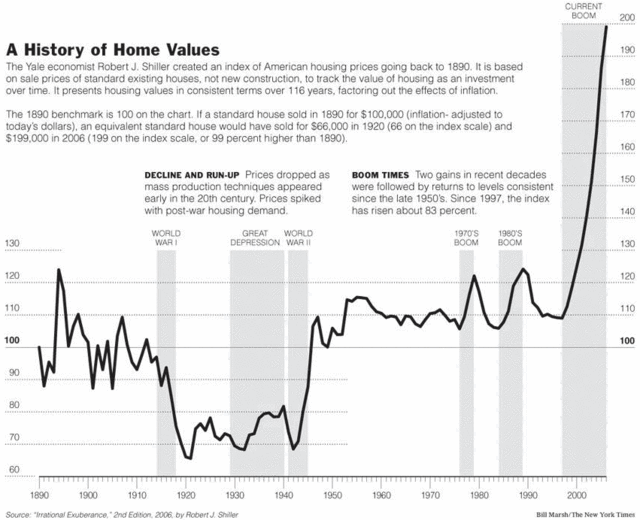
Alex Tabarrok of Marginal Revolution has gotten a lot of (mostly dissenting) attention for his argument that there was no housing bubble (hat tip: hmm, I don't even remember, but I'll cite Paul Krugman, Jane Galt Megan McArdle, and Battlepanda, among the many who have pointed to the post). Alex Tabarrok reproduces Shiller's now-famous chart of housing prices over the past 100 years and comments:
The clear implication of the chart is that normal prices are around an index value of 110, the value that reigned for nearly fifty years (circa 1950-1997). So if the massive run-up in house prices since 1997 [culminating at an index value around 200] was a bubble and if the bubble has now been popped we should see a massive drop in prices.

But what has actually happened? House prices have certainly stopped increasing and they have dropped but they have not dropped to anywhere near the historic average. Since the peak in the second quarter of 2006 prices have dropped by about 5% at the national level (third quarter 2007). Prices have fallen more in the hottest markets but the run-up was much larger in those markets as well.

Prices will probably drop some more but personally I don't expect to ever again see index values around 110. Do you?
As Battlepanda points out, "Do you?" is not a very convincing argument unless you already agree with him. But I think I can make it a little bit more convincing:
Prices will probably drop some more, but personally, given the likely effect that an additional 40% drop in home prices would have on the already weak economy, I don't expect that the Fed will allow index values to fall to anywhere near 110 in the foreseeable future. Do you?
Some people will respond with something like, "OK, I don't either, but that doesn't mean it wasn't a bubble; that just means there's a Bernanke put on home prices: there was a bubble, and the Fed is now going to ratify the results of the bubble." But that's not right. The Fed is not actively causing inflation in order to bail out homeowners and their creditors. The vast majority of professional forecasts call for the inflation rate to fall over the next few years. The Fed is just doing its job -- trying to keep inflation at a low but positive rate while maximizing employment subject to that constraint. The ultimate concern of the Fed is to avoid deflation, which becomes a serious risk if the US housing market has a total meltdown. It's very much as if the Fed were passively defending a commodity standard, with the core CPI basket as the commodity.

The ultimate source of the housing boom is the global surplus of savings over investment. That surplus is what pushed global interest rates down and thereby made buying a house more attractive than renting. And that surplus is still with us. If anything, it appears to be getting worse, as US households begin to reject the role of "borrower of last resort." And it is that now aggravated surplus that threatens us with weak aggregate demand and the risk of economic depression in the immediate future -- a risk to which the Fed and other central banks will respond appropriately. Until the world finds something else in which to invest besides American houses, the fundamentals for house prices are strong -- not strong enough, probably, to keep house prices from falling further, but strong enough to keep them well above historically typical levels.

Labels: , , , , , , , ,

Thursday, January 31, 2008

Monster Really Scares Me

Just as I finished leaving a comment (not yet accepted as of this writing) on Paul Krugman's blog arguing that UI claims for January remain on balance in the "good news" column and that the personal consumption report is not bad news given what we already knew about retail sales, I learned that the Monster Employment Index (which measures online help wanted advertising) fell by a whopping 9 points (from 169 to 160) in January, after falling an even more whopping (but less surprising given the usual seasonal pattern) 14 points in December and a not so whopping (but still significant because the index has never dropped 3 months in a row before) 5 points in November. That makes a total drop of 28 points, or about 15%, over 3 months. Before December 2007, the index had never fallen by more than 3% over any 3 month period (since it began in October 2003). And note that the 15% drop comes as newspaper help wanted advertising is scraping against an all time low (since 1951, when the Conference Board's index began, but note that in December, it rose slightly from the all-time low in November). Over the past week or two, I had been starting to think that the odds were shifting against recession. Now I'm not so sure. In any case I think we can rule out the possibility that 2008 will turn out unexpectedly to be a year of normal growth. And I'm not so worried about import prices now; I think they'll be offset by a slowing of domestic inflation.


[UPDATE3: OK, now I found the post on Paul Krugman's blog where he said that someone else edits the comments. (I missed it the first time, because it was in an update that I didn't read.) And I notice that one of my comments on an earlier post has suddenly appeared. I guess they decided I was a respectable commenter after all.]

[UPDATE2: I removed the previous update, because Paul Krugman (or whoever approves comments for his blog) did approve my comment. (See link at the top.) I had assumed it wasn't going to be approved, because there were later comments comments already approved, but I guess these things don't necessarily go in order.]

[UPDATE: [removed] ]

Labels: , , , , , ,

Saturday, December 15, 2007

Good News about US Inflation

Everybody’s getting so freaked out about the latest CPI report, and I don’t understand why. The supposed bad news – gargantuan increases in energy prices, substantial increases in food prices and in import prices – is last month’s news. You could have gotten most of this information by looking at commodity markets and foreign exchange markets a month (or two or three) ago, and, as Dean Baker points out, you could have gotten it with even more precision by looking at the latest report on import prices. I don’t see any real bad news in this report.

Over the past 3 months, energy prices have risen at a 33.8% annual rate. That’s dreadful, but it’s not news. Food prices have risen at a 4.3% annual rate. Kind of ugly, but also not news. In fact, the 0.3% November increase in food and beverage prices is kind of tame, considering. Transportation prices rose at a 14.4% annual rate over 3 months – that’s pretty much redundant information, since I already mentioned energy prices. Medical care prices rose at a 5.2% annual rate, but that’s not unusual.

The one thing that is both unusual and unexpected is the 0.8% monthly (4.1% annualized over 3 months) increase in apparel prices. But if you look at the 12-month change in apparel prices, it’s still down (-0.4%). While apparel prices may not fall as quickly in the future as they have in the recent past, I for one do not believe that we have suddenly entered a new regime during which apparel prices will be rising by 0.8% – or even 0.3% – every month. The fact that there was a blip in apparel prices in November – and not even enough to get the core inflation rate for November above 0.3% – is hardly a significant piece of bad news.

The last thing in the report that people may have found troubling is the 0.4% increase (3.6% for 3 months annualized) in housing prices (meaning mostly rent and owners’ equivalent rent). But are you really worried about housing costs – with huge inventories of unsold houses in most parts of the country? There is probably a temporary problem in the rental market, because people are getting foreclosed on and pushed into the rental market, and the properties they vacate are remaining vacant for a while. This problem may continue in coming months, but one can’t reasonably describe this as fundamental upward pressure on housing prices.

What’s left? The “other goods and services” category did rise by 0.3% in November – more than one would have hoped – but the other two categories, “education and communication” and “recreation,” each rose by only 0.1% – less than one would have expected. All in all, not a troubling report, unless you haven’t been paying attention to the news over the past few months.

If you’re obsessed with the aggregate inflation rate, you’re welcome to be horrified that “US inflation jumps to 4.3%” – as the headline on the weekend Financial Times declared, and you might also be unhappy with the 3-month core inflation rate (2.6% annualized). But when you look at the 12-month core rate of 2.3%, don’t be upset (like the Financial Times) that it is “higher than the Fed’s upper limit of 2 per cent.” That upper limit applies to the core personal consumption deflator, which is a different index and typically runs about 50 basis points (or anywhere from 0 to 100 basis points, depending on whom you ask) below the CPI. 2.3% core CPI inflation is not a problem.

Labels: , , , ,

Wednesday, November 14, 2007

A Crude Form of Inflation Targeting

In his latest sermon against core inflation, Barry Ritholtz makes an important point – sort of. At least, he brings up an important issue, but I think his message that the core is evil distracts him from thinking more subtly about the implications. The title of his post, “Rising Crude Oil Pushes Consumer Prices Higher,” says most of it, and when he says, “consumer prices,” he means, “even core prices.” It’s a fact that we can’t escape: energy is a critical input to many goods (and services) that are part of the core. And even if it is only targeting a core price index, the Fed still has to worry about oil prices.

This is, as I said, an important point, but I don’t think it implies that everyone who emphasizes the core is either a liar or an idiot. It just means that anyone who claims to make an optimal forecast of the core without taking oil prices into account is not being careful. It also means that, even if we are confident that the Fed is targeting a core index, we should expect the Fed to take into account the inflationary impact of large oil price increases. At the same time, the Fed may take into account the potential recessionary impact of rising oil prices, if it judges that the price increases are a supply-side effect and not a demand-side effect.

So the monetary policy implications of rising oil prices are ambiguous, but they clearly don’t follow the simple formula that the bond market sometimes seems to expect: tighter oil => weaker economy => easier money. If the change in oil prices is a demand-side effect, then it’s actually a symptom of a stronger economy rather than a cause of a weaker economy, and the formula goes something like this: stronger economy => tighter oil => tighter money. If the change in oil prices is a supply-side effect, it will unambiguously tend to weaken then economy, but the Fed may perhaps prefer an even weaker economy to an unchecked inflationary impulse, and the result may still be tighter money.

If it were up to me, the Fed’s target would not be core consumer prices but something (such as unit labor costs) that excludes the effects of energy shocks altogether. Such a target would allow the US to take an adverse energy shock entirely in the form of a higher price level (rather than going through the painful process of squeezing profit margins, which tends to have unemployment as a side effect) without raising long-term inflation expectations. (An abrupt energy shock could still weaken the economy by James Hamilton’s mechanism of forcing difficult transitions – squeezing profit margins in some areas while raising them in others – but I don’t think there’s much we can do about that.) Since unit labor costs seem to be a politically unacceptable target (and the data are unreliable in the short run), one could perhaps imagine a core price index that is corrected for the indirect effects of food and energy prices. (I guess that would piss Barry Ritholtz off even more.) I’d also like to exclude import prices, so the GDP deflator might be a reasonable first-round candidate, though it brings in another set of problems.

Labels: , , , , ,

Thursday, November 08, 2007

Stay Away from the Fan

If we lived in my fantasy world where the Fed targets unit labor costs and everybody knows it, we’d be fine – and due for some more substantial rate cuts. Not that I would have the Fed react dramatically to the latest dip in unit labor costs – which is only one quarter out of many and, after all, could be revised away. My fantasy Fed might take the latest labor cost report as a minor reason to congratulate itself on past policy actions, what with earlier seeming evidence of an acceleration in labor costs turning out to have been falsely alarming. But as for cutting rates, the Fed has plenty of other reasons: a deepening financial crisis that threatens to affect the real economy; a deepening housing recession (depression?) that threatens to spill over to the rest of the economy; a substantial decline in labor demand that has finally begun to show up in the unemployment rate. If labor costs were the target, the Fed could respond to all these concerns and shrug off the other news: the fastest increase in commodity prices since the 1970s. If everyone knew the Fed were targeting labor costs, then workers wouldn’t expect pay increases to compensate for rising energy costs and the like, and the Fed could ease without risking losing credibility or creating an inflationary spiral.

If we lived in my other fantasy world where the Fed follows a backward-looking Taylor rule, we’d be doing OK too – and still (in my opinion) due for some more rate cuts. Although there is inflation on the horizon, the Fed could use (and could already have used) the low reported trailing inflation rates as an excuse to cut rates. By the time the commodity price increases found their way into core inflation, hopefully the financial crisis would be over, and, with any luck, the Fed would re-tighten at just in time to prevent a boom.

But in the real world, Fed policy is judged not by unit labor costs or by its adherence to a backward-looking rule but by outcomes in the core inflation rate. (I’m thankful at least that I live in the USA, where we know that smoking cigarettes causes cancer and targeting headline inflation causes unnecessary recessions and booms.) If the Fed lets the core inflation rate rise for any reason, that will lead people to question the resolve of its still relatively new chairman. And workers, facing a reasonably healthy economy, will feel entitled to wage increases to offset their rising cost of living. And businesses, facing that same reasonably healthy economy and a seemingly friendly Fed chairman, will see no reason not to raise prices enough to preserve their record profits and compensate both for increased energy and materials costs and for increased wages. Unfortunately, the only way for the real Fed to maintain its credibility today is by keeping the economy weak and risking recession, so as to damp any economic optimism, which, in combination with rising non-labor costs, would result in a higher core inflation rate.

So here we are, people. Just over a month ago, I insisted that the s___ was not yet hitting the fan, but it looks like I spoke too soon. The fan is running. The s___ is flying. Just get out of the way.

Labels: , , , , , , ,

Friday, October 05, 2007

Core Inflation and Price Stability

I’ll begin with a hypothetical question: If half the prices went down by 10%, and the other half went up by 10%, would that be price stability? If you have faith in the General Price Level, you may answer yes, but since the General Price Level has never revealed itself to me, nor did my parents teach me to believe in it, I must ask, “How can it be price stability if none of the prices are stable?” As a price level agnostic, I have to think that “reasonable price stability” (a phrase from the Fed’s mandate in the 1978 Humphrey-Hawkins Act) requires that at least some prices (perhaps as many prices as possible) be stable.

Now, food and energy prices are nearly impossible to stabilize, because they are so volatile, and because it’s extremely difficult, except over very long time horizons, to distinguish temporary fluctuations from longer-term trends. (One could, I suppose, choose a particular food or energy price and stabilize it by intervening directly in the market, but I think most people can agree that would not be a reasonable policy.) Given that food and energy prices cannot reasonably be stabilized, does it make sense to make a half-hearted attempt to stabilize them at the expense of destabilizing most other prices?

Many prices, on the other hand, can be reasonably stabilized, primarily because the people who actually set those prices prefer them to be stable and will be willing partners (up to a point) in any attempt to stabilize them. I would argue that pursuing “reasonable price stability” does not mean sacrificing Isaac or Iphigenia on the altar of the General Price Level. Rather, it means using monetary policy to discourage the aforementioned naturally stable prices from exiting the realm of stability.

You can see (I hope) why I think that the core inflation rate is more relevant to the Fed’s mandate than the overall inflation rate. You may say that I am just playing semantic games here, but I believe the semantics have substantive importance. For one thing, my reference to human sacrifice is not entirely metaphorical: the human cost of attempts to stabilize the general price level can be quite high when volatile commodities face upward price pressures.

More to the point, perhaps, the semantic problems with attempting to stabilize the general price level are indicative of the danger that such attempts will backfire even with respect to their semantically questionable objective. Food and energy commodities are typically traded in speculative markets, and speculative markets have been known to exhibit both excessively persistent trends and very dramatic reversals. I don’t think I need to remind anyone of what NASDAQ stocks did between 1995 and 2003. Suppose the same thing were to happen to oil. (It very well may be happening, though I don’t mean to suggest that I expect a reversal.) Suppose oil prices were to rise persistently for 5 years and then reverse dramatically. A central bank bent on achieving “general price level stability” would be forced to keep the economy weak for those first 5 years so as to drive down other prices and compensate for the rising price of oil. When oil prices began to fall rapidly, the economy would be weak, and the non-energy part of the economy would already be experiencing falling prices. Before the central bank’s reaction to the reversal had a chance to affect most prices, the “general price level” would be dropping dramatically. (The same logic also applies in reverse, if you imagine oil prices falling for 5 years and then suddenly jackknifing upward and consider what the general inflation rate would look like.)

It’s interesting to consider alternative core measures, such as the Cleveland Fed’s median CPI or the Dallas Fed’s trimmed mean measures, in the light of my agnostic semantics of price stability. A literal application of those semantics would suggest that means and medians are the wrong kinds of statistics to use. Rather, it is the mode of the price distribution that should be of concern if the objective is to stabilize as many prices as possible. My last example, though, suggests that the purely statistical month-by-month trimming of a price index is not an adequate approach. The prices that need to be stabilized are not the ones that have recently been most stable but the ones that are most likely to be stable in general. While there may still be a good case for ignoring outliers in the price distribution, there is an even better case for ignoring prices that are generally unreliable.

Labels: , , ,

Thursday, October 04, 2007

Core For: More

Barry Ritholtz replies in the comments section of my earlier post about core inflation:
By framing the issue the way you did, you get one answer.

I prefer a different set of questions. These of course generate a different set of answers.

My questions:

1) What is the actual rate of inflation?

2) Why does the BLS model (the official inflation rate) vary so greatly from the real world experience?

3) What are the Fed policy repercussions of the spread between the two?

4) What does this mean to consumers? Investors? Savers?

I am not surprised that traditional economists have circled the wagons around my attack on the credibility of BLS and the Fed. Thats what all Guilds do when they sense a challenge to their authority . . .
He has more on his own blog, but let me try my answers. I first note that these questions, as he stated them originally, mostly relate to the full CPI, not particularly to the core CPI. The core is not “the official inflation rate,” nor should it be. At least in my view, the “official inflation rate” should measure what prices in general have done retrospectively; it gives us information about the past, and the core would be the wrong information. To the questions,
  1. What is the actual rate of inflation?

    It depends on what you mean, specifically, precisely, operationally, by inflation. It is a mistake to think there is one “true” inflation rate, because different prices are changing by different amounts and in different directions, and because quality is changing in ways that affect different people and different businesses differently, and because the effects of these changes – even on an individual – are often impossible to measure. How can we know, for example, how much it is worth to have a more powerful computer for the same price? In most cases, all we can do is make an educated guess, and depending on how one chooses to educate the guess, many different reasonable answers are possible.

    It is also a mistake to go (as Barry Ritholtz seems to do in the post cited) directly from the premise that “inflation is primarily a monetary phenomenon” to the conclusion that inflation should show a consistent quantitative link with a particular measure of the money stock. The relation between inflation and (any particular definition of) money depends on the evolution of payments technology and potential output. In particular the finding that the CPI diverged from M2 and M3 starting in the mid-90s tells us very little: either productivity really did start growing more quickly (in which case we should expect such a divergence) or else it didn’t.

  2. Why does the BLS model (the official inflation rate) vary so greatly from the real world experience?

    The question is not very meaningful unless you can specify what you mean by “real world experience” and demonstrate that it differs from the BLS model. If you mean subjective “real world experience,” then I’m inclined to blame psychology rather than measurement for the difference.

  3. What are the Fed policy repercussions of the spread between the two?

    OK, never mind. On his own blog, Barry changes the question:
    Why does the Fed Focus on the Core rate, and not the actual rate? What are the Fed policy repercussions of this?
    To the extent that the Fed does focus on the core rate, it does so primarily for two reasons (and more which I may discuss in a later post):

    • Using short-run (e.g, 1 year or less) measurements, the core rate has generally proven to be a better predictor of future inflation than the full rate.

    • The core represents items with relatively sticky prices, so price pressures on the core do more damage than price pressures on noncore items. In particular, downward price pressure on the core causes recessions. Because noncore prices are more flexible, the damage is absorbed by prices before it can cause distortions in quantities.

    The repercussion, over the past 5 years of rising energy prices, is that we have had 5 years of economic growth when we could have had an ongoing recession.

  4. What does this mean to consumers? Investors? Savers?

    To consumers, it means more of them have jobs than otherwise would. It also means that the decline in their real incomes has come in the form of price increases rather than wage cuts, so they can (wrongly) blame it on the Fed rather than the scarcity of oil. (It is always nice to have an institution to blame instead of an abstract concept.)

    To investors, it means that, in retrospect, they should have owned TIPS instead of nominal bonds. By the way, the Treasury is still selling TIPS, if you want ’em. Unfortunately, just as in 2002, we lack perfect foresight as to what the noncore component of inflation will do. It may go down, and you may get screwed owning TIPS. But if you want a secure real return, it’s available.

    To savers, I’m not sure what it means. Barry has a wee bit of a point that, by focusing on the core without making sufficient qualifications, the Fed may be misleading people into thinking that the core is the actual inflation rate, and savers will be disappointed when it comes time to spend their savings. I don’t see this as a reason to de-emphasize the core for policy purposes but as a reason to be more careful when speaking about it.
If traditional economists are circling the wagons around the core, that’s because it really is a better policy target. (As to BLS methods, that’s another question entirely, about which Barry and I might be able to find some common ground...but this post is already too long.)

Labels: , , ,

Monday, October 01, 2007

What is the core for?

Suddenly I have so much to say about the core CPI, in response to the latest attacks by Barry Ritholtz and Daniel Gross. I've already said most of it in comments to a post by Brad DeLong (also note kharris' insightful comments) and one to the original Barry Ritholtz post. I may reproduce some of them in future posts here, but my last (thus far) comment (from the DeLong post) is probably what needs to be said first:

There are really 3 separate questions here:

(1) What is the best measure of retrospective changes in purchasing power?

(2) What is the best indicator of the general trend in prices (with respect to what can expected in the immediate future)?

(3) What is the best target for monetary policy?

For the first question, obviously the full index is better than the core, and nobody denies that.

For the second question, there is room for debate, but if the only choices are the core and the full index (to measure inflation for a specific period of a year or less), I would still choose the core. (If you let me smooth the inflation rate with, say, an exponential smoother, I might prefer the full index.)

For the third question, I think there is little room for reasonable debate: the core is better. When food and energy prices go up relative to other prices, the optimal policy rule would accommodate those increases so as to allow other prices to remain stable. The increase in the general inflation rate does little harm; the alternative of deflation in the non-core component would do considerable harm.

Messrs. Ritholtz and Gross, and their supporters in this commentary, are finessing the issue by not distinguishing among these three purposes.

The answer to the third question only works if people know roughly what to expect in advance. If people expect the Fed to control the overall inflation rate but the Fed only attempts to control the core, the outcome will not be good when the two start to diverge. People who attack the core index are contributing to the likelihood of such a bad outcome, as well as to the likelihood of the other bad outcome in which the Fed actually does control the full inflation rate even in situations where it shouldn't.

Labels: , , , , ,

Sunday, September 30, 2007

Not Hitting the Fan Yet

The dollar is now at a record low against the Euro, down more than 20 percent from its peak in 2002, down so low it’s about equal to a Canadian dollar.
So begins Robert Reich's blog post to which I referred on Friday. By my arithmetic the situation is even more extreme, with the dollar having lost about 40% of its value in Euros since the 2002 peak. But should the drop in the dollar between January 2002 and September 2007 really be a cause for concern in the US?

I don't see why. Most of the drop happened in 2002 and 2003, and the remainder has happened slowly over the subsequent four years, with a slight acceleration over the past few weeks. That's water under the bridge. If that drop in the dollar were going to cause inflation in the US, or to cause a drop in US real incomes, it would already have happened.

But incomes (on average) have continued to rise, and as for inflation, I think the figures in the August Personal Income and Outlays report (see Tables 9 and 11, along with historical data available here) should put to rest any immediate concern. Looking at my favorite inflation indicator, the market-based personal consumption deflator excluding food and energy, we have the following annualized (logarithmic) growth rates:

1 month 1.15%
2 months 1.34%
3 months 1.39%
6 months 1.18%
9 months 1.67%
12 months 1.61%
18 months 1.89%
2 years 1.87%
3 years 1.80%
4 years 1.70%
5 years 1.57%
6 years 1.56%

None of this suggests that inflation has yet become a problem at all. Given the presumed target of 1.5%, the recent data would even make a better case for worrying about deflation than about inflation. (Remember that food and energy prices can be quite volatile, so one shouldn't ignore the risk that, for example, a reversal in the oil market could send the full deflator quickly into negative territory.)

Though I have worried in some recent posts about the potential for a drop in the dollar to force the Fed into a stagflation regime, it needs to be emphasized that this worry is about the future and not about the present. If the s___ is going to hit the fan, this is actually a pretty good time for it to hit.

Labels: , , , , , ,

Tuesday, September 25, 2007

Holy S___, Batman, Look at the Foreign Exchange Market!

In reaction to my last post about the s___ that may soon hit the fan and why labor cost targeting would help, Gabriel M. suggests that I discuss the nature of the s___ in question and how it came about. In a nutshell, the issue is that most economists (not all, but I would say the vast majority) think the dollar is significantly overvalued. For the moment, the market seems to disagree, inasmuch as interest rates on dollar-denominated bonds are not much higher than those on bonds denominated in, for example, euros. In theory, if people believed the consensus of economists, it would be a no-brainer for anyone with an international bond portfolio to dump their dollar assets and replace them with other assets such as euro bonds. (It’s implausible to me that the slight difference in nominal creditworthiness between the US treasury and, say, the German treasury, is enough to make this less of a no-brainer.) If everyone were doing that, dollar interest rates would already be significantly higher than non-dollar interest rates.

I don’t think I’m going too far out on a limb to say that, historically, when economists and the market disagree, the economists usually eventually turn out to be right (though the economists are usually wrong about how long it takes to get to “eventually”). A case in point is the last time the dollar was regarded as severely overvalued, in 1984. It may have taken an international agreement (the 1985 Plaza Accord) to get the dollar on a downward path, but once the decline started, it was beyond what international policymakers seemed able to control. Anyone who listened to economists in 1984 about the dollar, and then changed his mind when they turned out at first to be wrong, would have been extremely unhappy by late 1987.

I should note in passing that there were factors present in the mid-1980s that mitigated, and even reversed, the supply shock from the falling dollar. In 1985, when the dollar began to decline, the US was still recovering from worst recession since the 1930s, so there was considerable slack in the economy. (There may be considerable slack today, too, but that’s not the consensus.) Also, as a consequence of having shown itself willing to induce and prolong the worst recession since the 1930s, the Fed had a surplus of inflation-fighting credibility. And since the dollar had been continuing to rise until early 1985, there was something of a favorable import price shock already in the pipeline to offset the subsequent unfavorable one. Then in 1986, OPEC members were unable to reach agreement on new quotas, and the price of oil dropped dramatically, providing a favorable supply shock to (probably more than) offset the unfavorable shock from the falling dollar. Another factor was that many goods sold to Americans were (either explicitly or implicitly) priced in dollars, so the import price shock from the weak dollar was not as strong as it otherwise would have been. The same is true today, but less so.

Part of the reason that the dollar remains overvalued is that much of the investment in fixed income dollar assets comes from sovereign entities, such as the People’s Bank of China (PBoC) or the Saudi Arabian Monetary Authority (SAMA), that are less concerned about profit and loss than private investors. But even such entities are not entirely oblivious to profit and loss, and lately there are increasing signs of their desire to diversify away from the dollar. In doing so, they would also probably have to give up the currency pegs that have kept the dollar overvalued relative to their own currencies. SAMA gave the world a bit of a shock recently, when it uncharacteristically failed to echo the Fed’s interest rate cut. From China there are vague noises about the “nuclear option” of divesting of US bonds, which would entail dropping the dollar peg entirely. And China’s rising inflation rate is, one may presume, making it clearer to the Chinese authorities that continuing the peg in its current form is not in their national interest. So there are obvious cracks developing in the structure that has supported the overvalued dollar.

Another factor is the low national savings rate in the US, evident in both the negative personal savings rate and the federal fiscal deficit. With Americans not saving, the nation as a whole needs to attract capital from abroad, and that demand tends to keep interest rates high enough (relative to foreign rates) to keep the dollar from weakening too much. (My Keynesian self is telling me that is a big oversimplification, but I don’t want this post to get too long.) The risks here are (1) that (because of liquidity constraints due to falling home prices, or because of demographics, or just because of an attack of prudence) the savings rate could rise, taking away this support for the dollar, and (2) that, if the savings rate does not rise, foreign investors will lose confidence in the creditworthiness of the US and dump dollar assets until the dollar weakens or US interest rates rise.

The low savings rate in the US is necessarily offset by an excess of savings over investment abroad – the so-called “savings glut.” There’s a bit of a chicken-egg debate about which of these is the first cause, but from the point of view of the exchange rate, it doesn’t much matter. If the savings glut is the primary cause (a view to which I’m sympathetic), then the glut itself is arguably what has supported the dollar. However, the scenarios described in the previous paragraph still apply: (1) if Americans become no longer willing to absorb the excess savings, then the dollar will drop; (2) if international savers begin to think that the US is not a good place for their savings, then the dollar will drop. (The first of these scenarios – which I will call the “ice” scenario – is particularly troubling because, while it could be an inflationary shock for the US, it could at the same time be a particularly strong deflationary/recessionary shock for the rest of the world.)

So, whether or not it happens immediately, chances are there will be downward pressure on the dollar in near future, and we cannot assume that the market’s response will be orderly. If the dollar drops quickly, the price of imports would likely rise much faster than the US economy can adjust by shifting demand and production to domestic producers. That’s a classic example of an import price shock, and it would likely cause a rise in aggregate US consumer prices out of proportion with its relatively mild stimulative initial effect on US output (though the latter should increase over time). The shock will likely be exacerbated by rising commodity prices (including oil), as demand by stronger-currency countries pushes up the dollar price of commodities. (It’s debatable whether the last point has any real substance: most commodities are priced in dollars by convention, and their price in terms of some hypothetical “average” currency should not be affected by exchange rates. In theory, rising dollar commodity prices are just part of the original exchange rate shock, but when oil goes to $100, it will certainly get separate coverage in the media.)


Unfortunately, the prospects for anything even vaguely resembling explicit labor cost targeting are dismal at best. So I have left two great hopes for avoiding an unpleasant outcome for the US. First, that the rise in import prices will continue to be slow enough to avoid having much inflationary impact. Second, that there is more slack in the US labor market than the consensus recognizes, and this slack will absorb much of the price shock. Even if my hopes are realized, the outcome will be less than optimal, but then, when do we ever get an optimal outcome?

Labels: , , , , , ,

Sunday, September 23, 2007

More about Labor Cost Targeting

Several issues arise in the light of Mark Thoma’s post about my last post. First, there is the distinction between labor cost targeting and wage targeting. Mark brings up the general argument for targeting sticky prices and/or wages (in particular as presented by Michael Woodford). To the extent that wages are stickier than prices, the theoretical argument would call for targeting wages, if one wants a simple policy (although more generally it should be an index of most wages and some prices). The problem with targeting wages is that it makes the inflation rate less predictable by taking away its long-term anchor. If productivity grows quickly, a wage targeting policy would imply a very low rate of price inflation (possibly even deflation); whereas if productivity grows slowly, a wage targeting policy would imply a higher rate of inflation. Productivity growth is notoriously difficult to forecast over long horizons, so the details of the long-term inflation rate become a wild card. I’m not sure I have a theoretically sound argument, but something about having an indeterminate long run inflation rate makes me uncomfortable. Certainly it has the disadvantage of making it harder to price long-term bonds.

In contrast, targeting labor costs would only permit temporary variations in the inflation rate in response to external supply shocks or distribution shocks. For example, a large increase in import prices would cause the inflation rate to rise in the short run, but eventually the domestic price level will adjust, and the inflation rate will go back to its long-run path. It’s true that the relevant long run could be very long: for example, the inflation rate has been higher than the labor cost growth rate for most of the last 16 years, as the chart in my last post shows, because the distribution of income has been shifting gradually toward capital. We don’t know if that shift will continue or reverse or how much longer it might continue, but we can be sure it will end eventually, because income shares can only vary between 0% and 100%. (Historically, income shares have in fact been mean-reverting. Possibly we are in a new regime now in which there has been a permanent increase in capital’s share, but for practical purposes, even if we can’t be sure it will mean-revert, I think we can rule out a large permanent increase in capital’s share beyond its current near-record.)

Which brings me to another point I wanted to make. Several people have objected that targeting labor costs would mean putting a limit on wage growth, potentially further shifting income toward capital. I would call this a “glass half empty” view of labor cost targeting. The “glass half full” view is that labor cost targeting would insist on wage growth (up to a point). Since we’re talking about nominal wages, it’s not clear to me that either of these two views really has much substance to it: no matter what happens to nominal wages, prices can still change in such a way as to render real wages either higher or lower.

It has been suggested that, if the Fed were programmed to react to large wage gains by tightening, that would give workers less bargaining power. But if you look at the past 15-20 years, it looks like the Fed might have been targeting inflation at around 2%; if instead the Fed had targeted labor cost growth at 2%, that means the Fed would have tolerated even larger wage gains than it actually did, so presumably workers would have had more bargaining power than they actually did.

I’m not inclined to give much credence to these kind of arguments about bargaining power anyhow, because the Fed would be targeting aggregate labor costs, whereas wage bargains are made in individual industries (or at individual firms, or, these days, more likely by individual firms dealing with individual workers). If, for example, auto workers are somehow magically able to bargain for a 20% wage increase, the Fed need not necessarily react, unless it expects workers in other industries to get the same wage increase. I don’t see how there is much loss of bargaining power.

It’s also important to realize that labor cost targeting does not necessarily mean reacting directly to labor cost growth in the short run. As I pointed out in my last post, the data in the short run are unreliable, and it wouldn’t be appropriate to put too much weight on recent data that could be revised or could be just a temporary blip. So even if everyone gets a huge wage increase, the Fed’s reaction might be delayed. In general, workers could probably expect enough delay in the Fed’s reaction to make them comfortable driving as hard a bargain as their particular circumstances seem to warrant, since the tightening might well come later on when employers are trying to raise prices instead of when the actual wage increases happen.

Furthermore, to some extent labor costs have a predictable business cycle pattern, and big increases in labor costs are more likely to precede a recession. Since the Fed would want to dampen rather than amplify the business cycle, it would not be well advised to tighten in direct response to a cyclical increase in labor costs. Rather, it should have a forecast of the cyclical behavior of labor costs, and it should tighten or loosen depending on what labor costs do relative to that expected cyclical behavior. Realistically, though, the forecast should also include a lot of other indicators, and the Fed would be concerned with the ultimate level of labor costs at some point in the future. Though unexpected cyclical behavior would be a reason to revise that longer-term forecast of labor costs, it might well be offset by other reasons relating to the other indicators involved.


UPDATE: Another point occurs to me, which sort of ties together some of the points above. With wage targeting, the "damaged bargaining power" school might have a stronger case, because wage targeting would attempt (though with only limited likely success over any short time horizon) to put a constraint -- one that could be anticipated in advance -- on the aggregate behavior of wages at any particular time. With unit labor cost targeting, there is no absolute intended constraint on wage growth, because the intended wage growth would depend on productivity growth, which (a) could not be known in advance, (b) would not be known with any reliable precision until quite a bit later, and (c) might well depend on other aspects of labor negotiations, or for that matter, on wages themselves.

Labels: , , , , , ,

Saturday, September 22, 2007

Target Unit Labor Costs

Last year (here and here, with related posts here, here, here, here, here, here, and here – or just read the August 2006 archives and my post from yesterday) I suggested that the Fed should target unit labor costs. Upon additional thought, I still think so. I won’t go through the whole argument again, but I want to note a few important points:

  1. I’m referring to targeting a forecast of labor costs (using a “price rule” that would correct for the failures of earlier forecasts), not trying to react to every wiggle in the reported series, which is reported with a lag, quite volatile and subject sometimes to fairly dramatic revisions. The idea is for the Fed to have a long-run stable growth rate of unit labor costs as its ultimate objective, upon which it could be judged after several years of hindsight, when the final revisions come in and the trends become clear.

  2. The main purpose of this approach is to have a simple and easily understood (by the market) answer to the question of how to react to supply shocks. The appropriate response to supply shocks is a matter of great controversy in macroeconomics: should a central bank accommodate supply shocks and let the inflation rate rise temporarily in order to avoid a recession or a slowing of growth (or a boom, in the case of a favorable supply shock), or should it lean heavily against the inflationary impact (or the deflationary impact) of supply shocks in order to pursue an unchanged target inflation rate? The labor cost target settles the question: if the shock is to domestic productivity or to the labor market, then lean against the inflationary impact; if the shock is entirely outside the domestic labor market and production process, then accommodate (except to the extent that you expect the shock to have indirect effects on productivity and the labor market, such as might arise, for example, from sticky real wages).

  3. If the Fed is going to adopt such a policy, now is the time to announce it – or rather, to let the idea of prioritizing unit labor costs find its way into the speeches of Fed officials, since that’s the way the Fed operates. All indications today are that we are heading directly into an unfavorable import price shock. How will the Fed react? The market shouldn’t have to make random guesses. Moreover, there is great uncertainty about the intensity of the shock, and to some extent, the direction (because oil is something of a wild card and could have a big drop in price just as easily as a big increase). We want to know now what reactions to expect when these uncertainties are resolved.

  4. When today’s incipient shocks are fully realized, Fed credibility is going to be a big issue, especially with a relatively short-tenured Chairman and given the market’s response to this week’s Fed action. In the case of a severe adverse shock, if the Fed hasn’t specified in advance how it intends to react, it will face a choice between recession and loss of credibility. That’s not a situation that anyone will enjoy.

  5. As the following updated chart indicates, the Fed can make a pretty good case that it has already been targeting unit labor costs since the early 1990s. (The old talk about a preferred inflation rate between 1% and 2% rings a bit hollow – in addition to being, in my opinion, a less than optimal target range for inflation. But unit labor costs have stayed pretty nicely in that range – although, in my opinion, it’s a less than optimal target for unit labor costs as well, and I would hope the Fed would go maybe for something like 2%.)


From the chart, it looks like we need a slowing of unit labor costs now to continue keeping in line with the target. But given the recent weakness in the labor market and simultaneous recovery in output growth, as well as various factors suggesting a high risk of recession, I think the central tendency of the Fed’s forecasts will be for slower labor cost growth anyhow. All in all, labor costs are still very close to the presumed target, so the priority at this point should be for maintaining stable growth rather than attacking a bulge in labor costs. (And if the Fed were to do as I prefer, and raise the target to 2%, there wouldn’t be any question.)

Labels: , , , , , , , ,

Friday, September 21, 2007

Revised Smoothed Unit Labor Costs

Perhaps the most striking piece of data adduced by Allan Meltzer in arguing against an easing of monetary policy was “unit labor costs rising at a 5% rate.” It appears that he is comparing second quarter 2007 unit labor costs to second quarter 2006 unit labor costs to get that 5% growth rate. As I argued last year (ironically, arguing against Marty Feldstein, who went on to become Allan Meltzer’s major adversary in the recent debate),
...the right way to analyze these data is neither by comparing years to years nor by comparing fourth quarters to fourth quarters, but by smoothing the quarterly data over time to extract an estimate of the general trend.
I have updated the chart I made last year of the smoothed rate of unit labor cost growth, and the picture has not changed dramatically, though things do look a little bit more inflationary than they did a year ago. Certainly, my smoothed series does not suggest that that the 5% growth rate cited by Allan Meltzer is a very good indication of the general trend. The most recent smoothed growth rate is 2.5%, which, while it is higher than what today’s Fed would probably consider ideal, does not suggest that we are moving into a new regime of rapid labor cost growth.


It might also be worth thinking about what we should expect unit labor costs to do in the immediate future (or in the immediate past that hasn’t yet been reported in the data). Are there reasons to expect productivity growth to accelerate or decelerate? Are there reasons to expect compensation growth to accelerate or decelerate? To the extent that there are reasons for either, they go generally in the direction of accelerating productivity growth and decelerating compensation growth, so they point to a less inflationary trend in labor costs. Simply, the labor market is weak. With employment at a near standstill for the past 3 months, employers have little reason to raise compensation, and any significant output growth will have had to come in the form of rising productivity (since there is no indication that hours worked per employee is rising). Various indicators do suggest that output is still rising at a reasonable rate. (Also, I imagine compensation may take a substantial seasonally-adjusted hit when bonus time comes around for Wall Street and the mortgage and construction industries.) All in all, I don’t see much reason to be worried about rising labor costs.

Labels: , , , , , ,

Thursday, September 20, 2007

XFE vs. Trimmed Mean, etc.

Karl Smith’s objection to my whimsical call for a 175 basis point cut in the federal funds rate seems to depend on what price index is used. My preference was for the most recent 12-month change in the deflator for market-based personal consumption expenditures excluding food and energy:
The best price index we have is the market-based core personal consumption deflator, which gives an inflation rate of 1.7%…over the most recent 12-month period.
I really do think that’s probably the best simple indicator of the inflation rate (though without the constraint of simplicity I would make a lot of changes, such as using a weighted average rather than a 12-month figure, putting some nonzero weight on food and energy, taking other kinds of price indices into account, and so on). Rumor had it a few years ago that Alan Greenspan liked it too. Anyhow, Karl uses a slightly different PCE-based deflator:
Using the 12 month trimmed mean PCE deflator of 2.2, we get 4.3 rounded down to 4.25 for a 100 bps cut.
The difference in those inflation figures accounts for the difference in the interest rates prescribed by our respective Taylor rules. There are a couple of differences in the indices we use: mine excludes non-market based prices and all food and energy, whereas his excludes only the most extreme price changes, wherever those should happen to occur.

Though in real life I think Karl’s 100 basis point cut would have been a better idea than my 175 basis point cut (for reasons of interest rate smoothing and risks of market instability rather than basic Taylor rule considerations) and indeed, I think the Fed’s 50 basis point cut was probably just the right thing to do under the circumstances (given that there will be another chance at the end of October), I stand behind my preference of price index. Regarding the market-based feature, I’ve always preferred accuracy to comprehensiveness when it comes to price indexes, and I really don’t trust prices that have to be computed by statisticians rather than observed in a market context. And I have a couple of reasons for preferring the “ex food and energy” core to the “trimmed mean” core.

First, I see a core index not so much as a way of filtering out volatility (which, if you’re going to do it, shouldn’t you apply a time series filter as well as a cross-sectional one?) but as a way of filtering out price changes that specifically aren’t likely to be repeated. One thing much of the food and energy component has in common is that the prices are determined in speculative markets for storable commodities. Oil is the most obvious example: any change in the observed price of oil roughly represents a revision of the market’s best guess as to what the price of oil will be in the future, less storage and financing costs. If there’s a jump in the price of oil, and we want to know whether that jump will be repeated, we can infer that the people who know the most about it, on average, don’t think so. If they expected the jump to be repeated, futures traders would have bid up the prices of distant contracts, and spread traders would have bid up the spot price further in anticipation of purchases by arbitrageurs with storage capacity (who could sell the distant futures, buy the physical commodity at a lower price, and lock in a profit), and the original jump would already have been large enough to eat up most of the hypothetical repeat jump.

Granted “food and energy” is not the ideal proxy for “storable commodities with speculative markets plus goods and services whose prices depend primarily on such commodities,” but it’s a pretty good first stab. Excluding such items amounts to outsourcing part of the task of forecasting inflation to the private sector. When it comes to general macroeconomic conditions, the Fed may have better information than the market, but when it comes to pricing of specific commodities, it’s not really plausible that the Fed’s information is even as good as that of the market, where people with specialized knowledge (and often private information) stand to make and lose large amounts of money daily on price changes.

By contrast, if there’s a jump in the price of some non-speculative item – say, for example, hairstyling services – there is no a priori reason to think that the jump won’t be repeated. There are empirical reasons – price jumps tend not to be repeated – but without knowing something about the fundamentals of the hairstyling market, it’s hard to know whether a given experience is expected to represent the rule or the exception. So, at least as compared to oil prices, I would not be greatly inclined to exclude hairstyling services temporarily from my price index just because it had a big jump in one month or one year. To do so amounts to making a naïve inflation forecast, and if we’re going to make inflation forecasts, why not go to someone who knows how to do a better job of it, rather than just using naïve rules of thumb?

The other reason I like excluding food and energy is that I don’t think it’s optimal for the Fed to try controlling such prices. The point of controlling prices overall (the point, for example, of having an inflation target), as I see it, is to provide a nominal anchor for monetary policy, so as to avoid a situation where nearly all prices start rising at a faster and faster rate (roughly as they did in the 1965-1980 period). As I argued last year, the choice of nominal anchor is a matter of convenience. You could choose gold, but that turns out (as we learned in the early 1930s) to be a very inconvenient choice. You could also choose a comprehensive basket of goods and services, but that’s probably not the most convenient choice either.

If the price of important commodities such as oil were to continue rising rapidly year after year, it might necessitate a downward path for real wages. Given that nominal wages can be sticky downward, rather than forcing a difficult decline in nominal wages (and most likely one or several recessions) by trying to keep the overall price level stable, it would make more sense to let the energy component of prices rise while letting nominal wages remain stable. Taken to its logical conclusion, my argument might imply that the Fed should target wages, or some combination of wages and stickier prices. The details have yet to be sorted out, but it is clear that typically non-sticky prices, such as those that largely determine the cost of the food and energy component of personal consumption, are not a convenient part of the nominal anchor.

Labels: , , , ,

Monday, September 10, 2007

Inflation Worries?

Tim Duy is worried about inflation:
Note also that gold broke out above $700, copper bounced today, oil is poised to make a run for $80, the Baltic Dry Index is off the charts, productivity growth is falling, and the Dollar is set to make another drop. Moreover, I suspect China will be revisiting their currency/foreign exchange reserve policies after the 2008 Olympics, adding to additional downward pressure on the Dollar.

In short, I think the Fed is rightfully cautious about the inflation outlook, but policymakers are likely to cut rates anyway. Historians should take note; I have a sick feeling that this is the moment the tide turned on the 25+ year battle against inflation.
Considering Professor Duy’s apparently high inflation expectations and my low expectations (see point 3 from yesterday), this might be a good occasion for a wager. Unfortunately, pseudonymous persona that I am, I don’t think I’m permitted to make wagers. But if Professor Duy is a betting man, he can get plenty of action from my friend Mr. Market. I see the 10-year T-note quoted at a yield of 4.31%, while the 10-year TIPS is quoted at 2.12% -- a spread of 2.19%, even slightly narrower than the 2.20% where it closed at the end of August. I’ve been keeping track of the month-end closes of this spread, and August 2007 was the narrowest close since October 2003. So if anyone wants to bet on higher inflation, Mr. Market is offering rather attractive terms.

Realistically, one has to recognize that the TIPS-to-nominals spread is narrow in part because of a liquidity premium in the TIPS yield, given today’s thirsty market conditions. So I’m not entitled to say with confidence that the bond market anticipates a CPI inflation rate of 2.19% over the next 10 years or that its anticipated inflation rate is lower than it has been since 2003. Nonetheless, since the yield on nominal T-notes should include a premium for purchasing power risk, and since, by now, TIPS are not all that much less liquid than nominal T-notes, I think it’s fair to say that the bond market doesn’t share Professor Duy’s sick feeling.

Labels: , , , , ,

Sunday, September 09, 2007

50 Basis Points

I don’t expect that the Fed will cut the federal funds rate target by 50 basis points at its next meeting, but I do think that would be a good idea. (This conversation started on William Polley’s blog, but it’s going to get too long for a comment.) I see every reason to prefer erring on the side of too much stimulus rather than too little:
  1. With the release of the payroll employment figures for August, as well as the revisions for June and July, not to mention the widely expected prospect of additional downward revisions when the real data on births and deaths come in, we face the serious possibility that the US was already in a recession when August’s financial crisis hit. (That’s in addition to the possibility that we went into a recession in August, and the possibility that the effects of the financial crisis will tip us into recession over the coming months.) If it turns out that the recession began before the financial crisis, we will be experiencing a deepening recession over the coming months, and

  2. that recession could get really ugly. Although I made optimistic noises last year about the tractability of any possible recession, I am becoming increasingly worried about the possibility of a policy-resistant recession. Consider that

    • the international savings glut is still with us, and, if anything, it’s about time for the US to join the glut rather than playing the hero, as

      • American households have had a negative personal savings rate for two years, and this is unlikely to continue given the now more limited prospects for capital gains on assets and more restricted access to low-priced credit.

      • America’s children are about to graduate from college, which puts Mr. and Mrs. America at the point where it’s time to stop worrying about the kids and start panicking about inadequate retirement savings.

      • tax cuts are going to expire soon, and the Democratic congress is unlikely to extend them.

    • If the international savings glut should disappear, then we face the prospect of a potentially stagflationary fall in the dollar, which would inhibit the use of policy to end the recession.

    • A conventional monetary stimulus may in any case prove ineffective, given the “once bitten” status of the housing market and the unresponsiveness of capital spending. I don’t think Ben Bernanke wants to be in the position of having to use his helicopter.

  3. By the standards of the last 50 years, the inflation rate is damn low. The 12-month growth rate of the core consumption deflator is within the target range. Inflation expectations are well-contained by almost any reasonable measure – with median expected 10-year CPI inflation (according to the Philadelphia Fed’s Survey of Professional Forecasters) recently falling below the 2.5 percent level where it has spent almost all of the past 10 years. The weight of risks is overwhelmingly on the side of too little growth rather than too much inflation.

  4. From an economic point of view, monetary policy will still be tight, even after a 50 basis point cut. If you take the rule of thumb that the neutral real overnight interest rate is 2%, and add that 2% to the core PCE inflation rate, you get 3.9%. OK, maybe you don’t buy that – so make it 4.2%, or even 4.5%. But 4.75%? No way is that a stimulus policy.

  5. The longer-term prospects for the dollar are dismal, but at this moment, everyone wants dollars – probably because so many foreigners are trying (or being forced) to unwind levered positions in dollar-denominated assets. Instead of saying, “Let them eat euros!” why not give them the dollars now, and you can take them away later if necessary. If the stimulus turns out to be ”too much” from a business cycle point of view, so much the better from an “orderly foreign exchange markets” point of view. When the world has had its fill of dollars and the thought of the dismal US international investment position starts to cause indigestion, it will be just in time for the Fed to prevent a free fall by raising interest rates in the face of an overheating economy. I’m not advocating exchange-rate targeting, and under normal circumstances, I would say that the Fed should ignore the value of the dollar (except to the extent that it alters the picture for expected employment and inflation). But after so many years of huge and growing current account deficits, these are not normal circumstances; the Fed needs to worry about how potential exchange market instability might constrain its future actions.

  6. History will forgive a recently appointed central banker for overreacting to a financial crisis. (It surely forgave the former Chairman when he overreacted to the stock market crash.) History will not deal so kindly with a central banker who allows the economy to fall into an intractable recession. When the Emperor smells smoke, even if the odor is rather faint at first, he had best put down his fiddle.

  7. One of the mistakes of the last easing cycle was not to cut aggressively enough in the beginning. Ultimately (we can say with hindsight) the easing cycle went too far, but it definitely started too slowly. The Fed was also too slow to ease in 1990-91. The Fed has a lot of inflation-fighting credibility today, and should the economy seem to move in the direction of overheating, the Fed can take back any easing moves without having lost much ground. But you don’t get a second chance to prevent a recession.

  8. All the reasons that I have given already are things the financial markets can figure out for themselves. If the Fed only cuts by 25 basis points this month, markets will have good reason to expect another cut in October. If the Fed cuts by 50 basis points, it can credibly avow a reasonable hope that no further cuts will be necessary.

Labels: , , , , , , ,