Tuesday, December 25, 2007

Efficiency Wages?

`It's only once a year, sir,' pleaded Bob, appearing from the Tank. `It shall not be repeated. I was making rather merry yesterday, sir.'

`Now, I'll tell you what, my friend,' said Scrooge,' I am not going to stand this sort of thing any longer. And therefore,' he continued, leaping from his stool, and giving Bob such a dig in the waistcoat that he staggered back into the Tank again;' and therefore I am about to raise your salary.'

Labels: , , ,

Thursday, November 08, 2007

Stay Away from the Fan

If we lived in my fantasy world where the Fed targets unit labor costs and everybody knows it, we’d be fine – and due for some more substantial rate cuts. Not that I would have the Fed react dramatically to the latest dip in unit labor costs – which is only one quarter out of many and, after all, could be revised away. My fantasy Fed might take the latest labor cost report as a minor reason to congratulate itself on past policy actions, what with earlier seeming evidence of an acceleration in labor costs turning out to have been falsely alarming. But as for cutting rates, the Fed has plenty of other reasons: a deepening financial crisis that threatens to affect the real economy; a deepening housing recession (depression?) that threatens to spill over to the rest of the economy; a substantial decline in labor demand that has finally begun to show up in the unemployment rate. If labor costs were the target, the Fed could respond to all these concerns and shrug off the other news: the fastest increase in commodity prices since the 1970s. If everyone knew the Fed were targeting labor costs, then workers wouldn’t expect pay increases to compensate for rising energy costs and the like, and the Fed could ease without risking losing credibility or creating an inflationary spiral.

If we lived in my other fantasy world where the Fed follows a backward-looking Taylor rule, we’d be doing OK too – and still (in my opinion) due for some more rate cuts. Although there is inflation on the horizon, the Fed could use (and could already have used) the low reported trailing inflation rates as an excuse to cut rates. By the time the commodity price increases found their way into core inflation, hopefully the financial crisis would be over, and, with any luck, the Fed would re-tighten at just in time to prevent a boom.

But in the real world, Fed policy is judged not by unit labor costs or by its adherence to a backward-looking rule but by outcomes in the core inflation rate. (I’m thankful at least that I live in the USA, where we know that smoking cigarettes causes cancer and targeting headline inflation causes unnecessary recessions and booms.) If the Fed lets the core inflation rate rise for any reason, that will lead people to question the resolve of its still relatively new chairman. And workers, facing a reasonably healthy economy, will feel entitled to wage increases to offset their rising cost of living. And businesses, facing that same reasonably healthy economy and a seemingly friendly Fed chairman, will see no reason not to raise prices enough to preserve their record profits and compensate both for increased energy and materials costs and for increased wages. Unfortunately, the only way for the real Fed to maintain its credibility today is by keeping the economy weak and risking recession, so as to damp any economic optimism, which, in combination with rising non-labor costs, would result in a higher core inflation rate.

So here we are, people. Just over a month ago, I insisted that the s___ was not yet hitting the fan, but it looks like I spoke too soon. The fan is running. The s___ is flying. Just get out of the way.

Labels: , , , , , , ,

Monday, September 24, 2007

Shorter Case for Labor Cost Targeting

Look, there’s a good chance the s___ is going to hit the fan in the next few years, if not in the next few weeks**, with a crash in the dollar and a takeoff by commodity prices, especially oil. The Fed has 3 choices:
  1. It can wait for the s___ to hit the fan and then do nothing.* Bond markets, product markets, and labor markets will lose confidence in the Fed’s resolve for price stability, and the result will be stagflation (a concept with which readers my age and older will be familiar from experience, but younger readers may have to use their imaginations).

  2. It can wait for the s___ to hit the fan and then tighten aggressively. The result will be a major recession.

  3. It can “announce” as soon as possible that it intends to target labor costs, and when the s___ hits the fan, do nothing.* The result, with any luck, will be a couple of years of high inflation rates, with normal economic growth, followed by more normal economic growth along with low inflation rates.
I’m just saying, choose what’s behind door number 3. It doesn't really matter if you're a capitalist or a worker or a rentier or a financial technocrat or what. It's just the best choice.


*That is, nothing except for a mild tightening to offset the economic stimulus from the weaker dollar.

**UPDATE: Let's say quite possibly in the next few weeks, if not in the next few days. The following item appears in my email this morning:
Venezuela’s state-run oil company has demanded payment for all future sales of crude and products to be in euros rather than US dollars, according to a letter to customers on September 21.

Labels: , , , , , , ,

Sunday, September 23, 2007

More about Labor Cost Targeting

Several issues arise in the light of Mark Thoma’s post about my last post. First, there is the distinction between labor cost targeting and wage targeting. Mark brings up the general argument for targeting sticky prices and/or wages (in particular as presented by Michael Woodford). To the extent that wages are stickier than prices, the theoretical argument would call for targeting wages, if one wants a simple policy (although more generally it should be an index of most wages and some prices). The problem with targeting wages is that it makes the inflation rate less predictable by taking away its long-term anchor. If productivity grows quickly, a wage targeting policy would imply a very low rate of price inflation (possibly even deflation); whereas if productivity grows slowly, a wage targeting policy would imply a higher rate of inflation. Productivity growth is notoriously difficult to forecast over long horizons, so the details of the long-term inflation rate become a wild card. I’m not sure I have a theoretically sound argument, but something about having an indeterminate long run inflation rate makes me uncomfortable. Certainly it has the disadvantage of making it harder to price long-term bonds.

In contrast, targeting labor costs would only permit temporary variations in the inflation rate in response to external supply shocks or distribution shocks. For example, a large increase in import prices would cause the inflation rate to rise in the short run, but eventually the domestic price level will adjust, and the inflation rate will go back to its long-run path. It’s true that the relevant long run could be very long: for example, the inflation rate has been higher than the labor cost growth rate for most of the last 16 years, as the chart in my last post shows, because the distribution of income has been shifting gradually toward capital. We don’t know if that shift will continue or reverse or how much longer it might continue, but we can be sure it will end eventually, because income shares can only vary between 0% and 100%. (Historically, income shares have in fact been mean-reverting. Possibly we are in a new regime now in which there has been a permanent increase in capital’s share, but for practical purposes, even if we can’t be sure it will mean-revert, I think we can rule out a large permanent increase in capital’s share beyond its current near-record.)

Which brings me to another point I wanted to make. Several people have objected that targeting labor costs would mean putting a limit on wage growth, potentially further shifting income toward capital. I would call this a “glass half empty” view of labor cost targeting. The “glass half full” view is that labor cost targeting would insist on wage growth (up to a point). Since we’re talking about nominal wages, it’s not clear to me that either of these two views really has much substance to it: no matter what happens to nominal wages, prices can still change in such a way as to render real wages either higher or lower.

It has been suggested that, if the Fed were programmed to react to large wage gains by tightening, that would give workers less bargaining power. But if you look at the past 15-20 years, it looks like the Fed might have been targeting inflation at around 2%; if instead the Fed had targeted labor cost growth at 2%, that means the Fed would have tolerated even larger wage gains than it actually did, so presumably workers would have had more bargaining power than they actually did.

I’m not inclined to give much credence to these kind of arguments about bargaining power anyhow, because the Fed would be targeting aggregate labor costs, whereas wage bargains are made in individual industries (or at individual firms, or, these days, more likely by individual firms dealing with individual workers). If, for example, auto workers are somehow magically able to bargain for a 20% wage increase, the Fed need not necessarily react, unless it expects workers in other industries to get the same wage increase. I don’t see how there is much loss of bargaining power.

It’s also important to realize that labor cost targeting does not necessarily mean reacting directly to labor cost growth in the short run. As I pointed out in my last post, the data in the short run are unreliable, and it wouldn’t be appropriate to put too much weight on recent data that could be revised or could be just a temporary blip. So even if everyone gets a huge wage increase, the Fed’s reaction might be delayed. In general, workers could probably expect enough delay in the Fed’s reaction to make them comfortable driving as hard a bargain as their particular circumstances seem to warrant, since the tightening might well come later on when employers are trying to raise prices instead of when the actual wage increases happen.

Furthermore, to some extent labor costs have a predictable business cycle pattern, and big increases in labor costs are more likely to precede a recession. Since the Fed would want to dampen rather than amplify the business cycle, it would not be well advised to tighten in direct response to a cyclical increase in labor costs. Rather, it should have a forecast of the cyclical behavior of labor costs, and it should tighten or loosen depending on what labor costs do relative to that expected cyclical behavior. Realistically, though, the forecast should also include a lot of other indicators, and the Fed would be concerned with the ultimate level of labor costs at some point in the future. Though unexpected cyclical behavior would be a reason to revise that longer-term forecast of labor costs, it might well be offset by other reasons relating to the other indicators involved.


UPDATE: Another point occurs to me, which sort of ties together some of the points above. With wage targeting, the "damaged bargaining power" school might have a stronger case, because wage targeting would attempt (though with only limited likely success over any short time horizon) to put a constraint -- one that could be anticipated in advance -- on the aggregate behavior of wages at any particular time. With unit labor cost targeting, there is no absolute intended constraint on wage growth, because the intended wage growth would depend on productivity growth, which (a) could not be known in advance, (b) would not be known with any reliable precision until quite a bit later, and (c) might well depend on other aspects of labor negotiations, or for that matter, on wages themselves.

Labels: , , , , , ,

Saturday, September 22, 2007

Target Unit Labor Costs

Last year (here and here, with related posts here, here, here, here, here, here, and here – or just read the August 2006 archives and my post from yesterday) I suggested that the Fed should target unit labor costs. Upon additional thought, I still think so. I won’t go through the whole argument again, but I want to note a few important points:

  1. I’m referring to targeting a forecast of labor costs (using a “price rule” that would correct for the failures of earlier forecasts), not trying to react to every wiggle in the reported series, which is reported with a lag, quite volatile and subject sometimes to fairly dramatic revisions. The idea is for the Fed to have a long-run stable growth rate of unit labor costs as its ultimate objective, upon which it could be judged after several years of hindsight, when the final revisions come in and the trends become clear.

  2. The main purpose of this approach is to have a simple and easily understood (by the market) answer to the question of how to react to supply shocks. The appropriate response to supply shocks is a matter of great controversy in macroeconomics: should a central bank accommodate supply shocks and let the inflation rate rise temporarily in order to avoid a recession or a slowing of growth (or a boom, in the case of a favorable supply shock), or should it lean heavily against the inflationary impact (or the deflationary impact) of supply shocks in order to pursue an unchanged target inflation rate? The labor cost target settles the question: if the shock is to domestic productivity or to the labor market, then lean against the inflationary impact; if the shock is entirely outside the domestic labor market and production process, then accommodate (except to the extent that you expect the shock to have indirect effects on productivity and the labor market, such as might arise, for example, from sticky real wages).

  3. If the Fed is going to adopt such a policy, now is the time to announce it – or rather, to let the idea of prioritizing unit labor costs find its way into the speeches of Fed officials, since that’s the way the Fed operates. All indications today are that we are heading directly into an unfavorable import price shock. How will the Fed react? The market shouldn’t have to make random guesses. Moreover, there is great uncertainty about the intensity of the shock, and to some extent, the direction (because oil is something of a wild card and could have a big drop in price just as easily as a big increase). We want to know now what reactions to expect when these uncertainties are resolved.

  4. When today’s incipient shocks are fully realized, Fed credibility is going to be a big issue, especially with a relatively short-tenured Chairman and given the market’s response to this week’s Fed action. In the case of a severe adverse shock, if the Fed hasn’t specified in advance how it intends to react, it will face a choice between recession and loss of credibility. That’s not a situation that anyone will enjoy.

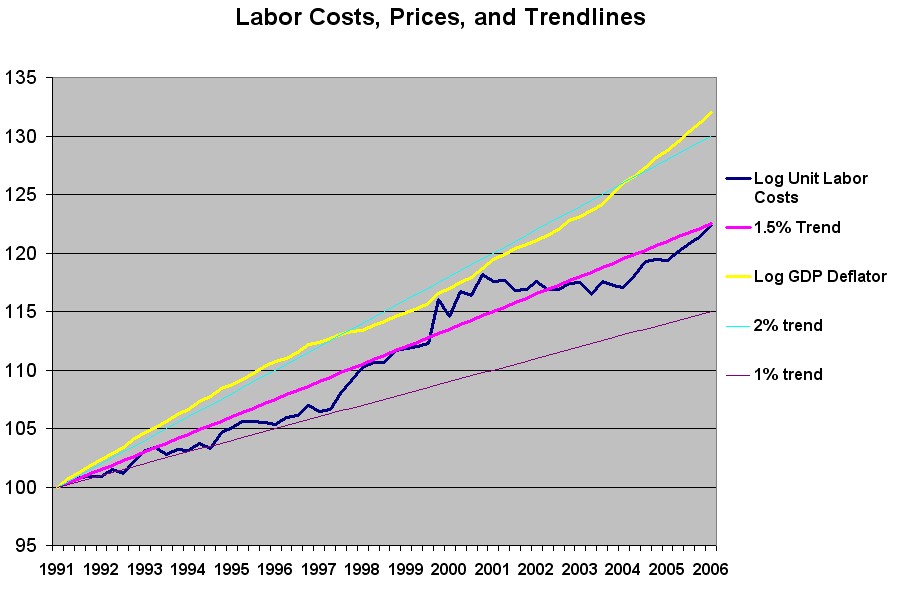
  5. As the following updated chart indicates, the Fed can make a pretty good case that it has already been targeting unit labor costs since the early 1990s. (The old talk about a preferred inflation rate between 1% and 2% rings a bit hollow – in addition to being, in my opinion, a less than optimal target range for inflation. But unit labor costs have stayed pretty nicely in that range – although, in my opinion, it’s a less than optimal target for unit labor costs as well, and I would hope the Fed would go maybe for something like 2%.)


From the chart, it looks like we need a slowing of unit labor costs now to continue keeping in line with the target. But given the recent weakness in the labor market and simultaneous recovery in output growth, as well as various factors suggesting a high risk of recession, I think the central tendency of the Fed’s forecasts will be for slower labor cost growth anyhow. All in all, labor costs are still very close to the presumed target, so the priority at this point should be for maintaining stable growth rather than attacking a bulge in labor costs. (And if the Fed were to do as I prefer, and raise the target to 2%, there wouldn’t be any question.)

Labels: , , , , , , , ,

Friday, September 21, 2007

Revised Smoothed Unit Labor Costs

Perhaps the most striking piece of data adduced by Allan Meltzer in arguing against an easing of monetary policy was “unit labor costs rising at a 5% rate.” It appears that he is comparing second quarter 2007 unit labor costs to second quarter 2006 unit labor costs to get that 5% growth rate. As I argued last year (ironically, arguing against Marty Feldstein, who went on to become Allan Meltzer’s major adversary in the recent debate),
...the right way to analyze these data is neither by comparing years to years nor by comparing fourth quarters to fourth quarters, but by smoothing the quarterly data over time to extract an estimate of the general trend.
I have updated the chart I made last year of the smoothed rate of unit labor cost growth, and the picture has not changed dramatically, though things do look a little bit more inflationary than they did a year ago. Certainly, my smoothed series does not suggest that that the 5% growth rate cited by Allan Meltzer is a very good indication of the general trend. The most recent smoothed growth rate is 2.5%, which, while it is higher than what today’s Fed would probably consider ideal, does not suggest that we are moving into a new regime of rapid labor cost growth.


It might also be worth thinking about what we should expect unit labor costs to do in the immediate future (or in the immediate past that hasn’t yet been reported in the data). Are there reasons to expect productivity growth to accelerate or decelerate? Are there reasons to expect compensation growth to accelerate or decelerate? To the extent that there are reasons for either, they go generally in the direction of accelerating productivity growth and decelerating compensation growth, so they point to a less inflationary trend in labor costs. Simply, the labor market is weak. With employment at a near standstill for the past 3 months, employers have little reason to raise compensation, and any significant output growth will have had to come in the form of rising productivity (since there is no indication that hours worked per employee is rising). Various indicators do suggest that output is still rising at a reasonable rate. (Also, I imagine compensation may take a substantial seasonally-adjusted hit when bonus time comes around for Wall Street and the mortgage and construction industries.) All in all, I don’t see much reason to be worried about rising labor costs.

Labels: , , , , , ,

Thursday, September 20, 2007

XFE vs. Trimmed Mean, etc.

Karl Smith’s objection to my whimsical call for a 175 basis point cut in the federal funds rate seems to depend on what price index is used. My preference was for the most recent 12-month change in the deflator for market-based personal consumption expenditures excluding food and energy:
The best price index we have is the market-based core personal consumption deflator, which gives an inflation rate of 1.7%…over the most recent 12-month period.
I really do think that’s probably the best simple indicator of the inflation rate (though without the constraint of simplicity I would make a lot of changes, such as using a weighted average rather than a 12-month figure, putting some nonzero weight on food and energy, taking other kinds of price indices into account, and so on). Rumor had it a few years ago that Alan Greenspan liked it too. Anyhow, Karl uses a slightly different PCE-based deflator:
Using the 12 month trimmed mean PCE deflator of 2.2, we get 4.3 rounded down to 4.25 for a 100 bps cut.
The difference in those inflation figures accounts for the difference in the interest rates prescribed by our respective Taylor rules. There are a couple of differences in the indices we use: mine excludes non-market based prices and all food and energy, whereas his excludes only the most extreme price changes, wherever those should happen to occur.

Though in real life I think Karl’s 100 basis point cut would have been a better idea than my 175 basis point cut (for reasons of interest rate smoothing and risks of market instability rather than basic Taylor rule considerations) and indeed, I think the Fed’s 50 basis point cut was probably just the right thing to do under the circumstances (given that there will be another chance at the end of October), I stand behind my preference of price index. Regarding the market-based feature, I’ve always preferred accuracy to comprehensiveness when it comes to price indexes, and I really don’t trust prices that have to be computed by statisticians rather than observed in a market context. And I have a couple of reasons for preferring the “ex food and energy” core to the “trimmed mean” core.

First, I see a core index not so much as a way of filtering out volatility (which, if you’re going to do it, shouldn’t you apply a time series filter as well as a cross-sectional one?) but as a way of filtering out price changes that specifically aren’t likely to be repeated. One thing much of the food and energy component has in common is that the prices are determined in speculative markets for storable commodities. Oil is the most obvious example: any change in the observed price of oil roughly represents a revision of the market’s best guess as to what the price of oil will be in the future, less storage and financing costs. If there’s a jump in the price of oil, and we want to know whether that jump will be repeated, we can infer that the people who know the most about it, on average, don’t think so. If they expected the jump to be repeated, futures traders would have bid up the prices of distant contracts, and spread traders would have bid up the spot price further in anticipation of purchases by arbitrageurs with storage capacity (who could sell the distant futures, buy the physical commodity at a lower price, and lock in a profit), and the original jump would already have been large enough to eat up most of the hypothetical repeat jump.

Granted “food and energy” is not the ideal proxy for “storable commodities with speculative markets plus goods and services whose prices depend primarily on such commodities,” but it’s a pretty good first stab. Excluding such items amounts to outsourcing part of the task of forecasting inflation to the private sector. When it comes to general macroeconomic conditions, the Fed may have better information than the market, but when it comes to pricing of specific commodities, it’s not really plausible that the Fed’s information is even as good as that of the market, where people with specialized knowledge (and often private information) stand to make and lose large amounts of money daily on price changes.

By contrast, if there’s a jump in the price of some non-speculative item – say, for example, hairstyling services – there is no a priori reason to think that the jump won’t be repeated. There are empirical reasons – price jumps tend not to be repeated – but without knowing something about the fundamentals of the hairstyling market, it’s hard to know whether a given experience is expected to represent the rule or the exception. So, at least as compared to oil prices, I would not be greatly inclined to exclude hairstyling services temporarily from my price index just because it had a big jump in one month or one year. To do so amounts to making a naïve inflation forecast, and if we’re going to make inflation forecasts, why not go to someone who knows how to do a better job of it, rather than just using naïve rules of thumb?

The other reason I like excluding food and energy is that I don’t think it’s optimal for the Fed to try controlling such prices. The point of controlling prices overall (the point, for example, of having an inflation target), as I see it, is to provide a nominal anchor for monetary policy, so as to avoid a situation where nearly all prices start rising at a faster and faster rate (roughly as they did in the 1965-1980 period). As I argued last year, the choice of nominal anchor is a matter of convenience. You could choose gold, but that turns out (as we learned in the early 1930s) to be a very inconvenient choice. You could also choose a comprehensive basket of goods and services, but that’s probably not the most convenient choice either.

If the price of important commodities such as oil were to continue rising rapidly year after year, it might necessitate a downward path for real wages. Given that nominal wages can be sticky downward, rather than forcing a difficult decline in nominal wages (and most likely one or several recessions) by trying to keep the overall price level stable, it would make more sense to let the energy component of prices rise while letting nominal wages remain stable. Taken to its logical conclusion, my argument might imply that the Fed should target wages, or some combination of wages and stickier prices. The details have yet to be sorted out, but it is clear that typically non-sticky prices, such as those that largely determine the cost of the food and energy component of personal consumption, are not a convenient part of the nominal anchor.

Labels: , , , ,

Saturday, October 07, 2006

Bad Wages

Dean Baker notes that the preliminary benchmark revision to US payroll employment data will mean lower productivity growth. Another implication, provided that there are no compensatory revisions in average hours worked or total compensation, is that average hourly compensation will be lower. For those who have been complaining about anemic wage growth, it looks like the situation may be even worse than they thought.

Labels: , , , , , ,

Friday, October 06, 2006

To Wage War

According to Paul Krugman in today’s New York Times (by way of Mark Thoma and of jurassicpark at Welcome to Pottersville, and thanks to Google Blog Search, since I’m not a Times subscriber right now):
The Dow is doing well largely because American employers are waging a successful war against wages. Economic growth since early 2000, when the Dow reached its previous peak, hasn’t been exceptional. But after-tax corporate profits have more than doubled, because workers’ productivity is up, but their wages aren’t — and because companies have dealt with rising health insurance premiums by denying insurance to ever more workers.

If you want to see how the war against wages is being fought, and what it’s doing to working Americans and their families, consider the latest news from Wal-Mart....
I have an immediate problem with this explanation for the rising stock market (which is not to say that I have a better explanation). If wages (and total compensation) are being kept down in the face of rising productivity, why isn’t competition keeping prices down as well? It seems to me that, to make his explanation complete, Prof. Krugman needs a story about reduced competition in product markets. Otherwise, there is no reason to expect that the markup of prices over wages should rise as wage bills decline. If wages are the only story, then at best the stock market is being short-sighted in not seeing the eventual effects of competition.

Prof. Krugman’s example, Wal-Mart, is an excellent case in point. Historically, Wal-Mart has reaped the benefit of reduced costs not by raising its margins but by cutting its prices and thereby increasing its market share. Wal-Mart’s profits have gone up, but its competitors’ profits have gone down. (More precisely, some of the competitors’ profits have gone up, but more slowly than they would have in the absence of Wal-Mart’s cost-cutting, whereas other competitors have stopped earning profits altogether and, in many cases, gone out of business.) Historically, Wal-Mart’s cost cutting has not obviously resulted in increased profits for the retailing business in general. Things may have changed now – Wal-Mart may now have such a large market share that it plans to grow by raising margins rather than cutting prices – but in that case, the story is not really a story about costs but a story about monopoly power.

As I said parenthetically above, I don’t have a good explanation for the rising stock market. My best guess as to why profits are so high has been that economic rents in certain industries (oil and software, for example) are puffing up aggregate profits. But this wouldn’t explain why the stock market is still going up. Of course, one doesn’t really need an explanation because we can always attribute stock price movements to changes in the required equity risk premium.

Labels: , , , , , ,

Friday, September 08, 2006

Income Distribution and Monopoly Rents

Maybe I am a lefty. In any case I find this discussion of income distribution (by Maynard of Creative Destruction) rather compelling:
I think one thing that's going on with the income distribution is this. With the development of communication and computer technology and the greater reach of large corporations in the last several decades, our productive technology is increasingly characterized by scale economies (I haven't read Rosen's Economics of Superstars, AER 1981, in awhile, but I think my argument is related to his). Two examples. Microsoft dominates the "market" for operating systems because of network effects: the more people who use Windows, the more valuable it becomes for the marginal user. Tom Hanks gets paid an outrageous amount of money because the distribution of his movies has become so sophisticated. It costs next to nothing at the margin to distribute one more copy of the same movie, so he is able by dint of a slight advantage in talent over a performer that no one has ever heard of to dominate the market. This means that there are huge monopoly rents that are up for grabs across huge swaths of the American economy. In the old days when the economy was insulated to some extent from the rest of the world and workers were represented by strong unions, you might have seen workers take a big chunk of these rents. But in the present environment, the rents go to those in the strongest bargaining position, namely the executives at large corporations and institutions and the performers who always have the recourse to walk away from the next film (or music, or sports) deal. So Brooks is right that our "meritocracy" is rewarding people based on individual talents, those who are organized, self-motivated, and socially adept. But the talent that is being rewarded is the talent to extract rents, not the talent to produce a higher quality product than the competition. Rewarding that particular talent produces no benefits for society; there is no economic argument to justify such a meritocracy, no economic basis for opposing, say, a steeply progressive tax system that would counteract some of the forces pushing us toward greater income inequality.
In fact, progressive taxation is more efficient. People in the bottom half of the income distribution aren’t getting much of the rents. They’re being paid roughly their marginal product, and taxes would distort their labor/leisure decision. People near the top of the distribution are the ones who have succeeded in capturing rents. They are being paid much more than their marginal product, and taxes actually correct a distortion in their labor/leisure decision.

Note, however, that these arguments don’t apply to capital taxation. (Maybe I’m not a lefty, after all.) If an individual has a lot of capital income, it is probably because that individual had a lot of capital to invest, not because she is capturing a disproportionate amount of rents in her capital income. So there is no efficiency justification for progressive taxes on capital income.

Labels: , , , , ,

Wednesday, September 06, 2006

Q2 Labor Costs, Revised

The big increase in US hourly compensation in the second quarter didn’t make sense when it was first reported. Now that it has been revised upward, it makes even less sense. The best explanation I’ve heard comes from Dean Baker, who suggests, based on the NIPA statistical discrepancy, that some capital gains (obtained, for example, via exercise of employee stock options) might be misclassified as compensation. (Conceptually, in the case of stock options, the compensation took place when the options were granted, not when they were exercised. Anything that happened to the value in the intervening time was a capital change rather than income, but the value of the options doesn’t show up on the income side of the national accounts until they are exercised.)

Labels: , , , , , ,

Thursday, August 17, 2006

In Defense of Labor Cost Targeting

A week or two ago, I made the apparently heretical suggestion that the Fed should target unit labor costs. Brad DeLong picked it up with a link to my subsequent post. Several objections have been raised, and I want to deal with those objections here.

The main objection, coming from Dean Baker and kharris, is essentially – to use my own earlier words – that the unit labor cost series is “subject to revision, and volatile from quarter to quarter.” As I agued in the original post, “This would be a big problem for an intermediate indicator, but not so much for an ultimate target. The important thing is that the long-term trend be predictable…” Unit labor cost depends on compensation rates and productivity. I think the Fed is already pretty good at forecasting the trend in compensation rates. Productivity is more difficult, but this is a problem even if you target inflation.

Granted, the long-term trend in labor costs is probably not (contrary to what I suggested in the original post) as predictable as that of inflation. This is a disadvantage, but it is (I would argue) far outweighed by the advantages, particularly the relative robustness to the effects of supply shocks. Under a price-based (rather than labor cost-based) targeting regime, a huge adverse import price shock (such as a major dollar crash or sudden increase in oil prices) would virtually force the Fed to induce a recession. (Indeed, the Fed may have induced a recession – yet to fully materialize – in response to the more gradual oil price increases of the past few years.) Under a labor cost-based regime, the price shock could feed through to consumer prices without necessarily having a large effect on economic growth or employment. In principle, why should a scarcity in one commodity (such as oil) automatically induce a scarcity in another commodity (money)? Doesn’t a currency “backed by the productivity of the US labor force” inspire more confidence than a currency “backed by the promise of price stability”?

As my thinking has evolved, I would also suggest that a labor cost target should have the form of a “price rule” rather than a “growth rule.” That is, the Fed should explicitly try to correct deviations from trend rather than establishing a new trend when the old one is broken. The “price rule” approach helps with the data volatility problem by letting the Fed allow temporary deviations while credibly promising to maintain the longer-term trend.

Another objection, coming from an avowed non-expert:

When I hear "targeting unit labor costs" what I also hear is "we don't want workers to make more money, ever." To a lay observer like me, the Fed (and its counterparts in Europe) seem determined to prevent workers' wages from rising.

Actually, when I wrote the original post, I asked myself, “Would this regime discriminate against workers?” Would it automatically “take away the punch bowl before workers get to drink?” I think the answer is no. A labor cost target would allow workers to take full advantage of productivity gains, something they have apparently not been able to do under the current regime. Of course, firms could take back that advantage by raising prices, but I’m not sure that’s such a bad thing. In a sense, the current regime has allowed firms to undertake “stealth price increases” by keeping wages down. Under the current regime, the Fed is like, “Oh, hey, we’re just controlling inflation,” and firms are like, “Oh, hey, we’re just trying to keep costs down.” Under my proposed regime, firms would have to own up to the fact that they are grabbing a bigger share of the pie. If there are legitimate economic forces that are granting them that bigger share, then so be it, but let’s bring this process out into the open air of consumer markets rather than burying it in the back room of compensation determination.

Labels: , , , , , ,

Sunday, August 13, 2006

The Profit Margin Puzzle

Take another look at this picture. Something screwy is going on. Labor costs have risen at an average rate of 1.5% over the past 15 years, but prices have risen at an average rate of more than 2%. That means labor is really cheap today compared to what it was 15 years ago. Why isn’t somebody hiring that cheap labor and undercutting competitors by charging lower prices (bringing down the rate of price growth, or bringing up the rate of labor cost growth by bidding more for labor)? I consider several explanations, but none seems quite satisfactory.

1. Rising raw material prices. If the cost of non-labor inputs is going up, then firms could be forced to raise prices even when labor is cheap. When you look at oil prices today, this seems like a good explanation, but take a look at this chart, which Barry Ritholtz found in a St. Louis Fed publication. Profits have risen dramatically as a share of national income, while compensation has fallen. If raw materials costs were the problem, we would expect them to be cutting into profits. Clearly they’re not, at least not in aggregate.

2. Increasing cost of capital. When economists talk about the “zero profit condition,” they are careful to distinguish economic profits from accounting profits. Accounting profits have clearly risen, but perhaps these profits just represent a higher required return on capital, not an increase in economic profit. This explanation fits well with the observation of a very low savings rate, which makes capital scarce. However, it is not consistent with the observation of a low interest rate. Obviously capital is still cheap for high-quality borrowers like the US government. Why would it be so expensive for businesses?

3. Increasing price of risk. The capital that gets compensated by profits is necessarily high-risk capital. Possibly, even though generic capital is cheap, the risk premium for equity capital has risen: investors have gotten more timid. If we compare today to 2000, this is almost certainly part of the story. But if we compare today to 1990, this argument is less compelling. Overall, price-earnings ratios have risen over the past 15-20 years, and dividend yields have fallen, which suggests people are more, not less, willing to invest in risky assets.

4. Rising rents. Some of what is counted as profits may actually be rents, and those rents may be rising. For example, an oil company that owns mineral rights continues to account for depletion based on original cost, even though the economic value of those rights has risen, so the implied rental cost shows up as profit. You could also argue that firms like Microsoft that own valuable intellectual property are earning large rents on that property, and those rents show up as profits. This explanation is more promising than some of the others. It’s certainly consistent with the observed unevenness of profits across sectors.

5. Reduced competition. Maybe the zero profit condition doesn’t apply any more. It’s hard to think of examples, though.

6. Product and labor market disequilibrium. Over the course of the business cycle, labor costs tend to rise during booms and fall during recessions, whereas prices rise more evenly throughout the cycle and perhaps accelerate before the boom phase is reached. If the Fed’s anti-inflation policies have made recessions more common than booms (“taking away the punch bowl before workers get to drink”), this could explain a shift of income away from labor. If this explanation is right, it bodes badly for profits in the future, because disequilibria tend to get corrected in the long run, no matter what the Fed does.

7. Capital market disequilibrium. Economic liberalization has resulted in a large increase in the effective global labor supply. According to classical economic theory, this should result in a (possibly temporary) increase in the cost of capital, as scarce capital is allocated toward the newly available labor. As noted earlier, observed low interest rates are not consistent with this story, but perhaps allocating capital is more complicated in the short run. Suppose, for example, that firms have a limit on the number of investment projects they can undertake at a given time. Even if capital is cheap, they won’t be able to take full advantage, but those projects they do undertake will be located where the plentiful labor is – i.e., not in the US. Thus the required return for US investments could be quite high (hence high US profits and high prices relative to wages) even if the raw cost of capital is low.

Labels: , , , , , , , ,

Friday, August 11, 2006

Q2 Labor Costs

By most indications US labor costs rose rapidly (by recent standards) in the second quarter. But something is wrong with this picture. Ordinarily one would like to attribute an increase in the price of something (labor, in this case) to either a leftward shift in the supply curve (decrease in supply) or a rightward shift in the demand curve (increase in demand). In the case of labor, there is no evidence that either of these things happened; indeed, the evidence suggests that the demand for labor declined.

I have noted before the dramatic decline in help wanted advertising. It is not matched by the official data on job openings; the latter are roughly flat but certainly show no sign of increasing. New hires, however, did decline in the official data. And aggregate payroll employment growth slowed to an average of 112,000 per month (not enough to keep up with recent average labor force growth) from 176,000 per month in the previous quarter (which is comparable to the average for the prior two years).

This apparent decline in the quantity demanded might suggest that the labor supply curve shifted. That is, there were fewer workers available at any given wage, so firms both raised wages and reduced hiring. But the direct evidence does not support this hypothesis. Labor force participation actually increased throughout the quarter (and also in July, so one cannot reasonably attribute the increases in May and June to sampling error). There was no increase in the rate of unemployment due to voluntary quits. There was a slight decrease in the overall unemployment rate, but the decrease was reversed in July.

Another explanation for rising wages might be an increase in inflation expectations, or a correction for price increases that had already occurred. The argument, I suppose, would be that employers deliberately raised wages because they realized that, given higher prices or higher expected inflation, they would need to do so to retain their desired workforce. Absent an actual increase in quits, however, I find this explanation implausible. If employers were so scared of quits that didn’t actually happen, why did they simultaneously reduce their help wanted advertising? If they decided to spend less on recruitment, why would they be willing to spend more on wages?

My guess is that the increase in labor costs will turn out to be a statistical illusion. Aggregate compensation per hour is reported to have risen at a 5.1% annualized rate for the business sector, but this number is subject to considerable revision. The employment cost index, which corrects for shifts across industry and occupation, shows an annualized increase of 3.6%, still high by recent standards but not quite as troubling. When incentive-paid occupations are excluded, the increase drops to 2.8%, which is roughly the trend growth rate of productivity.

Labels: , , , , , , ,

Thursday, August 10, 2006

Price Rule?


If the Fed is trying to follow a price rule for unit labor cost based on 1.5% annual growth, it appears they’ve been quite successful.

Labels: , , , , ,

Tuesday, August 08, 2006

Revised and Updated Labor Costs Still Tame

Some people will look at the new second quarter figure for unit labor cost in this morning’s productivity report and conclude that labor costs have become an inflation problem. Unit labor cost was up at 4% annual rate in the second quarter and up 3.1% from the same quarter a year ago. As I’ve said before, though, this series is volatile, and the appropriate way to analyze it is to smooth the quarterly changes. Taking into account the revisions and the latest update, my smoothed series now looks like this:


It stands at 1.7%, still quite close to the 1.5% center of the assumed hypothetical target range. In fact, on the off chance that the Fed really is targeting unit labor costs, let me offer my personal congratulations to each of the FOMC members right now for coming so close. Let me also say that, if I believed that the Fed were targeting unit labor costs, I would be pretty confident that we would not see any further interest rate increases, at least not in the next 3 months (and certainly not this afternoon). When the economy is facing a possible recession and your target number is right where you want it, you don’t push things. (As it is, I don’t think the Fed is targeting unit labor costs, and I think there’s actually a significant chance of an increase this afternoon, contrary to the current consensus.)

You might want to look more closely at the second quarter figure. One reason it was so high is that productivity growth was slow. In general, one wouldn’t expect that weak productivity growth in a particular quarter means we should expect weak productivity growth in the future. Applying my smoother to productivity growth, I get a rate of 2.7%, compared to the 1.1% reported for the second quarter. So if we use trend productivity growth instead of the quarterly observation, that shaves 1.6 percentage points off that ugly 4% and leaves us with 2.4%, a much less alarming number.

The other side of the picture is compensation growth. Nominal hourly compensation grew quite rapidly (5.1% annual rate) in the second quarter. Does anyone expect it to keep growing at that rate? I certainly don’t, not after the recent huge drop in help wanted advertising.

Labels: , , , , , ,

Monday, August 07, 2006

Feldstein’s Deceptive Statistics

According to Martin Feldstein, writing in today’s (Monday) Wall Street Journal (in an op-ed piece cited variously by Greg Mankiw, Brad DeLong, Mark Thoma, and William Polley, among undoubtedly many others):

The result of the slower productivity growth and rising compensation per hour (from a 4% rate in 2003 to 5.1% in 2005) caused the increase in unit labor costs to accelerate from 1.3% in 2003 to 2.1% in 2004 and 2.8% in 2005.


These numbers don’t quite agree with what I just downloaded from the BLS, but they tell roughly the same story if you take them at face value. Unfortunately, the face value is deceptive. As best I can tell, these numbers compare annual aggregates from one year to the next. If you look more closely and examine the quarterly data, the story they tell is very different.

In the third quarter of 2003, there was a dramatic and unexpected increase in productivity. Unit labor costs fell by about 4% in one quarter, which depressed their growth rate for both 2003 and 2004, if you compare each annual aggregate to the previous year. In the third and fourth quarters of 2004, there were dramatic increases in hourly compensation, which appear to be the result of a combination of rising benefit costs and a shift in employment toward higher paying jobs. These increases in hourly compensation exaggerated the growth rate of unit labor costs for 2005, as compared to 2004.

If you look at unit labor costs on a fourth-quarter-to-fourth-quarter basis, rather than a year-to-year basis, the pattern of acceleration is revealed as a statistical illusion. The growth rate was about 0.3% in 2003, about 3.5% in 2004, and about 0.3% in 2005.

Of course, the right way to analyze these data is neither by comparing years to years nor by comparing fourth quarters to fourth quarters, but by smoothing the quarterly data over time to extract an estimate of the general trend. Any reasonable smoothing procedure (such as the one I used in the previous post) will show that there is no clear pattern of acceleration. (Possibly that will change with tomorrow’s revisions, but I doubt the change will be dramatic.) There are plenty of reasons to worry about inflation in the prices of goods and services, but as of this afternoon, there is still no reason to worry about inflation in labor costs.

Labels: , , , , , ,

What would happen if the Fed were targeting unit labor costs?

…as it should

For one thing, people like me wouldn’t be so panicked about stagflation right now. When you hear about the CPI and the PCE deflator, things look bad, but when you look at unit labor costs, it’s just another ordinary day. I reserve judgment, though, on whether we’ll be panicked tomorrow morning, when the second quarter productivity report comes out.

Also, people like Brad DeLong wouldn’t be so worried about import prices. Import prices don’t directly influence US labor costs, and presumably, if the Fed made a credible commitment to stabilizing labor costs, then workers would see that it is not in their interests to demand pay raises to compensate for import price increases.

Incidentally, the Fed might have started to tighten more quickly during the early part of 2005, after a couple of unpleasant unit labor cost numbers came out. In retrospect, that would have been a good time to tighten. However, the Fed might also have recognized that those numbers were just temporary problems. The subsequent inflation problems seem to be for different reasons (rising oil prices, mostly).

To put things in perspective, here is a chart of smoothed unit labor cost growth. (I used a logarithmic growth rate and chose an exponential smoothing parameter to maximize predictive accuracy at a 4-quarter horizon.)


Historically, things start to get ugly in 1969, with a breakout above 3%; they get uglier in 1974 with a breakout above 5%, and uglier still in 1979 with a breakout above 7%. Today, however, nothing unpleasant seems to be going on: this series remains near the bottom end of its historical range. (The situation may change tomorrow, but, given my smoothing parameter, the change is unlikely to be dramatic.) So, what would happen if the fed were targeting unit labor costs? Well, if the target growth range were 1% to 2% (as contemporary opinion suggests it might be), then we would congratulate the Fed for doing such a good job.

Labels: , , , , ,

Sunday, August 06, 2006

Should the Fed Target Unit Labor Costs?

Yes, if you ask me. I would suggest using unit labor costs as the ultimate target of Fed policy, not just as an indicator to watch for signs of inflation. In fact, I think an explicitly announced long-term target might be a good idea (better than an inflation target).

Why should the Fed choose unit labor costs as a target?

1. It’s simple. There are no subtle debates required about things like “Should we include energy?” and “Should we exclude housing?”

2. It avoids wage-price spirals. When the spiral hits wages, it gets nipped in the bud.

3. It avoids “bad sunspots.” That is, it never gives reason to lose confidence in the value of money, since it ties the value of money to the labor content of goods and services. (Avoiding “bad sunspots” is the most basic rationale for having some sort of target in the first place.)

4. It achieves “greasing the wheels” (provided that productivity growth is consistently non-negative and the target growth rate for unit labor costs is positive). In other words, in most cases, it makes nominal wage cuts unnecessary and thereby avoids the situation where firms reduce employment because they doubt workers would accept such wage cuts.

5. It allows the Fed to accommodate external supply shocks, so that such shocks (hopefully) don’t produce recessions.

6. It allows the Fed to provide a stimulus to take full advantage during times of rapid productivity growth.


There are a couple of drawbacks I can think of, but they don’t bother me much:

1. The data series has unpleasant characteristics. It is reported with a lag, subject to revision, and volatile from quarter to quarter. This would be a big problem for an intermediate indicator, but not so much for an ultimate target. The important thing is that the long-term trend be predictable, and in this respect, unit labor costs is probably no worse than any other series.

2. In the event of a persistent supply shock (such as the recent experience with oil prices, if that experience continues), this approach would allow persistent inflation. And my response is, “So what?” Inflation is mildly unpleasant, but the alternative of economic stagnation is highly unpleasant. On welfare grounds, it makes no sense to insist that the inflation rate always be low. If individuals are worried about inflation risk, they can buy insurance, probably at prices which (as suggested by TIPS spreads) would be very reasonable. (Of course, if such insurance is never offered, because there is no market for it, that just makes my point that inflation risk is not such a big deal.)

Labels: , , , , ,

Friday, July 21, 2006

Who cares about wages?

David Altig of Macroblog argues (continued here) that we should just ignore wages and look at total compensation. Greg Mankiw agrees. Brad DeLong disagrees, but only because we don’t have good enough data on total compensation. I would suggest, however, that there are a couple of reasons we should care about wages for their own sake.

First, even though compensation is the theoretically correct variable that rational firms and workers should care about, their behavior in the real world may reflect rules of thumb that give precedence to wages over benefits. As a result, the behavior of the Phillips curve – the short-run tradeoff between inflation and output – may depend on the exogenous behavior of benefit costs. Recent increases in the real cost of health insurance have, in my opinion, had an inflationary impact. In principle, they shouldn’t: firms facing rising benefit costs should just keep wages down. In practice, I suspect this is often not what they do. I can’t prove it, but I believe that the weak wage growth in recent years has been the result of weak labor market conditions – conditions that would normally have been disinflationary – and not the result of increasing benefit costs.

At the place I used to work, I was there for 6 years, and every year, they would announce a 5% wage increase. I found it kind of amusing because the memo always said what the inflation rate was, but it never seemed to make any difference: we automatically got a bigger real wage increase in years when the inflation rate was low. Since our benefits included health insurance, we also got a bigger increase in total compensation in years when the cost of health insurance rose more rapidly. (That part wasn’t even in the memo.). Firms have to take benefit costs into account in making employment and pricing decisions, but when it comes to wage-setting decisions, I would guess that a lot of firms behave like my old employer.

The second reason has more troubling implications. Wages, I think, have a lot to do with the subjective sense of prosperity. “Honey, I got a raise!” sounds a lot better than, “Honey, they expanded our health insurance to cover several newly developed procedures!” Even though rising benefit costs largely reflect real improvements in the quality of health care, these improvements don’t make us feel richer. Unfortunately (this is the troubling part) they really represent an acknowledgement that we weren’t doing so well to begin with. There are all kinds of health problems we could get, and it’s a good thing when new solutions are developed, but for those who are currently healthy, it is much easier to ignore the potential problem when we don’t have to pay for a potential solution.

Labels: , , , , ,