Friday, March 21, 2008

What's going on?

In Paul Krugman’s latest column (hat tip: Mark Thoma), he compares the current financial crisis to the bank runs of 1930 and 1931:
The financial crisis currently under way is basically an updated version of the wave of bank runs that swept the nation three generations ago. People aren’t pulling cash out of banks to put it in their mattresses — but they’re doing the modern equivalent, pulling their money out of the shadow banking system and putting into Treasury bills. And the result, now as then, is a vicious circle of financial contraction.
That sounds like a pretty good description of what’s going on, but there’s something missing. Thinking about this as a regular person rather than an economist, I have to ask, “Who are these ‘people’ that are pulling their money out of the shadow banking system and putting it into treasury bills?” Because it sure isn’t me. I have my cash in a prime money market fund; I deliberately passed up the “treasury-only” option, and I see no reason to change my mind now. My fund hasn’t broken the buck. In fact, I haven’t heard of any money market fund that has broken the buck recently. (Possibly something escaped my attention, with all the news that’s come out lately, but even if there have been one or two cases, there haven’t been many, and they haven’t been big ones.)

I don’t know exactly what my fund manager is doing; I imagine they’ve probably increased the proportion of treasuries in their portfolio, and I guess, technically, it was “people” that made that decision, but it wasn’t any people that I know personally. If anything, I’d like my fund to skate closer to the edge. It would not drive me into bankruptcy if the share price went from $1.00 to $0.99. In fact, I probably wouldn’t even notice, except for the fact that I’d read about it in the newspaper, and the fund would probably send me all kinds of stuff in the mail about how something went terribly wrong and the employee has been fired and this will never ever happen again in a million years and they’re completely changing all their control procedures and they’re changing their name just to show that they aren’t really the ones who lost that one cent.

So I guess the point is, it’s not really “people,” in the sense of retail investors, who have lost confidence; it’s institutions. Maybe that’s why so many “people” have a hard time seeing what the big deal is and why the Fed needs to help “bail out” Bear Stearns. As for me, when I see the TED spread approaching 200 basis points and the treasury bill rate approaching zero, I know that something is very wrong and that the Fed has good reason to be taking drastic measures, but I’m still a little confused as to why all this is happening. I understand that the consequences of the failure of a major investment bank under these conditions would be disastrous, but I still have trouble seeing why J.P. Morgan needed $30 billion in non-recourse financing to convince it to buy Bear Stearns for a tiny fraction of what the market seemed to think it was worth.

Labels: , , , , ,

Monday, March 17, 2008

Capital Flight is Good

Some people (Yves Smith and Tim Duy, to name two, but I’m sure there are many others that I haven’t gotten around to reading yet) are worried that concern about capital flight is going to have to be a constraint on the Fed’s ability to deal with this crisis. I disagree. I don’t think the Fed will or should be concerned about capital flight. In fact, I think capital flight is part of the solution, not part of the problem.

In general, capital flight is a problem if you care about quantities that are not denominated in your own currency. If all the quantities you care about are (or can be) denominated in your own currency, then you can just print as much currency as you need to replace the foreign capital. There are basically 4 situations where capital flight is a problem, which I will call the 4 Fs:
  1. Full employment. If all your real domestic resources are being used, then the withdrawal of foreign capital will mean the withdrawal of real resources, which will reduce your growth potential. This was an issue for the US in the late 90s. But today the US is not at full employment. And if you still think it is, just wait a few months.

  2. Fixed exchange rate. If you need to defend an exchange rate, the government will effectively have to supply exiting capital out of limited official reserves. This was a large part of the problem in the early 30s. But today the US does not have an obligation to defend its currency, nor does it have (about which see the rest of this post) and interest in maintaining its currency’s value.

  3. Foreign currency-denominated debts. If you have to pay back foreign currency, you’ll be in trouble if capital flight weakens your own currency and thereby makes foreign currency harder for you to get. This has been a problem in various places, particularly Latin America, in the past, but it’s not an issue for the US today: almost all our debts are denominated in dollars.

  4. (in)Flation. If your country is experiencing, or on the verge of experiencing, an unwelcome inflation, capital flight will exacerbate the problem by weakening your currency and thereby raising import prices. As of 8:29 AM on Friday, I still thought this was an issue for the US today. I no longer do.
For the US today, the real problem would be if foreigners insisted on continuing to purchase US assets. That would support the dollar, making it that much harder to sell US goods and services and contributing to the weakening of the economy, thereby exacerbating the positive feedback between a weak economy and a weak financial system.

As long as inflation was a major issue, there were limits to what the Fed could do to stabilize the domestic financial system. It could only take on mortgage securities, for example, up to the point where it used up all its assets. In that situation, an absence of foreign demand for US securities might be a big problem.

If, as now appears to be the case, the risk of deflation is a bigger issue than the risk of inflation, then there is no limit to what the Fed can do. If it runs out of assets, it just prints more money to buy assets with. If foreigners refuse to buy US assets, the Fed prints money for Americans to buy them. If Americans refuse to buy risky assets, then the Fed can trade its own assets for risky assets through programs like the TSLF. Or lend money directly against risky assets. If foreigners withdraw capital, the Fed can replace it with newly created money. (Actually, it won’t need to, because when the proceeds from the withdrawn capital are converted out of dollars, the counterparty to that conversion will have dollars to invest.)

If the dollar weakens, so much the better. $2/Euro. $3/Euro. In the words of Chico Marx, “I got plenty higher numbers.” It might be a problem for Europe, but not for the US (and for Europe it would be a self-inflicted wound, since there is plenty of room to expand the supply of euros if there were a will to do so).

There is no limit to the potential magnitude of the Fed’s actions, but there could conceivably be limits to the effectiveness of those actions even as the magnitude becomes infinitely large. That situation is exactly one where capital flight would be a good thing. If the Fed can’t manage to stimulate the economy sufficiently by printing money, the stimulus has to come from somewhere else. Increased demand for US exports, due to a weak dollar, due to capital flight, is one of the chief candidates.

Labels: , , , , , , , , ,

Sunday, March 16, 2008

TSLF: Is the government taking a risk?

In one of the latest blogospheric analyses of the Fed’s plans to accept private-label mortgage backed securities as collateral, James Hamilton concludes that the government is taking on a definite risk (specifically, although the Fed is the agent, it is really the Treasury’s risk, since the Fed’s profits are received by the Treasury) but that the risk is not a very large one. I wonder, though, if it’s appropriate to view the risk characteristics of the specific transactions in isolation without considering how they influence the Treasury’s other risks.

Modern portfolio theory teaches us that an asset that looks risky in isolation can actually decrease the risk of a portfolio. For example, if you have a portfolio that consists entirely of government bonds, and you take out some of the bonds and replace them with stocks, you have replaced a safer asset with a riskier one, and yet your portfolio overall is now less risky. In that context it is the correlation (or rather, lack thereof) between asset returns that is the issue, but in the case of the government itself, a more important issue is how transactions in one set of assets affect the value of other assets and liabilities.

In particular, the government’s most important asset, in real economic terms, is the expectation of tax revenues. Tax revenues depend mostly on incomes. In particular, revenues depend not on potential incomes but on actual incomes, so any expected gap between the two reduces the value of the government’s most important asset. The government’s most important liabilities are the securities it issues, most of which are denominated in nominal dollars and most of which do not contain a call provision. A worst case scenario for the government is a Japanese-style deflationary depression, in which the value of the government’s liabilities rises in real terms, while the value of its most important asset is eroded by an ongoing output gap.

Deflation might not have seemed like an issue before Friday’s CPI report, but now the risk cannot be so easily dismissed. Most of the positive inflation in recent months appears to be the result of rapidly rising commodity prices, which are volatile and could easily reverse direction. Meanwhile, the US labor market is weak, and the financial system – what’s left of it – is fragile. If, by taking on certain (relatively small, in the grand scheme of things) financial risks, the government is able to materially reduce the risk of a financial collapse and thereby reduce the risk of a deflationary depression, there is probably a net decline in the government’s total risk.

To put it a little differently, as James Hamilton says, “you don’t get something for nothing,” but, it seems to me, if the something that you get is clearly worth more to you than the something that you gave up, you kind of do get something for nothing. Don’t you?

Labels: , , , , , , , ,

Friday, March 14, 2008

This inflaiton report scares me.

Quoting myself from the comments section of my last post:
...Japan had plenty of missed opportunities in the early to mid 90s to prevent the depression from getting out of hand. It was only when the inflation rate went to zero...that it really became intractable.
Speak of the devil, and he shall arrive appear. I'm pretty sure we'll get positive core inflation in March (and there's no question that we'll get positive headline inflation), but seeing zero even in one month (as in today's February CPI report), while commodity prices are rising at unprecedented rates, is pretty disturbing. Both the 12-month CPI inflation rate and the 3-month annualized rate are 2.3%, which is right in the middle of the normal range. This is disturbing because it seems to indicate that business don't even have enough pricing power to pass on part of the huge cost increases they are facing in energy and materials. What happens when commodity prices stop rising? I don't think I want to find out.

Labels: , , , ,

Sunday, March 09, 2008

Rising Inflation Expectations: Bad News or Good News?

Suppose that Greg Mankiw and others are correct in suggesting that inflation expectations have risen dramatically. Is this bad news or good news?

By way of full disclosure, I should note that it’s clearly good news for me, since I’m short nominal Treasury notes. If you follow the logic, that means it’s in my interest to convince other investors that conditions are more inflationary than I really think they are, so while the main point of my last post still stands, you should probably take the caveats (“There's little question that the expected inflation rate has risen...”) with a grain of salt. (Rising inflation expectations are clearly good news for me, but if this is what the good news looks like, I’d hate to see what happens to nominal yields when inflation expectations are falling!)

As to the “general interest,” however, the most obvious interpretation is that rising inflation expectations are bad news, because they mean that markets have lost confidence in the Fed’s willingness to keep inflation within its perceived target range. Or, as Greg puts it (quoting the Cleveland Fed’s Web server and adding a double entendre), “the system ‘has experienced an unexpected error.’” If the market loses confidence in the Fed’s inflation target, then, theoretically, the change in the expectations term in the Phillips curve causes it to shift upward, and we can anticipate both higher unemployment rates (in the short run) and higher inflation rates (in both the short run and the long run, unless confidence is eventually restored) than we would otherwise experience at any given level of aggregate demand.

Under that interpretation, the higher unemployment rates in the short run are clearly bad news. As for the higher inflation rates, I’m not so sure. A slightly different, but related, interpretation is that the market correctly perceives that the Fed has finally come to its senses and raised its inflation target from an unreasonably low level. Indeed, the current crisis, in which reasonable people are worried both about inflation becoming unhinged and about a potential deflationary collapse, is a good demonstration of why the target should be higher. It is kind of hard to believe that the Fed has come to its senses, though, since the rest of the world’s major central banks have been even further from their senses than the Fed.

Even if you think the Fed’s perceived* inflation target (between 1.75% and 2% on the personal consumption deflator, which is maybe about 2.25% to 2.5% on the CPI) is reasonable, you might think there are certain situations where the target should be raised. One of those situations might be a “safety trap” – where investors shun all but ultra-safe assets, even when the expected returns become much lower than those on risky assets. Arguably (though the argument becomes much weaker when you look at the stock market instead of the credit markets) the US is experiencing a safety trap now, and one solution is to take away the safety of the supposed safe asset by promising to inflate away the returns to be earned by government bondholders. Another situation where raising the target might be a good idea is when the uncertainty around the expected inflation rate increases, so that pursuing the original target would produce a significant risk of deflation. There might be a fairly strong case (as I suggest in the previous paragraph) that the US is in that situation right now. Obviously if you think that current circumstances call for an increase in the inflation target, then it is good news to learn that (in the judgment of the market) the target has actually increased.

But all these interpretations assume that the general shape of the distribution of inflation possibilities remains roughly the same. Moreover, casual talk of “expected inflation” suggests that we think the mean and the median of the distribution are roughly the same, since “expected inflation” could refer to either one. But perhaps what has happened is that the mean of the distribution has risen but the median has not. I would interpret the Fed’s target more as a median than as a mean. I would certainly hope that it isn’t the mean, and that the Fed would be more willing to tolerate inflation rates 3% above its target (high by recent standards but far from disastrous) than rates 3% below its target (deflation, which could be disastrous). Under this interpretation, the market still has confidence in the Fed’s target as a median, but the market is reassured that extremely low inflation rates will not be tolerated, so that the distribution has become more skewed to the right, and the mean has risen. In that case, the increase in mean (but not median) inflation expectations is good news.

[UPDATE: Paul Krugman, using what seems to be another species of the "in this situation, the inflation target should be raised" argument, makes the case that high inflation expectations are good news.]


*The Fed has actually announced a 3-year-ahead forecast, which can perhaps be reasonably interpreted as a target.

Labels: , , , , , ,

Monday, February 18, 2008

St. Augustine

I guess I was a little early with the Augustine reference back in August 2006, and maybe I should have translated it into English, but it looks like it's finally catching on.

Labels: , , , ,

Friday, February 15, 2008

Not a Bubble

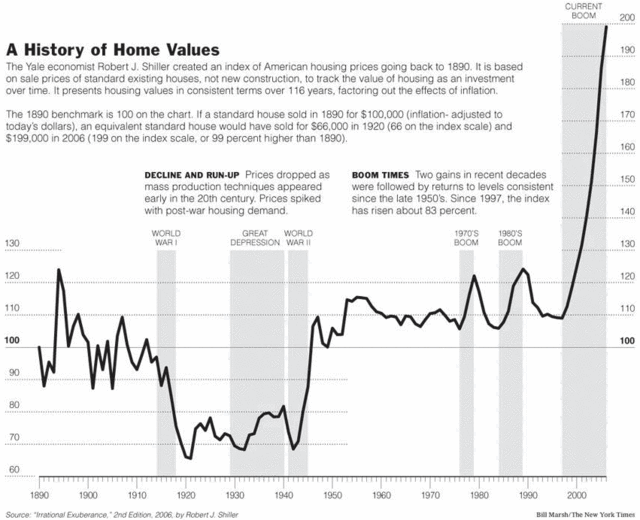
Alex Tabarrok of Marginal Revolution has gotten a lot of (mostly dissenting) attention for his argument that there was no housing bubble (hat tip: hmm, I don't even remember, but I'll cite Paul Krugman, Jane Galt Megan McArdle, and Battlepanda, among the many who have pointed to the post). Alex Tabarrok reproduces Shiller's now-famous chart of housing prices over the past 100 years and comments:
The clear implication of the chart is that normal prices are around an index value of 110, the value that reigned for nearly fifty years (circa 1950-1997). So if the massive run-up in house prices since 1997 [culminating at an index value around 200] was a bubble and if the bubble has now been popped we should see a massive drop in prices.

But what has actually happened? House prices have certainly stopped increasing and they have dropped but they have not dropped to anywhere near the historic average. Since the peak in the second quarter of 2006 prices have dropped by about 5% at the national level (third quarter 2007). Prices have fallen more in the hottest markets but the run-up was much larger in those markets as well.

Prices will probably drop some more but personally I don't expect to ever again see index values around 110. Do you?
As Battlepanda points out, "Do you?" is not a very convincing argument unless you already agree with him. But I think I can make it a little bit more convincing:
Prices will probably drop some more, but personally, given the likely effect that an additional 40% drop in home prices would have on the already weak economy, I don't expect that the Fed will allow index values to fall to anywhere near 110 in the foreseeable future. Do you?
Some people will respond with something like, "OK, I don't either, but that doesn't mean it wasn't a bubble; that just means there's a Bernanke put on home prices: there was a bubble, and the Fed is now going to ratify the results of the bubble." But that's not right. The Fed is not actively causing inflation in order to bail out homeowners and their creditors. The vast majority of professional forecasts call for the inflation rate to fall over the next few years. The Fed is just doing its job -- trying to keep inflation at a low but positive rate while maximizing employment subject to that constraint. The ultimate concern of the Fed is to avoid deflation, which becomes a serious risk if the US housing market has a total meltdown. It's very much as if the Fed were passively defending a commodity standard, with the core CPI basket as the commodity.

The ultimate source of the housing boom is the global surplus of savings over investment. That surplus is what pushed global interest rates down and thereby made buying a house more attractive than renting. And that surplus is still with us. If anything, it appears to be getting worse, as US households begin to reject the role of "borrower of last resort." And it is that now aggravated surplus that threatens us with weak aggregate demand and the risk of economic depression in the immediate future -- a risk to which the Fed and other central banks will respond appropriately. Until the world finds something else in which to invest besides American houses, the fundamentals for house prices are strong -- not strong enough, probably, to keep house prices from falling further, but strong enough to keep them well above historically typical levels.

Labels: , , , , , , , ,

Thursday, January 31, 2008

Monster Really Scares Me

Just as I finished leaving a comment (not yet accepted as of this writing) on Paul Krugman's blog arguing that UI claims for January remain on balance in the "good news" column and that the personal consumption report is not bad news given what we already knew about retail sales, I learned that the Monster Employment Index (which measures online help wanted advertising) fell by a whopping 9 points (from 169 to 160) in January, after falling an even more whopping (but less surprising given the usual seasonal pattern) 14 points in December and a not so whopping (but still significant because the index has never dropped 3 months in a row before) 5 points in November. That makes a total drop of 28 points, or about 15%, over 3 months. Before December 2007, the index had never fallen by more than 3% over any 3 month period (since it began in October 2003). And note that the 15% drop comes as newspaper help wanted advertising is scraping against an all time low (since 1951, when the Conference Board's index began, but note that in December, it rose slightly from the all-time low in November). Over the past week or two, I had been starting to think that the odds were shifting against recession. Now I'm not so sure. In any case I think we can rule out the possibility that 2008 will turn out unexpectedly to be a year of normal growth. And I'm not so worried about import prices now; I think they'll be offset by a slowing of domestic inflation.


[UPDATE3: OK, now I found the post on Paul Krugman's blog where he said that someone else edits the comments. (I missed it the first time, because it was in an update that I didn't read.) And I notice that one of my comments on an earlier post has suddenly appeared. I guess they decided I was a respectable commenter after all.]

[UPDATE2: I removed the previous update, because Paul Krugman (or whoever approves comments for his blog) did approve my comment. (See link at the top.) I had assumed it wasn't going to be approved, because there were later comments comments already approved, but I guess these things don't necessarily go in order.]

[UPDATE: [removed] ]

Labels: , , , , , ,

Wednesday, January 30, 2008

Not Such a Weak Report

Reading between the lines of the 4th quarter advance GDP report, I estimate that nonresidential final sales rose at about a 3% annual rate, which is about where I see the potential growth rate (and faster than the potential growth rate that the Fed sees). It thus appears that, in the 4th quarter, fundamental weakness was still localized in the residential construction industry, which will eventually get as small as it's going to get and stop bringing down GDP. While this report doesn't allow one to rule out the possibility that a recession began during the quarter, and it certainly doesn't foreclose the possibility of a recession beginning in 2008, it does, in my opinion, line up on balance as evidence against the likelihood of one.

Labels: , ,

Thursday, January 17, 2008

Note to Congressional Democrats

(This means you, Senators Edwards and Clinton.)

If Congress passes a stimulus package full of new programs and all sorts of bells and whistles and tinsel and lights and stars and angels and golden balls with glitter on them, one that President Bush is almost certain to veto, and one that he, given his ideological preferences, could very easily justify vetoing, and indeed would have a hard time justifying singing signing, then it will be your fault, not his fault, if the recession turns out more severe than expected. I will hold you responsible. I suspect that voters will hold you responsible too.

If, on the other hand, Congress passes a simple if imperfect stimulus program that works on the revenue side -- say an across-the-board one-time tax rebate -- one that President Bush may not be happy with but will have a hard time justifying a veto, then if he does end up vetoing it, that will be his fault -- and all the more reason to elect a Democratic president. And if he signs it, well, I guess you'll just have to take the risk that the stimulus will actually work and that it will make things look a little better on election day than they otherwise would. A non-recessionary economy in 2008 -- seems to me that's a risk worth taking.


[Update: I should proofread these posts better. I don't think we're going to be seeing "Recession -- The Musical" any time soon.]

[Update2: ...and I should check my facts, too. Brock points out in the comments section that John Edwards is no longer in the Senate. Edwards does seem to have his own stimulus plan, though, and I hope he isn't thinking that it can wait until 2009 to be implemented. I guess I should include Senator Obama in my warning, too, but his suggestions have come closer to the sort of thing of which President Bush would have trouble justifying a veto, so I kind of felt he didn't need to be warned.]

Labels: , , , , , ,

Saturday, December 15, 2007

Good News about US Inflation

Everybody’s getting so freaked out about the latest CPI report, and I don’t understand why. The supposed bad news – gargantuan increases in energy prices, substantial increases in food prices and in import prices – is last month’s news. You could have gotten most of this information by looking at commodity markets and foreign exchange markets a month (or two or three) ago, and, as Dean Baker points out, you could have gotten it with even more precision by looking at the latest report on import prices. I don’t see any real bad news in this report.

Over the past 3 months, energy prices have risen at a 33.8% annual rate. That’s dreadful, but it’s not news. Food prices have risen at a 4.3% annual rate. Kind of ugly, but also not news. In fact, the 0.3% November increase in food and beverage prices is kind of tame, considering. Transportation prices rose at a 14.4% annual rate over 3 months – that’s pretty much redundant information, since I already mentioned energy prices. Medical care prices rose at a 5.2% annual rate, but that’s not unusual.

The one thing that is both unusual and unexpected is the 0.8% monthly (4.1% annualized over 3 months) increase in apparel prices. But if you look at the 12-month change in apparel prices, it’s still down (-0.4%). While apparel prices may not fall as quickly in the future as they have in the recent past, I for one do not believe that we have suddenly entered a new regime during which apparel prices will be rising by 0.8% – or even 0.3% – every month. The fact that there was a blip in apparel prices in November – and not even enough to get the core inflation rate for November above 0.3% – is hardly a significant piece of bad news.

The last thing in the report that people may have found troubling is the 0.4% increase (3.6% for 3 months annualized) in housing prices (meaning mostly rent and owners’ equivalent rent). But are you really worried about housing costs – with huge inventories of unsold houses in most parts of the country? There is probably a temporary problem in the rental market, because people are getting foreclosed on and pushed into the rental market, and the properties they vacate are remaining vacant for a while. This problem may continue in coming months, but one can’t reasonably describe this as fundamental upward pressure on housing prices.

What’s left? The “other goods and services” category did rise by 0.3% in November – more than one would have hoped – but the other two categories, “education and communication” and “recreation,” each rose by only 0.1% – less than one would have expected. All in all, not a troubling report, unless you haven’t been paying attention to the news over the past few months.

If you’re obsessed with the aggregate inflation rate, you’re welcome to be horrified that “US inflation jumps to 4.3%” – as the headline on the weekend Financial Times declared, and you might also be unhappy with the 3-month core inflation rate (2.6% annualized). But when you look at the 12-month core rate of 2.3%, don’t be upset (like the Financial Times) that it is “higher than the Fed’s upper limit of 2 per cent.” That upper limit applies to the core personal consumption deflator, which is a different index and typically runs about 50 basis points (or anywhere from 0 to 100 basis points, depending on whom you ask) below the CPI. 2.3% core CPI inflation is not a problem.

Labels: , , , ,

Friday, November 30, 2007

Paradoxical Responses to Fedspeak

Throughout November, the US Treasury bond market seems to have been responding to Fedspeak by going in the opposite direction from what Fed statements would suggest about interest rates. Early in the month, when Fed officials were sounding (to my ears, anyhow) hawkish, interest rates fell. Over the past few days, with Fed officials sounding more dovish, interest rates have risen.

With respect to long-term bonds, this behavior is consistent with a view in which statements by Fed officials give clues about the Fed’s degree of commitment to keeping inflation low. Hawkish statements mean less inflation, which means lower long-term interest rates. Dovish statements mean more inflation, which means higher long-term interest rates.

It’s a bit harder to rationalize the response of short-term bonds (by which I mean 2-year Treasury notes, Treasury bills, and seasoned securities nearing maturity). The Fed’s commitment to keeping inflation low shouldn’t be much of an issue here, because there isn’t enough time for the inflation to develop before the bond matures.

Another explanation is flight to quality: when the Fed is more hawkish, bondholders worry more about the creditworthiness of other borrowers and shift their assets into Treasury securities, causing the interest rates on those securities to fall. But even the Eurodollar market, which is considered more risky than the Treasury market, has been responding in the same direction.

A variation on the flight to quality explanation is that the flight is from stocks: hawkish statements by the Fed cause investors to sell stocks and replace them with bonds, thus causing bond yields to fall. But presumably the reason investors sell stocks is that they think higher interest rates are bad for the stock market. Why would this cause them to bid down interest rates to an even lower level? Once interest rates fall, wouldn’t they immediately go back into stocks?

My best guess about what’s going on is that the bond market thinks it understands Fed policy better than the Fed does. The bond market is convinced that interest rates will eventually have to come down to prevent, or to recover from, a recession. The sooner the Fed starts cutting – the sooner it sets into motion the recovery process – the less cutting it will eventually have to do. In particular, if the Fed cuts sufficiently at the next two meetings, it may be able to avoid a recession. If not, a recession is nearly certain, and more dramatic (and longer lasting) cuts will be necessary to recover from the recession. This is how I imagine that the bond market reasons, but I’m not convinced that the bond market is right.

Labels: , , , , ,

Thursday, November 22, 2007

Indirect Effects of Export Demand

Today let us be thankful for multiplier and accelerator effects. And in any case let us at least be aware of multiplier and accelerator effects. In particular, if you want to talk about the potential role of export demand in preventing a US recession, the story you tell should mostly be about multiplier and accelerator effects rather than direct effects. If you tell the story without mentioning multiplier and accelerator effects, the prospect looks pretty dismal, as in the following from an otherwise excellent commentary by Martin Wolf:
But exports are only some 12 per cent of GDP. They must grow by considerably more than 10 per cent a year, in real terms, if the contribution of net trade to the rate of growth is to be as much as 1 percentage point. It is likely to be much less.
“Much less” than 1 percentage point sounds like a pretty feeble force to set against the likely effects of a meltdown in housing and a collapse of credit, given the apparent importance of credit and of the “wealth effect” in maintaining consumer spending. But borrowing and wealth effects have never been the primary elements used to explain consumer spending: rather, they are factors that help explain deviations from the normal relationship between spending and income. That relationship has certainly not disappeared, and income is still the primary factor. The personal savings rate may be unusually low, but this doesn’t mean that consumption has started to follow a path independent of income. And when income rises, as it would from an increase in exports, we can expect consumption to rise also.

A little quick Keynesian arithmetic should make the point. Let’s suppose that the marginal propensity to consume is 0.7. That is, for every dollar in new income that households receive, they increase their consumption by 70 cents. (There may be other things happening simultaneously that reduce their consumption, so I don’t necessarily expect consumption to grow at 0.7 of the growth rate of income, but 0.7 seems plausible to me as an estimate of the direct effect of income. It’s certainly a lot more conservative than what we would get from the rule of thumb that takes the average propensity to consume as an estimate of the marginal propensity.) Then, as the familiar story goes, people in the export industry will spend 70% of their new income; then the people from whom they buy will spend 70% of their new income; and the people from whom those people buy will spend 70% of their new income; and so on. The sum of that infinite series is 1/(1-0.7) or 3.3. The total effect of that hypothesized 1 percentage point contribution from export growth becomes 3.3 percentage points. Suddenly I’m glad the actual export contribution is unlikely to be that high: I wouldn’t want the Fed to have to raise interest rates dramatically to prevent overheating.

I’ve ignored the effect of taxes, because I think 0.7 might be a reasonable guess at the marginal propensity to consume out of gross income, including the effect of taxes. US consumption shows a striking tendency to gravitate toward about 70% of GDP, though the mechanism might be something completely different. Anyhow, I’ll leave it to real economic modelers to sort out the details. The point is just that the multiplier effect is quantitatively important, and if one tries to discuss the effect of exports without it , one will miss more than half the picture.

But let’s not forget the accelerator effect either. After the last 5 or 25 years, the US is probably not geared up to be an export powerhouse. Recent export growth has nonetheless been impressive. But with few economists predicting a significant recovery in the dollar any time soon, the important question for businesses is not how much they can export immediately but how much they can export over, say, the next 10 years. The process of gearing up becomes a worthwhile proposition in itself. Thus it is to be expected that export demand should induce a significant increase in the category of nonresidential investment (although, as with consumption, it may be partly offset by other factors causing a decline in nonresidential investment). Then there is the interaction between the multiplier and accelerator effects: some investment will also be needed to support the new consumption that results from export demand, and so on.

It may have gone out of fashion to talk about multiplier and accelerator effects as such. But we still read statements like, “Gains in employment and income will support growth in consumer spending.” The gains in employment and income don’t come out of nowhere; there has to be some underlying source of demand. A scenario under which exports provide an underlying source of demand, and the indirect effects offset weakness in other areas, seems quite possible to me.


[UPDATE: I forgot to include the hat tip to Mark Thoma for that Martin Wolf commentary.]

Labels: , , ,

Tuesday, November 20, 2007

Is a Cheap Currency Good?

In the comments section of my first post about the euro, reader Keith asks:
  1. Isn't it better to have a cheap currency? You get to export more and bring in more money. A cheap currency hurts if you travel outside the country, but on the other hand, you have more money to spend because you export more.

  2. Why has the US followed a strong dollar policy? It seems Japan has had the right idea by keeping their currency cheap.

The simple answer to the first question is that a cheap currency is good for the tradables sector (exports, potential exports, and industries that actually or potentially compete with imports) but bad for the notradables sector (everything else). It’s bad for the nontradables sector because the economy has limited resources, and the additional resources that get used in the tradables sector are no longer available for use in the nontradables sector. For example, China has a cheap currency, and it has thriving export industries, but it has really bad health care, presumably in part because people who could be training to be nurses find it more convenient to take factory jobs in the export sector.

There are any number of problems with the last paragraph. For one thing, Gabriel is probably going to complain about my cavalier use of the words “good” and “bad.” I’m pretty sure that, in a model with nominal rigidities, fixed capital, and search costs, a cheap currency can be shown to have good and bad welfare consequences (respectively) in the short run for people associated with those respective sectors. But I’m also quite sure that the proof would be a pain in the ass, and I expect that somebody (I have no idea who) has already done it, so I’m not going to attempt it. As for the long run, exchange rates are irrelevant because prices and wages adjust completely. (Well, not really irrelevant, because there is path-dependence: what happens in the particular short runs helps determine the long-run equilibrium. But that’s getting too deep for now.)

The second problem is that the phrase “limited resources,” while quite valid, is misleading. Resource limitations are not a simple, tight constraint. There is always some unemployment, and always some idle capacity, so there is always the opportunity to push on resource limitations. The problem is, when unemployment gets too low, or capacity utilization gets too high, then inflation starts to accelerate. And it’s never exactly clear how low is too low and how high is too high. If the country has plentiful slack resources, then a cheap currency is good for everybody. If the country is already overutilizing its resources, a cheap currency could be bad for everybody if it causes an inflationary spiral (but if the central bank is on its toes, this presumably won’t happen).

The third problem is that my China example is not a very good one. (Maybe someone else can think of a better example.) China’s health care problems have more to do with bad insurance markets than with potential nurses becoming factory workers. And China’s construction industry – also part of the nontradables sector – seems to be doing fine. China is quite an interesting case, though, because, on the one hand, it appears to have plenty of slack resources (people working inefficiently in agriculture who can easily take factory jobs) and therefore one might think that there is no disadvantage to a cheap currency. But on the other hand, it is beginning to experience an inflation problem, which would suggest that it is getting the worst disadvantage from a cheap currency. Part of the solution to this paradox, I think, is that China is trying to mobilize its slack resources too quickly and running into bottlenecks. And there’s also the issue of natural resources. I could go on and talk about China’s potentially destabilizing absorption of massive dollar reserves and about China’s possible attempt to exploit path dependence and so on, but I want to get to the second question.

So, why has the US followed a strong dollar policy? And should it? In the late 1990s, I think a strong dollar policy made sense (though Dean Baker disagrees). The reason it made sense is that the nontradables sector in the US was doing a lot of useful things – creating new technologies and investment goods to make US production more efficient in the future – and a weaker dollar would have forced a shift of resources out of the nontradables sector.

Today, though, I don’t think a strong dollar makes any sense, and I think most economists would agree. The economy is weak, and we may be going into a recession, so there are a lot of potential slack resources, and the nontradables sector in recent years has not been doing anything terribly useful with its marginal capacity (mostly building a lot more houses than we really need). That doesn’t necessarily mean, though, that a “strong dollar policy” is a bad idea, if a “strong dollar policy” just means a lot of cheerleading by the Treasury Secretary. I think most economists would agree, what we want is for the dollar to fall slowly, so as not to destabilize markets or cause a bout of inflation. But if investors expect the dollar to fall slowly, they will all sell their dollar assets, and the dollar will fall quickly. The solution, I suppose, is for Hank Paulson to keep saying we like a strong dollar and to convince a gradually decreasing number of suckers that he really means it, so they will wait before selling their dollar assets and prevent a free fall.


[Afterthought: I’m beginning to wonder, though, whether the dollar still is very much overvalued against the euro. It’s getting easy to imagine that, at a dollar/euro exchange rate not too far from the present level, once temporary effects wash out, the Euro Zone and the US could both end up with moderate trade deficits, rather than (as it has been recently) the US having a very large deficit and the Euro Zone having roughly balanced trade. Increasingly, the problem is not an overvalued dollar but undervalued currencies that happen to be pegged to the dollar but that perhaps at this point might almost as well be pegged to the euro.]

Labels: , , , ,

Thursday, November 15, 2007

Why doesn’t Europe have a large trade deficit? (Part 2)

The first rule of this game is that you’re not allowed to answer, “Because Europe has a high savings rate.” The whole point of Paul Krugman’s post to which I linked in Part 1 (as well as this 1995 Krugman piece to which he links therein) is that there has to be some mechanism by which a higher savings rate leads to a smaller trade deficit (or a surplus). The usual mechanism is the exchange rate, but in this case, the dollar has not appreciated against the euro. (It has depreciated in nominal terms and probably mildly depreciated in real terms also.) You can’t just say that when people save more, they buy fewer imports: if this were the only mechanism, then an increased savings rate would necessarily lead to a huge recession, because people would also buy fewer domestic products. Once the central bank and the financial markets make the necessary adjustments to avoid that recession, they increase the demand for imports again, and we’re back where we started. Unless something else – such as the value of the currency – changes.

I’m somewhat disappointed that I haven’t yet seen an answer that is both convincing and conventional. Apparently, there is no easy story that explains the divergence in trade balances between the US and Europe. (When I say Europe, BTW, I mean the Euro Zone – since I’m speaking with reference to exchange rates. Steve Waldman points out that there is diversity within the Euro Zone, with Germany running a surplus and most of the others running deficits. At a pinch, I’ll make this whole discussion about Germany and say, “Why does Germany still have a trade surplus?”)

There were a couple of interesting unconventional answers that involve complementarity. Karl Smith (in a comment that he develops more fully on his own blog) suggests a complementarity between Asian production and US distribution. In this story, the major cause of the US trade deficit is what might be called the “Wal-Mart effect.” Imports have become cheap to buy in the US, not so much because they have become cheap to produce in Asia, but because US retailers have learned to operate on thinner margins. European retailers, on the other hand, have not.

A couple of people hinted at another possible complementarity: between European (i.e., German) exports and the Asian production process. If the Asian (Chinese) investment boom has created a specific demand for European (German) capital goods, then the resulting export demand could outweigh the effect of euro’s appreciation. It’s not entirely clear to me why it wouldn’t also create a demand for (presumably cheaper) US capital goods, but then I know very little about the details, so perhaps US capital goods just aren’t the kind that China needs.

Some people suggested various things, such as European protectionism and the VAT, that might help explain why Europe has in general had a stronger trade balance than the US, but as far as I can tell, they don’t explain why the US has developed a trade deficit over the past decade and Europe hasn’t. The VAT was there a decade ago, when the euro was weaker and Asia was less productive, so why didn’t Europe have a large trade surplus at that time?

Gabriel M. asks why it all matters. He wants the answer to boil down to welfare. Steve Waldman gives an answer which may help satisfy Gabriel. As for me, I don’t have an answer that boils down to welfare, because in this case I’m one of the agents trying to form my own expectations about exchange rates. The observation that the US is importing a lot more than it is exporting, and the presumed unwillingness of people outside the US to keep sending goods to the US without eventually receiving something in exchange, suggests to me that the dollar is overvalued. The fact that a similar argument cannot be made for Europe suggests that the euro is undervalued against the dollar. But I’m troubled because there is a piece of the puzzle that doesn’t seem to fit.

Labels: , , , , , ,

Sunday, November 11, 2007

Why doesn’t Europe have a large trade deficit?

Paul Krugman (hat tip: Greg Mankiw) points out that, for national savings (and investment) to affect the trade balance, it first has to affect the exchange rate. (In particular, if the US had a higher savings rate, the trade deficit wouldn’t fall unless the dollar depreciated further, so it is absurd to blame the weak dollar on the low savings rate.) One of the implications of this realization is that one can talk about the immediate causes of trade imbalances without mentioning national savings or investment: the cause has to be either in the (real) exchange rate or in the business cycle.

In terms of exchange rates, it’s pretty easy to see why the US has a large trade deficit today. (For now I’ll leave out the oil issue, though that’s part of the explanation.) The Asian countries (and China in particular) have become dramatically more productive over the past decade. Therefore their prices for traded goods have fallen dramatically, but they have not allowed their currencies to appreciate commensurately. Consequently, the dollar is overvalued (in real terms) relative to those currencies today. Ergo, the US has a trade deficit.

OK, so far it makes sense, but wait a minute: productivity growth in Europe has not been much faster than productivity growth in the US over the past decade. Prices of traded goods produced in Europe have not fallen. The euro has not, on balance, depreciated against the dollar. And Europe didn’t have a huge surplus with the US a decade ago (despite the booming US economy at the time). So if Asian goods are cheap today relative to US goods, then Asian goods must also be cheap relative to European goods. So why doesn’t Europe have a large trade deficit like the US?

If I get a chance, I’m going to download actual data on trade balances and exchange rates and see if I can figure this out. For now, though, it’s a puzzle. And it makes me wonder if we should start to get really worried about Europe’s trade balance now that the euro has appreciated dramatically against the dollar.

Labels: , , , , , ,

Thursday, November 08, 2007

Stay Away from the Fan

If we lived in my fantasy world where the Fed targets unit labor costs and everybody knows it, we’d be fine – and due for some more substantial rate cuts. Not that I would have the Fed react dramatically to the latest dip in unit labor costs – which is only one quarter out of many and, after all, could be revised away. My fantasy Fed might take the latest labor cost report as a minor reason to congratulate itself on past policy actions, what with earlier seeming evidence of an acceleration in labor costs turning out to have been falsely alarming. But as for cutting rates, the Fed has plenty of other reasons: a deepening financial crisis that threatens to affect the real economy; a deepening housing recession (depression?) that threatens to spill over to the rest of the economy; a substantial decline in labor demand that has finally begun to show up in the unemployment rate. If labor costs were the target, the Fed could respond to all these concerns and shrug off the other news: the fastest increase in commodity prices since the 1970s. If everyone knew the Fed were targeting labor costs, then workers wouldn’t expect pay increases to compensate for rising energy costs and the like, and the Fed could ease without risking losing credibility or creating an inflationary spiral.

If we lived in my other fantasy world where the Fed follows a backward-looking Taylor rule, we’d be doing OK too – and still (in my opinion) due for some more rate cuts. Although there is inflation on the horizon, the Fed could use (and could already have used) the low reported trailing inflation rates as an excuse to cut rates. By the time the commodity price increases found their way into core inflation, hopefully the financial crisis would be over, and, with any luck, the Fed would re-tighten at just in time to prevent a boom.

But in the real world, Fed policy is judged not by unit labor costs or by its adherence to a backward-looking rule but by outcomes in the core inflation rate. (I’m thankful at least that I live in the USA, where we know that smoking cigarettes causes cancer and targeting headline inflation causes unnecessary recessions and booms.) If the Fed lets the core inflation rate rise for any reason, that will lead people to question the resolve of its still relatively new chairman. And workers, facing a reasonably healthy economy, will feel entitled to wage increases to offset their rising cost of living. And businesses, facing that same reasonably healthy economy and a seemingly friendly Fed chairman, will see no reason not to raise prices enough to preserve their record profits and compensate both for increased energy and materials costs and for increased wages. Unfortunately, the only way for the real Fed to maintain its credibility today is by keeping the economy weak and risking recession, so as to damp any economic optimism, which, in combination with rising non-labor costs, would result in a higher core inflation rate.

So here we are, people. Just over a month ago, I insisted that the s___ was not yet hitting the fan, but it looks like I spoke too soon. The fan is running. The s___ is flying. Just get out of the way.

Labels: , , , , , , ,

Monday, October 29, 2007

125 Basis Points

Is it time for another Fed meeting already? How time flies when you’re watching CDO tranches get downgraded from top quality to junk!

I just want to point out that the Taylor rule is still calling for a federal funds rate of 3.5%, and there are 125 basis points left to get there, so by this measure, the FOMC’s job has barely begun. Since the last meeting, the (12-month market-based core PCE) inflation rate has fallen (from 1.7% to 1.6%, rounded) and the unemployment rate has risen (from 4.6% to 4.7%, rounded, but mostly due to rounding), so if anything, the target would be even lower. But with quarter-point rounding in the funds rate target, the combined effect of these changes is not enough to change the result.

As to what the FOMC will actually do this week, I’ll go with the consensus of 25 basis points. As Mark Shivers suggests, there are persuasive arguments to be made for either 0 or 50, and the arguments are sufficiently persuasive that neither of these options can be chosen, because either one would imply a strong rejection of the other. Although the financial crisis has clearly diminished, it may not have diminished as much or as quickly as the Fed had hoped, and part of the reason for its diminishing is the expectation of another rate cut. Depending on how you read the beige book, there either are or aren’t indications that the crisis is affecting the real economy, so the appropriate rate cut is either 50 basis points (to nip this trend in the bud) or 0. An individual might make the choice by flipping a coin, but a committee makes it by splitting the difference.

As for my serious opinion of what the FOMC should do, I think I would go with 50. A 75 basis point cut would risk too much financial market (and foreign exchange market) instability, but even a more conservative Taylor rule would call for at least 50. (Say, for example, we reduced the target inflation rate from 2% to 1.5% and increased the natural real federal funds rate from 2% to 2.5%. That would increase the target funds rate by 75 basis points, leaving 50 still to go. Personally, I’d rather stick with the original rule if we’re going to use Taylor rules at all, but I’m open to choosing a higher inflation reading than my 1.6%.) Some of the arguments I made in September no longer apply (e.g. the temporarily robust dollar, falling employment), but most of them still do, and the bottom line is that even 4.5% qualifies as a slightly restrictive policy, not appropriate when the core inflation rate is still low and 65% of Americans expect a recession (hat tip: Barry Ritholtz).

I could also point out that, while the financial crisis has diminished, the underlying housing problem has gotten worse (and by worse I mean worse relative to expectations). Here in eastern Massachusetts (home of the world champion Boston Red Sox!), where a year ago it was difficult to find anecdotal evidence to support the statistical finding that house prices were declining, it is now difficult to avoid the anecdotal evidence. At dinner Saturday evening, for example, the waitress told my wife about how she and her husband were planning to move but underwater on their mortgage and hoping the bank would accept a short sale. With the personal savings rate still near zero, declining house prices are likely to be a drag on consumer spending for quite a while, and the risk that the we could discover a nonlinearity in the response sometime soon – particularly with oil prices making new record highs and credit conditions fairly tight – is palpable. When and if we hit that nonlinearity, it will be too late to prevent a recession.

Labels: , , , , ,

Sunday, September 30, 2007

Not Hitting the Fan Yet

The dollar is now at a record low against the Euro, down more than 20 percent from its peak in 2002, down so low it’s about equal to a Canadian dollar.
So begins Robert Reich's blog post to which I referred on Friday. By my arithmetic the situation is even more extreme, with the dollar having lost about 40% of its value in Euros since the 2002 peak. But should the drop in the dollar between January 2002 and September 2007 really be a cause for concern in the US?

I don't see why. Most of the drop happened in 2002 and 2003, and the remainder has happened slowly over the subsequent four years, with a slight acceleration over the past few weeks. That's water under the bridge. If that drop in the dollar were going to cause inflation in the US, or to cause a drop in US real incomes, it would already have happened.

But incomes (on average) have continued to rise, and as for inflation, I think the figures in the August Personal Income and Outlays report (see Tables 9 and 11, along with historical data available here) should put to rest any immediate concern. Looking at my favorite inflation indicator, the market-based personal consumption deflator excluding food and energy, we have the following annualized (logarithmic) growth rates:

1 month 1.15%
2 months 1.34%
3 months 1.39%
6 months 1.18%
9 months 1.67%
12 months 1.61%
18 months 1.89%
2 years 1.87%
3 years 1.80%
4 years 1.70%
5 years 1.57%
6 years 1.56%

None of this suggests that inflation has yet become a problem at all. Given the presumed target of 1.5%, the recent data would even make a better case for worrying about deflation than about inflation. (Remember that food and energy prices can be quite volatile, so one shouldn't ignore the risk that, for example, a reversal in the oil market could send the full deflator quickly into negative territory.)

Though I have worried in some recent posts about the potential for a drop in the dollar to force the Fed into a stagflation regime, it needs to be emphasized that this worry is about the future and not about the present. If the s___ is going to hit the fan, this is actually a pretty good time for it to hit.

Labels: , , , , , ,

Friday, September 28, 2007

For Richer or Poorer

Robert Reich (hat tip: Mark Thoma) says that the weak dollar is going to make Americans poorer (except for those who are rich enough to hedge against the dollar’s fall) and that “the real worry isn’t inflation” but “our pocketbooks.” Reich’s scenario is indeed what you get from a comparative static exercise in a simple full-employment model: when the terms of trade shift against you, you end up worse off, and (provided nobody expands the money supply) inflation isn’t an issue because falling prices outside the tradable sector (like, let’s say, in housing) offset rising prices for tradables.

But real life is not a comparative static exercise, and everything else doesn’t get put on hold when we go from an old equilibrium to a new one. In the past, the overwhelming tendency has been for the US (as a whole, anyhow) to get richer over time, and I doubt that the terms-of-trade shock, by itself, will be enough to reverse that tendency over the next few years. The US may get a recession, and that may make the US temporarily poorer, but if we are heading for a recession right now, it is in spite of, not because of, the falling dollar. Aside from the possibility of a recession, the US capital stock will continue to grow as usual, technology will continue to improve as usual, and, provided that the terms-of-trade shock is not too precipitous, improving domestic productivity will offset the deteriorating terms of trade.

What if the terms-of-trade shock is too precipitous? Then the US will get poorer, temporarily, but the long-run improvement in productivity will continue, and after a few years, we should catch up again. But a precipitous shock would lead me to question Professor Reich’s assertion that “the real worry isn’t inflation.” A sudden deterioration in the terms of trade would (as I argued in my earlier posts about labor cost targeting) put the Fed in a difficult position. Given the stickiness of many domestic wages and prices, the diminution of living standards that Reich foresees would not happen without a fight, and the result of the fight would be either inflation or recession. I would be more worried about either of those possibilities than I would about the fact that some people will have to make modest reductions in their standards of living.

It’s also not unthinkable that the falling dollar could end up improving US living standards, paradoxical though that may seem. The overvalued dollar has pushed a disproportionate fraction of US resources into the nontradable sector. One has to wonder whether this imbalance has damaged productivity growth. It’s a lot easier to imagine productivity growth happening in tradable industries like manufacturing and Internet-based services than in, say, construction and mortgage finance. Surely real investment will make a much greater contribution to productivity if it goes into plant and equipment for export industries rather than into residential housing. And as one who believes that there is more slack in the US labor market than is generally recognized, I hold out the hope that the stimulus from a weak dollar will help us discover that slack and give the US a Keynesian free lunch to offset the rising cost of the French wine we’ll be drinking with that lunch.

Professor Reich also suggests that the weak dollar will have a regressive effect on distribution, but again I’m skeptical. The tradable sector is where most of the good working class jobs are (or were, and presumably could be again). Reduced foreign competition will also put workers in a better position to negotiate a bigger slice of the pie in industries where there’s room for negotiation. If it becomes relatively more economical to produce in America, that’s no net advantage for the world’s capitalists (who will lose, for example, on European production what they gain on American production), but it will be a big advantage for the American workers who are available to do the producing.

Having said all this, I want to point out that, while the prognosis for the dollar is certainly not good, reports that the dollar is already dead have been greatly exaggerated. Yes, the dollar is at a record low against the Euro, but this doesn’t mean that the dollar has crashed. It just means that the dollar’s general downtrend, which has been in place for five years, is continuing, and that we happen to have been in a declining phase of the variation around the trend. There is a good chance that the dollar will keep going down from here and that the general trend will accelerate. But that’s hardly a foregone conclusion. Anyone who remembers the fall of 2004 should know to be cautious in extrapolating the weak dollar into the immediate future.

Labels: , , , , , ,