Sunday, July 06, 2008

Porn and Transportation are Substitutes

OK, I couldn't leave this one alone. Greg Mankiw points to some research showing that "many websites focused on adult or erotic material have experienced an upswing in sales in the recent weeks" since the stimulus checks were mailed out. I can buy the theory that many of their marginal customers are liquidity constrained, which I'm guessing is the way Greg sees it, but there's another issue here that hasn't been addressed. The stimulus checks are only one of a number of things that have happened over the past few months. You might also have noticed, for example, a dramatic increase in the price of gasoline, coming at a time when people were already adjusting to dramatic increases over the past 4 years. I think that particular change is an important part of the picture.

"Adult or erotic material" is a form of entertainment, or, if you will, recreation. But unlike various other forms of entertainment and recreation, it can be consumed at home. And I suspect that a lot of people think it's more fun than most other forms of entertainment and recreation that can be consumed at home. You can go out to a bar or a club or a ball game or a movie or a show or the beach or, well, a brothel, if you're in Nevada, or you can stay home and consume forms of entertainment that can be consumed at home. I can remember seeing a story recently (I don't remember where) about how brothels in Nevada are being hit hard by the economic slowdown. If you stay home, you don't have to use up gasoline, so the relative cost of at-home entertainment goes down when the price of gasoline goes up. Adult Web sites are probably not a Giffen good, so, if we could hold other income constant, we should expect that the demand for adult Web sites should go up when the price of gasoline goes up.

Granted, other income isn't constant. The rising price of gasoline affects a lot of other areas besides entertainment and recreation, so it represents a general decline in real income. And the economy is weak. So maybe the stimulus checks compensate for these declines in income. If the effect of the stimulus checks is to bring income up to the level that it was before the increase in gasoline prices, we should expect an increase in demand for adult Web sites. So the stimulus checks matter, but it isn't just the stimulus checks.

I should give credit where credit is due. The basic substance of this idea about gas prices and porn comes from this YouTube video:


Not coincidentally, the woman in the video (Isobel Wren, whom you may remember from an earlier post on this blog) has her own Web site "focused on adult or erotic material." And in the interest of smoothing the transition to a less energy-intensive economy, or maybe just to be naughty, I'll give you the link again. (Note that it is an adult Web site, so don't click the link unless you're over 18 and your boss isn't watching.)


UPDATE: I just noticed that this video is the same one that I linked to in the earlier post. Oh, well, now you get to watch it in embedded form.

Labels: , , , , , , ,

Sunday, March 09, 2008

Rising Inflation Expectations: Bad News or Good News?

Suppose that Greg Mankiw and others are correct in suggesting that inflation expectations have risen dramatically. Is this bad news or good news?

By way of full disclosure, I should note that it’s clearly good news for me, since I’m short nominal Treasury notes. If you follow the logic, that means it’s in my interest to convince other investors that conditions are more inflationary than I really think they are, so while the main point of my last post still stands, you should probably take the caveats (“There's little question that the expected inflation rate has risen...”) with a grain of salt. (Rising inflation expectations are clearly good news for me, but if this is what the good news looks like, I’d hate to see what happens to nominal yields when inflation expectations are falling!)

As to the “general interest,” however, the most obvious interpretation is that rising inflation expectations are bad news, because they mean that markets have lost confidence in the Fed’s willingness to keep inflation within its perceived target range. Or, as Greg puts it (quoting the Cleveland Fed’s Web server and adding a double entendre), “the system ‘has experienced an unexpected error.’” If the market loses confidence in the Fed’s inflation target, then, theoretically, the change in the expectations term in the Phillips curve causes it to shift upward, and we can anticipate both higher unemployment rates (in the short run) and higher inflation rates (in both the short run and the long run, unless confidence is eventually restored) than we would otherwise experience at any given level of aggregate demand.

Under that interpretation, the higher unemployment rates in the short run are clearly bad news. As for the higher inflation rates, I’m not so sure. A slightly different, but related, interpretation is that the market correctly perceives that the Fed has finally come to its senses and raised its inflation target from an unreasonably low level. Indeed, the current crisis, in which reasonable people are worried both about inflation becoming unhinged and about a potential deflationary collapse, is a good demonstration of why the target should be higher. It is kind of hard to believe that the Fed has come to its senses, though, since the rest of the world’s major central banks have been even further from their senses than the Fed.

Even if you think the Fed’s perceived* inflation target (between 1.75% and 2% on the personal consumption deflator, which is maybe about 2.25% to 2.5% on the CPI) is reasonable, you might think there are certain situations where the target should be raised. One of those situations might be a “safety trap” – where investors shun all but ultra-safe assets, even when the expected returns become much lower than those on risky assets. Arguably (though the argument becomes much weaker when you look at the stock market instead of the credit markets) the US is experiencing a safety trap now, and one solution is to take away the safety of the supposed safe asset by promising to inflate away the returns to be earned by government bondholders. Another situation where raising the target might be a good idea is when the uncertainty around the expected inflation rate increases, so that pursuing the original target would produce a significant risk of deflation. There might be a fairly strong case (as I suggest in the previous paragraph) that the US is in that situation right now. Obviously if you think that current circumstances call for an increase in the inflation target, then it is good news to learn that (in the judgment of the market) the target has actually increased.

But all these interpretations assume that the general shape of the distribution of inflation possibilities remains roughly the same. Moreover, casual talk of “expected inflation” suggests that we think the mean and the median of the distribution are roughly the same, since “expected inflation” could refer to either one. But perhaps what has happened is that the mean of the distribution has risen but the median has not. I would interpret the Fed’s target more as a median than as a mean. I would certainly hope that it isn’t the mean, and that the Fed would be more willing to tolerate inflation rates 3% above its target (high by recent standards but far from disastrous) than rates 3% below its target (deflation, which could be disastrous). Under this interpretation, the market still has confidence in the Fed’s target as a median, but the market is reassured that extremely low inflation rates will not be tolerated, so that the distribution has become more skewed to the right, and the mean has risen. In that case, the increase in mean (but not median) inflation expectations is good news.

[UPDATE: Paul Krugman, using what seems to be another species of the "in this situation, the inflation target should be raised" argument, makes the case that high inflation expectations are good news.]


*The Fed has actually announced a 3-year-ahead forecast, which can perhaps be reasonably interpreted as a target.

Labels: , , , , , ,

Friday, December 28, 2007

The Economics and Politics of Trade

Paul Krugman (hat tip: Mark Thoma, as usual) says:
…I’m not a protectionist. For the sake of the world as a whole, I hope that we respond to the trouble with trade not by shutting trade down, but by doing things like strengthening the social safety net. But those who are worried about trade have a point, and deserve some respect.
Greg Mankiw asks:
But what if those who are worried about trade are protectionists? Should we still respect them?
Until Paul Krugman gives his own answer, I think we can presume that the answer is yes. Respecting protectionists doesn’t mean we are willing to give in to their protectionist demands, but it does mean that we appreciate their concerns and presumably that we are interested in finding some way of accommodating those concerns, short of actual protectionist policies.

It helps, I think, to separate the positive question from the normative question. The positive question is, “Who is helped by trade, and who is harmed?” The normative question, in the abstract, is, “How much weight should we give to the interests of the various parties that are helped and harmed by trade?” Twenty years ago, there was an easy answer to the first question: “Nearly everyone is helped in the long run, and in the short run, only people in a few specific industries are harmed.” That made the answer to the normative question irrelevant. Unless one wanted to give a ridiculously high weight to the short run interests of industries that were hurt by trade, the conclusion was always that trade was good, and protectionism was bad. And anyone who disagreed could be written off as either representing a special interest or misunderstanding the positive economics, thus not deserving our respect.

The answer to the positive question is no longer easy, and Prof. Krugman suggests that the answer now may be something like this: “Rich Americans and poor foreigners are helped, while typical Americans are harmed.” I think most American economists, including both Greg Mankiw and Paul Krugman, will agree with my answer to the normative question: “Since poor foreigners are much, much, much, much poorer than typical Americans, any reasonable notion of distributive justice, utilitarian optimization, or human charity requires that we give more weight to the interests of poor foreigners.” But that answer is unattractively convenient for American economists, since, whether or not they are personally rich, they fall into the functionally defined category of “rich Americans” that benefit from trade. As Archie Bunker once said, “It’s always good to be generous when it don’t cost you nothing.”

The ultimate answer may be even more convenient for Paul Krugman, because it justifies his prior political preferences. He advocates addressing the concerns of protectionists by means of (broadly speaking) redistributionist policies that benefit typical Americans (trade losers) at the expense of rich Americans (trade winners). That answer is convenient, but nonetheless, provided that Prof. Krugman can substantiate his positive conclusions, pretty convincing (though perhaps I’m not one to judge, since I tend to agree with his prior political preferences anyhow). Whatever ones initial preferences regarding equity-efficiency tradeoffs, a recognition of the politics of trade should shift them a bit to the equity side. Or, more precisely, if the marginal efficiency gains (and equity gains at the global level) from trade are first order and you are already at your domestic optimum for the equity-efficiency tradeoff, then, with the introduction of the political constraint, the envelope theorem requires that you revise that domestic optimum.

Labels: , , , , ,

Sunday, November 18, 2007

Social Security

According to Greg Mankiw,
Concern about social security's future comes not from decades of scare-mongering by conservative ideologues but from decades of dispassionate analysis by some of the best policy economists.
He cites a 1998 statement by Bill Clinton and another by President Clinton’s Advisory Council on Social Security. Greg certainly has a point that Paul Krugman is stretching by using the word “decades,” since 1998 was less than a decade ago, and there were, at the time, clearly many relatively liberal policy analysts who were concerned about the future of Social Security (though I think the most vocal expressions of concern came from conservatives). But I think Greg is also being a bit disingenuous here.

Though I know little about the details of Social Security projections, I know something about the assumptions that go into them, and those assumptions, I’m pretty sure, have changed dramatically between 1997 (when the Advisory Council published its report) and 2007. The title of the report is “Report of the 1994-1996 Advisory Council on Social Security,” which suggests that the analysis was done before 1997, at a time when the US productivity slowdown that began in the 1970s still appeared to be an ongoing process. When productivity grows slowly, the outlook for Social Security looks bad.

Starting in the mid-1990s, but not fully apparent in available statistics until the decade was drawing to a close, US productivity accelerated to growth rates not seen since the 1960s. Productivity in the early 2000s appeared to accelerate even further. Over the past couple of years, productivity has appeared to decelerate again, but this deceleration is at least partly a cyclical phenomenon that is not expected to last (and, for the last two quarters, I might add, productivity has accelerated again, although that acceleration is also suspect). Certainly the average expectation of economists today would call for much faster productivity growth in the future than did the average expectation in 1996. When productivity grows quickly, the outlook for Social Security looks fine.

One could, however, make the point that, if we want to be honest with ourselves, we really don’t have much of a clue whether the Social Security system is in trouble or not. Any expectation – high, low, or in between – about the future rate of productivity growth is scarcely more than a slightly educated guess. To be truly conservative, we should make the worst reasonable assumption (based still on only a slightly educated guess as to what range of assumptions is reasonable), and use that assumption in the analysis, which will then tell us that Social Security is in trouble. So on this issue at least, the conservatives (and Barrack Obama) really are being conservative.

But I still have a problem with Senator Obama’s conservative position. As I understand it, the Medicare system fails even under fairly optimistic assumptions about productivity. If you make the assumptions bad enough to make Social Security require significant changes, you’ve made them so bad that the Medicare system requires a complete overhaul and damn near goes broke anyway. Given our limited analytic and political resources in coming up with and implementing solutions to these problems, doesn’t it make sense to spend those resources in such a way that we at least have a chance of coming out OK – that is, spend them on a Medicare overhaul that is almost surely necessary, rather than on a Social Security overhaul that may or may not be necessary?

Labels: , , , , , , ,

Tuesday, November 06, 2007

Health Care Problems Exaggerated?

I’m a bit confused by Greg Mankiw’s latest blog post on the subject of health care. He seems to be arguing that, aside from redistribution issues and the perception of rising prices, the problem is relatively minor. (“...the magnitude of the problems we face are often exaggerated by those seeking more sweeping reforms...”) I suppose Greg regards the actuarial insolvency of the Medicare system as a problem of smaller magnitude than those alleged by reformers, or perhaps as a purely demographic problem that is only nominally related to the health care issue. But it seems to me, if the government has made a commitment to pay for certain things, the fact that the prices of those things are rising rapidly – regardless of whether quality is rising faster than prices – is a big problem.

I agree with Greg’s contention (in his New York Times piece) that it can be perfectly rational to spend a larger and larger fraction of our income on health care, but that doesn’t change the fact that, under current institutional arrangements, figuring out how to pay for it is a big, big problem. To put my point a little differently, those “pundits of the left” who pretend to be concerned about the health care system but really have a redistribution agenda, they would seem to be holding some pretty good cards right now, given that the government has already promised more free health care than it will be able to deliver under current fiscal arrangements.

When Greg asks the question, “What health reform would you favor if the reform were required to be distribution-neutral?” it is impossible to answer without making an assumption about how the distributions will be worked out under the current system. One possible assumption is that the Medicare problem will be solved by means testing. If so, one objection I have to the current system is that it will distort saving incentives by means-testing away the wealth that people have saved. That is an efficiency problem, not a distribution problem, but it’s hard to think how one might address that problem in a way that is both distribution-neutral and politically feasible. I believe (though Greg may disagree) that taxing rich workers is more efficient than taxing middle-class capitalists, but clearly that change is not distribution-neutral. I also believe (and Greg will probably agree) that taxing middle-class workers is more efficient than taxing middle-class capitalists, but…like that’s gonna happen.

I suspect that Greg is wrong about the motivation of radical health reform advocates. Redistribution, I would argue, is not the reason for health reform but the way to sell it. Somebody’s going to have to pay for Americans’ future health care, and if you say you’ll make the rich pay for it, the non-rich majority will be more willing to listen to the rest of your ideas.

I also suspect that Greg is wrong about why Americans are unhappy with the current system. I personally don’t mind rising prices, but I am unhappy with the current system. What makes me most unhappy (and has ever since I graduated college during a recession and had to apply for individual health insurance because I didn’t have a job yet) is the insecurity of it. Group health insurance (which most Americans get through their own or their spouse’s employer) is expensive but not prohibitively so. Individual health insurance is on average somewhat more expensive, but the problem is not the mean; the problem is the variance. If you don’t have access to group health insurance, there is no guarantee that you can be insured for any price.

There’s a distributional issue that’s important to me, too, but it’s not the rich vs. everyone else distribution that Greg talks about. And it isn’t the poor (in general) vs. everyone else either: the poor already have Medicaid. The category of people that I worry about are those who are poor, or who become poor, specifically because they (or people in their families) are sick. In some cases, it is probably their own fault for passing up health insurance when it was available. In other cases, I imagine, they never had a chance to become insured, or their insurance was cancelled.

No doubt the breadth of both of these problems – the problem of insecurity and the problem of people who are poor because of large health expenses – is exaggerated in my mind, but they make me very uncomfortable with the current system. And I don’t sense that the virtues of the current system (compared to those in other industrialized countries) are sufficient to justify the existence of these problems.

Labels: , , , , , ,

Wednesday, September 26, 2007

It Depends Why You're Using the Word "Why"

Gabriel M. makes a good point about John Stewart's and Greg Mankiw's question, "Why do we have a Fed?" The answer not only depends (as I argued) on what alternative you have in mind; it also depends on what you mean by "why." The question can mean, "Why is it a good idea to have a Fed?" (Gabriel's answer: it's not. Obviously I disagree.) Or it can mean, "How did it come about that we have a Fed?" Only under a very optimistic view of history are the two questions equivalent. I would personally argue that the reasons given at the time for establishing the Fed were (approximately) valid and remain (approximately) valid today. But even with my relatively sanguine view of quasigovernmental institutions, I have to acknowledge both that the Fed's founders may have had ulterior motives and that the rationale they gave proved quite imperfect in many respects.


UPDATE: In a comment, Gabriel indicates that his answer to "Why is it a good idea to have a Fed?" is not as extreme as I stated above.

Labels: , , ,

Thursday, September 20, 2007

Why do we have a Fed?

John Stewart asks the question, and Greg Mankiw echoes it, elevating the question from comedy to serious economics, or at least serious economic pedagogy. The problem, as I argued in the comments section of Greg’s post, is that the question is ambiguous unless you specify what alternative you have in mind. (Part of John Stewart’s comedy technique, it seems to me, is to ask oversimplified questions.) You need to ask, “Why do we have a Fed instead of X?” where X is some specific other possibility. Otherwise (in the words of my commenting self)
you're asking a lot of different questions, and no wonder there is no simple answer: Why do we have money instead of barter? Why do we have a huge, public central bank instead of letting private banks handle the function of "bankers' banking"? Why do we have fiat money instead of a commodity standard? Why do we have a discretionary central bank instead of a merely technical money-creation facility that would follow a set of legislated rules?
And now I will answer those questions.

Why do we have money instead of barter? Because barter is ridiculously inconvenient. Do I really have to go into the economic theory here?

Why do we have a huge, public central bank instead of letting private banks handle the function of "bankers' banking"? Because of economies of scale in central banking and the fact that an efficiently sized private central bank would have too much power. Before the Fed came into existence, the “central” problems in banking were often solved by temporary cartels. The last straw in private central banking was when J.P. Morgan solved a banking panic by essentially declaring himself the leader of an impromptu central banking cartel and demanding, successfully, that the other members do his bidding.

Why do we have fiat money instead of a commodity standard? Greg should be happy with “sticky prices” but I don’t even think we need to mention such theoretically troublesome matters. How about just the risk of hyperdeflation – when the monetary commodity becomes a bubble asset. This is roughly what happened during the early 1930s, and it was solved, separately in various different countries, by abandoning the commodity standard. Granted, sticky prices and wages made the hyperdeflation a lot more painful than it otherwise might have been, but isn’t avoiding hyperdeflation a good enough reason by itself?

Why do we have a discretionary central bank instead of a merely technical money-creation facility that would follow a set of legislated rules? One way to answer this is to say that there is no good reason and to spin some theory of conspiracies or vested interests or self-important macroeconomists standing in the way of progress. But I think there is a good reason. The reason is that our objective function for central banking is so complicated that it would be impractical to put it into a fixed set of rules. The rules would constantly run into problems when we realized that they were missing some detail that circumstances suddenly rendered critical, and Congress would have to have emergency sessions and appoint temporary central bankers to deal with the problems. We want a stable financial system (even though the system is constantly evolving); we want stable prices; we want stable interest rates; we want stable employment; we want this; we want that; … The macroeconomy is like a spoiled child demanding all sorts of subtle and incompatible things. Rather than trying to make the child (who, by the way, isn’t very good at making decisions, since he has to use the democratic process to do it) specify “I’m willing to accept X amount of interest rate variance in exchange for Y amount of inflation variance” and so on, isn’t it better just to appoint a wise and respected nanny to make the necessary compromises?

Labels: , , ,

Wednesday, September 12, 2007

100 Basis Points

Even I won't call for a 100 basis point cut in the federal funds rate target this month. But Greg Mankiw has unwittingly made me realize that a quick adjustment to his rule-of-thumb Taylor equation would argue for just so large a cut.

To start with, Eddy Elfenbein of Crossing Wall Street does the calculation (hat tip: Greg Mankiw) using Greg's original rule of thumb

    Federal funds rate = 8.5 + 1.4(Core inflation-Unemployment)

and gets 5.088. Rounded to the nearest 25 basis points, that's 5.00, exactly what the current consensus expects from the Fed this month.

But in the original Taylor rule, it's not the unemployment rate, but the difference between actual and potential output, that shows up in the equation. Okun's law would justify using the unemployment rate instead of output, but the implicit assumption of Greg's equation is that "potential unemployment" -- which is to say, the NAIRU -- is constant over time.

In practice, the consensus estimate for the NAIRU has fallen dramatically over the past 15 years. In the early 1990s, 6% was a sort of canonical magic number (and, as I recall, Greg himself argued in December 1994 that the NAIRU was significantly higher than that). According to the Philadelphia Fed's latest Survey of Professional Forecasters, the median estimate today is 4.7% -- a difference of 1.3 percentage points from the early 90s. (Note on the chart on Crossing Wall Street that the Greg's rule tends to come out below the actual funds rate in the early years and above in the later years -- which suggests that the Fed was in fact doing something similar but with changing NAIRU estimates.)

So let's make the assumption that Greg's rule applies in the very middle of that transition -- when the consensus NAIRU estimate was half way between 6.0% and 4.7%, or 5.35%. Now write the more general rule:

    FFR = C + 1.4(Core inflation-(Unemployment-NAIRU))

plug in 5.35 for the NAIRU, and solve for the constant C:

    8.5 + 1.4*(I-U) = C + 1.4*(I-(U-5.35))

Rounding to the nearest tenth, we get

     C=1.0

(That value sounds divinely ordained; doesn't it?) Plug in today's 4.7% consensus NAIRU estimate, and you get

     FFR=1.0+1.4*(I-(U-4.7))

or

    Federal funds rate = 7.6 + 1.4(Core inflation-Unemployment)

Plugging in 4.647 for unemployment and 2.210 for core inflation, as per Crossing Wall Street, gives

     Federal funds rate = 4.188

which I'm happy to round up to 4.25


UPDATE: I just checked the Survey of Professional Forecasters, and I now realize my mind was rounding up the median NAIRU estimate from 4.65 to 4.7. Using the accurate median of 4.65, and making the same "middle of the transition" assumption about Greg's rule, would reduce the calculated target federal funds rate by 3.5 bps, to 4.15, so it still rounds to 4.25.

Labels: , , , , ,

Monday, April 16, 2007

Does Romer & Romer mean that tax cuts are generally good for growth?

U.S. federal tax returns are due tomorrow, and the subject seems to be on the mind of bloggers. Greg Mankiw cites a recent study by Christina and David Romer, which finds a strong inverse association between exogenous tax changes and economic output:

Our baseline specification suggests that an exogenous tax increase of one percent of GDP lowers real GDP by roughly three percent.
Greg cites the paper without comment, leaving readers to draw their own conclusions, and it appears that many readers have drawn conclusions that may not be warranted (and in some cases, clearly are not warranted) by the paper. The difficulty arises from taking the above finding out of context while failing to consider another important finding about the response to a tax increase:
…inflation appears to fall substantially. The point estimates show the impact reaching 2.2 percentage points after ten quarters, then spiking down to 3.1 percentage points in quarter 11 before returning to 2.2 percentage points in quarter 12.
There are two things to notice about this inflation impact. First, it goes in the opposite direction from what would be expected based on a supply-side explanation of the impact of tax changes: if tax increases reduced supply, the inflation rate should rise, not fall. Second, if we take the point estimates seriously, the effect on inflation is huge. Anyone expecting a tax cut to increase growth is going to have to take into account the fact that Ben Bernanke is also likely to read this study – and we all know what Ben is likely to do when he expects inflation.

To put it bluntly, Romer & Romer’s results are quite consistent with a world in which any future tax cut (unless it is offset by a spending cut) is likely to reduce growth, once the expected monetary policy response is taken into account. Their results do not allow us to decompose the tax impact into a supply-side effect and a demand-side effect, but they are at least consistent with the complete absence of a supply-side effect, whereas they are not consistent with the absence of a demand-side effect. If there is no supply-side effect, then there is no change in the economy’s potential growth rate in the short run. Therefore there will be no change in the Fed’s target level of output. Therefore (barring a liquidity trap) the Fed will act to fully offset the short-run impact of tax changes on output. And to do so, in response to a tax cut, the Fed will have to raise interest rates, increasing financing costs for businesses and discouraging investment. Unless the marginal propensity to consume is zero or the Fed makes a mistake, the path of investment will end up lower than what it would have been in the absence of the tax cut. Therefore the capital stock will end up lower, and long-run growth will end up lower.

As I said, the results do not allow us to rule out a supply-side effect, and it’s quite possible that the supply-side effect will be enough to offset the damage to growth from the Fed’s response to the demand-side effect. But I wouldn’t be in too much of a hurry to cite this study as a reason to extend the Bush tax cuts.

Labels: , , , , , , ,

Friday, January 19, 2007

Oil Demand Elasticity

In the light of the story in column 5 of today’s Wall Street Journal, I’d like to amend my application for membership in Greg Mankiw’s Pigou Club. To quote my earlier position,
I have to confess that my rationale is not 100% Pigovian. It seems clear to me that, even if Al Gore is only a little bit right about the causes and consequences of global warming, the optimal Pigovian tax is extremely high – much higher than what would be politically feasible (in the US) even in my wildest dreams. Energy demand is just not elastic enough, even in the long run, and the social costs of global warming are too high. So, for practical purposes, I see any increase in energy taxes more as a nondistortionary tax than as a Pigovian tax. There is a standard argument that taxes don’t do any harm if they don’t change behavior; in this case, changing behavior is gravy. (As for global warming, well, I’m just glad I’m going to die in another 40 years or so.)
“Energy demand is just not elastic enough, even in the long run…” After today’s news, I’m not so sure:
Oil consumption fell in the developed world last year for the first time in more than 20 years…
Never mind the rest of the article; the first half of the headline is enough. I thought oil consumption might fall eventually, but I was sure it would take a big recession to accomplish that. But instead here it is: good, old-fashioned demand elasticity. Make energy more expensive, and people just buy less of it. I feel like a kid who is old enough not to believe in Santa Claus but then sees a man in a red suit climb out of the fireplace.

I still think the optimal Pigovian tax is considerably higher than anything that might conceivably be politically feasible in the US. But I’m willing to say now that this is more a problem with the US political climate than with the enormity of the economic problem surrounding climate change. The economic problem is still a big one, but perhaps not so gargantuan as to be unsolvable. And I guess I can be a true Pigovian now, rather than a Ricardian masquerading as a Pigovian.

I temper my newfound optimism, however, in a couple of ways. First, as implied above, given political reality, I do not think a Pigovian tax would be sufficient to solve the problem (especially when you recognize that the US – indeed the whole developed world – is only part of it). Second, I’m not quite sure this guy in the red suit is really Santa Claus: a lot of what has happened recently is a shift of energy-intensive production from the developed world to the developing world, and most of the products are still consumed in the developed world, so it’s not clear how much of this ostensible reduced demand is really just a geographic shift in where the energy is used to satisfy existing final demand. Still, I didn’t expect to see anyone in a red suit coming out of the fireplace, so I’m pretty impressed, even it’s just Uncle Joe who decided to do something crazy after the 20th eggnog.

Labels: , , , ,

Friday, October 13, 2006

Join the Club

In reaction to this, I’m ready to join Greg Mankiw’s Pigou Club (people who support Pigovian taxes on carbon-based energy to deal with global warming – or other detrimental external effects of energy consumption – in an efficient way). There are a few reasons I might not be accepted, though:
  1. I’m not sure that anonymous bloggers are qualified for admission.

  2. I have to confess that my rationale is not 100% Pigovian. It seems clear to me that, even if Al Gore is only a little bit right about the causes and consequences of global warming, the optimal Pigovian tax is extremely high – much higher than what would be politically feasible (in the US) even in my wildest dreams. Energy demand is just not elastic enough, even in the long run, and the social costs of global warming are too high. So, for practical purposes, I see any increase in energy taxes more as a nondistortionary tax than as a Pigovian tax. There is a standard argument that taxes don’t do any harm if they don’t change behavior; in this case, changing behavior is gravy. (As for global warming, well, I’m just glad I’m going to die in another 40 years or so.)

  3. I’m not sure Greg Mankiw reads my blog regularly enough to catch this post.
The argument commonly advanced against Pigovian taxes is that we cannot measure the relevant quantities well enough to ascertain the optimal tax. For example, in the (Toronto) National Post article linked at the beginning of this post:
The problem with a Pigovian gasoline tax is that it means using the same tools that failed planners everywhere over the past century. None of this stuff is measurable. What is the planned reduction in gasoline consumption? And what's the price to be set at? How high will the tax have to go before it changes behaviour enough to reduce demand? Will the government just wing it and see what happens? Will the alternative behaviour be any better or create new externalities and unintended consequences? What does government do with the money collected -- except launch a program of subsidies and spending to run alternative economic initiatives?
Since I’m convinced that the optimal tax is much higher than what is politically feasible, the uncertainty about the exact number is not a problem for me: I just advocate the highest tax possible. More generally, though, one might always set some reasonable lower bound and argue that the tax should be at least that high. The Post’s argument, as I commented in Greg Mankiw’s blog post (linked at the top), is essentially saying that government is generally incompetent, so whenever there’s a problem that the private sector can’t fix, the only reasonable approach is to ignore the problem. And then I proceeded to apply the same logic elsewhere:
The problem with using government-supplied police officers to protect citizens from crime is that it means using the same tools that failed planners everywhere over the past century. None of this stuff is measurable. What is the planned reduction in crime? And what are the wages of police officers to be set at? How much of this so-called police protection will have to be supplied before crime is sufficiently reduced? Will the government just wing it and see what happens? Will the police forces be any better than criminals, or will they create new externalities and unintended consequences? Where will the government get the money to pay these police officers?
I realize that a few anarchists won’t regard this as a reductio ad absurdum, but I’m not an anarchist myself. The debate does continue, however, and you can read it in the subsequent comments to Greg Mankiw’s post.

Labels: , , , , , ,

Tuesday, September 05, 2006

Enough with the Envy and Spite Rhetoric

(See my last post, and its many links, for background.)

The terms “envy” and “spite,” it now occurs to me, not only frame the debate in an unpleasant light: they are also fundamentally inaccurate characterizations of the issue involved. Envy and spite are emotions directed at people: “I am envious of Peter”; “I am spiteful toward Paul”. These emotions imply hostility, which in fact has nothing to do with the argument that people derive utility from relative wealth. Thus Tyler Cowen Alex Tabarrok can complain that he doesn’t like being envied, but here he is talking about the actual emotion of envy (with all the attendant hostility), not about the property of certain utility functions that has been labeled as “envy.”

To say that I get utility from my relative wealth is not to say that I have any particular feeling about those against whom I compare myself. The word “envy” (and similarly the word “spite”) exaggerates the degree of other-regard that is present. The “others” in this case are not concrete people about whom I have feelings, but abstract reference points against which I compare myself. It’s not that the poor are envious of the rich; it’s that the poor feel bad about themselves when they compare themselves to the rich (or more likely to a social average in which the rich are only one element). Similarly, it’s not that the rich are spiteful toward the poor, it’s that they feel good about themselves when they compare themselves to the poor (or to the social average).

I doubt that Tyler Cowen Alex Tabarrok really gets significant disutility from being part of such an abstract reference point, but if he does, he seriously needs to chill. And his comparison of envy to homophobia is also “fruit of the poison tree,” since it derives from the original misuse of the word “envy.” The hatred that homophobes feel toward homosexuals is entirely other-regarding. Very much in contrast to relative wealth feelings, it has nothing (except at a deep psychological level) to do with what the homophobe feels about himself. Homosexuals have a legitimate complaint about being the objects of actual hate, rather than imagined envy.

In fact, when Brad DeLong brought the word “spite” into this discussion, he was conceding a point that he never should have conceded. The phrase “politics of envy” is used, by those who oppose redistribution, to frame the debate in emotional terms. The phrase may perhaps be a reasonably accurate characterization of the politics. To get people excited about redistribution – to get them to vote on that basis – you may have to make them emotional, literally “envious.” Rational arguments about their underlying preferences probably won’t do the trick. But Greg Mankiw let the term “envy” slip from the political argument into the economic one, where it becomes quite misleading. That, in my opinion, was a mistake that needs to be corrected before the discussion can proceed.

UPDATE: Oops, I referenced the wrong Marginal Revolution blogger (for this post).

Labels: , , , , , ,

Monday, September 04, 2006

Inequality, Spite, and the Game of Love

The debate du jour in the economic blogosphere seems to be about relative wealth – whether it affects welfare and whether public policy should take this possible effect into account. We have the usual dramatis personae, with Brad DeLong and Greg Mankiw in the leading roles, Jane Galt as the female lead, a cameo appearance by Chris Dillow, and Mark Thoma in the role of messenger (and let’s not forget Tyler Cowen…and now Gabriel Mihalache...and...and...and...never mind, I'm going to have to post this before I read every single blog). Most of the discussion concerns “envy” and “spite” – the supposed emotions of the poor and rich, respectively, which mediate the welfare effect of relative wealth.

I have a couple of points to bring up. First, from a utilitarian point of view, it doesn’t help Brad’s case that he points particularly to the spiteful rich rather than the envious poor. If the rich get pleasure from knowing they are better off than the poor, that, by itself, is a good reason to keep the income distribution unequal. Why not give the rich that extra pleasure of being relatively, rather than just absolutely, rich? The only utilitarian reason is that it (ostensibly) harms the poor, which is to say, in the terms of the discussion, that the poor are envious. Yes, I do understand that Brad is countering Greg’s comment about “making envy a basis for public policy,” but it seems to me that Greg's whole line of thought brings us into the realm of emotional, rather than rational, policy analysis. Greg casts redistribution in an unpleasant light by using the word “envy,” and instead of trying to cast it in a pleasanter light (“people like being equal”), Brad reflects back the bad light by using the word “spite.” In any case, it’s all mood music.

But I wonder why everyone (except Chris Dillow) thinks that the effect of relative wealth is merely subjective. As Chris points out, there are objective ways in which consumption by the rich may hurt the not-so-rich. I wonder why nobody has brought up what seems to me to be the obvious example: sexual competition. (For example, suppose you like tall redheads and you’re into spanking….OK, never mind.) I think particularly of competition among men, although arguments can also be made about competition among women. (My example also assumes, without loss of generality, that the men are heterosexual. And, oh, yes, back in the 80s I used to believe that stuff about men and women being roughly equal, so it didn’t matter who was chasing whom…but the 80s ended back in 1989, if I recall.)

In the area of beauty, evolution somehow seems to have failed the human male (well, most human males, anyhow: men are no plums, but they do contain the occasional Pitt). So men tend to compete for the attention of women not (like peacocks) on the basis of their natural endowment but on the basis of other things, which are often expensive. If I own a BMW and you buy a Jaguar, it hurts me objectively, because all the chicks that used to ride in my BMW will want to ride in your Jaguar instead. (In reality, it’s probably just as well that I drive a Saturn; my wife wouldn’t be too happy if I used the car to go cruising for chicks.) There’s no envy or spite involved here: just men who are competing rationally and women who like men with fancy cars. Although the competition has some benefit for the women involved, it’s easy to see that there’s also a deadweight loss. It’s a multi-player prisoner’s dilemma, and there is no mechanism to produce a cooperative solution.

UPDATE: Steve Waldman brings up another, much more important (but less sexy!) area in which objective competition causes relative wealth to have an impact: politics.

UPDATE2: I missed Alex Tabarrok’s important post, which might sort of provide a justification for Brad’s focus on spite. Also this other one by Gabriel Mihalache.

Labels: , , , , , ,

Friday, June 30, 2006

The Debate Burns On

Greg Mankiw challenges my interpretation of Arthur Burns’ legacy. Monetary policy, he points out, affects inflation with a lag. Once you take the lag into account, Burns looks quite bad, since the inflation rate fell a bit during the first year of his term (presumably due to his predecessor’s efforts) and rose dramatically during the year after he left.

At first, my quant hand was pretty much convinced by Greg’s argument. After all, when you run the numbers, it’s quite unambiguous: monetary policy variables have only a slight impact on contemporaneous inflation; most of the impact comes later. But my rational economist hand wasn’t so sure, and in the end, it managed to convince my quant hand that Burns was, as I had originally suggested, more a victim of his predecessor’s excesses than a contributor to runaway inflation.

To illustrate, let’s start with a comment from Greg’s post. Happyjuggler0 writes:

All I'll say to that is that Milton Friedman publicly predicted the stagflation of the 70's before it happened, indeed before the word was even coined. It was a nonexistent phenomenon before then. It is not Dr. Friedman's fault that both Burns and the 70's presidents ignored him. It is not like Friedman was quiet about his views either....


Fair enough, maybe Burns should have paid more attention to what Friedman said. But what I notice is that Friedman made his statements (beginning with his 1968 American Economic Association presidential address) long before Burns took office. If Friedman could already see, two years earlier, that the Fed was losing its credibility, how could that loss of credibility have been Burns’ fault? (That line of reasoning is actually what got me thinking about this question in the first place.)

What’s particularly puzzling is the rapidity with which inflation accelerated during the year after Burns left. The inflation rate rose by almost 3 percentage points within less than a year, and that was with the unemployment rate around 6%, hardly a level one would normally associate with a dramatically overheating economy. The data don’t offer me any obvious clues as to what’s going on, but I would suggest that the credibility of monetary policy under then-current chirman G. William Miller may have had more to do with the problem than excessive ease during Burns’ final year.

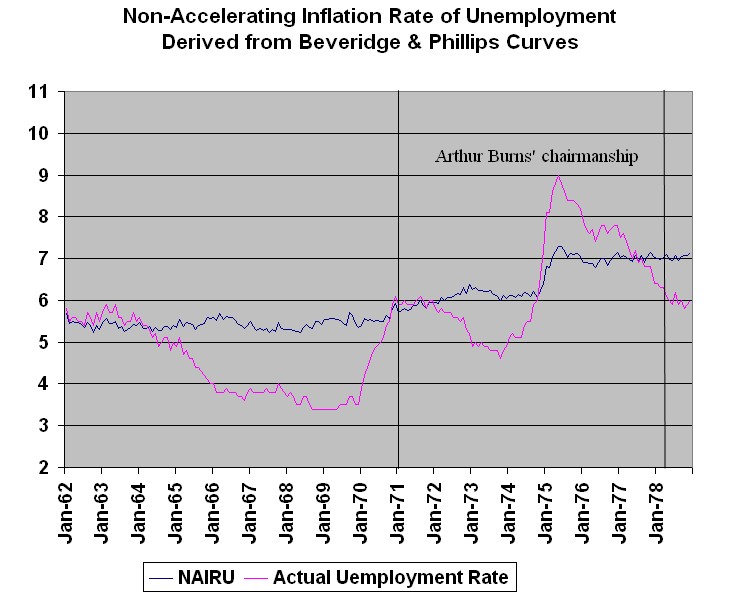
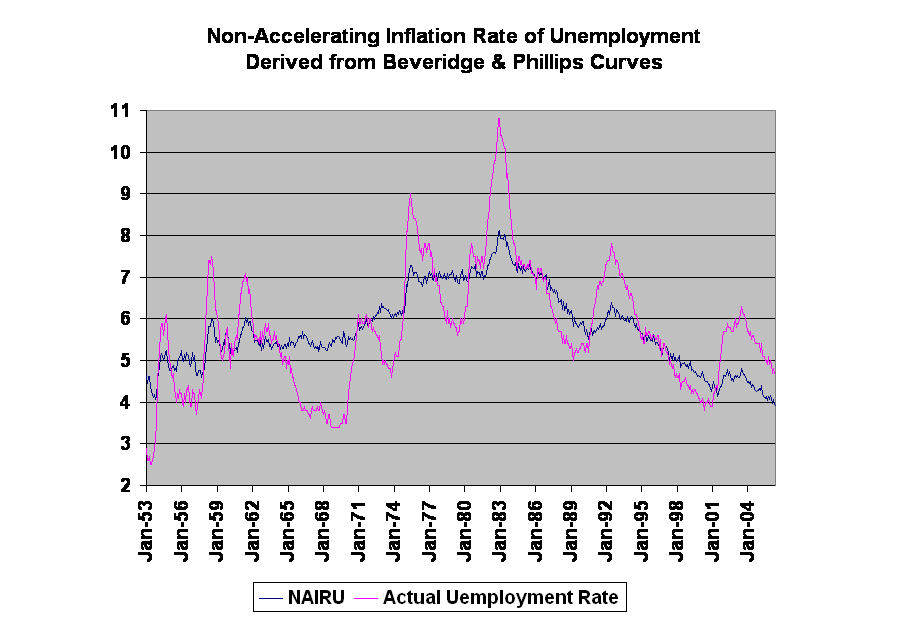
If we look at Burns’ overall period of chairmanship, it does not appear that he was, on average, pushing the economy beyond its limit. Consider this blowup of part of a chart that appeared in an earlier post. You can quarrel with my NAIRU methodology, but I don’t think the estimates are very far from the consensus. And what it shows is that, in terms of the employment gap, the weakness during the second half of Burns’ chairmanship roughly compensated for the strength during the first half, whereas during the years before Burns took over, there was a persistent period of inflationary high employment.


The implications of this chart are quite specific, given the coefficients of my Phillips curve. If we assume a 6-month lag in the effect of monetary policy on employment, then the years prior to Burns added 6.4 percentage points to the inflation rate, whereas Burns added only 0.4 percentage points.

Labels: , , ,

Sunday, June 11, 2006

Practical Tobinism

I have a lot more to say about the NAIRU (and various other topics, believe it or not), but this week I may be too busy applying Tobin’s separation theorem – something else that James Tobin and Greg Mankiw would agree about (but it’s pretty hard for anyone to disagree with a theorem). Since people actually pay me for this kind of thing, I’m beginning to see why Tobin is worth naming a dog after, even if you disagree with him about a lot of things. (My cat and I disagree about a lot of things, too.)

Labels: , ,

Tuesday, June 06, 2006

The Naming of Dogs

A difficult matter: Why does Greg Mankiw have a dog named Tobin? In principle, there are two possible reasons:

(A) he wants to honor Tobin by naming a cherished pet after him;
(B) he wants to dishonor Tobin by naming a mere dog after him.

In practice, I’m sure it’s A, for several reasons (any of which would probably be sufficient):

1. The disrespect (to a Nobel laureate, no less) implied by B would be entirely out of character for Greg.

2. Greg used to have a dog named John Maynard Keynes. At the time, his main claim to fame was as one of the leaders of the “new Keynesian” school of macroeconomics, so it’s implausible that he would have wanted to dishonor Keynes. (It’s also implausible that he would have completely reversed his dog-naming policy subsequently.)

3. I was once at a talk by James Tobin, at which Greg asked a question in a tone that clearly indicated he did not regard Tobin as a dog.

(Actually, possibility C is that his wife named the dog, but I will ignore that possibility for now. Possibility D, which I reject out of hand, in part because of 2 above, is that the name refers to a different Tobin and has nothing to do with the famous economist.)

It seems odd to me that Greg would choose James Tobin out of all the possibilities. When I think about the two of them, it seems there are very few things on which they would agree (if Tobin were alive today). OK, “Keynes was a great economist,” and “Certain nominal quantities values are sticky in the short run.” But beyond that, they would probably disagree about which nominal quantities values (wages or prices), why they are sticky, how long they are sticky, whether the stickiness is symmetric, and so on. They would certainly disagree about the policy implications (e.g., active policy vs. fixed rule). Tobin certainly wouldn’t have taken (or been offered) a job in the Bush administration. Would Mankiw have taken (or been offered) a job in the Kennedy administration? Maybe, but it’s a stretch.

Of course, you can still have great admiration for someone with whom you disagree. But my sense is that there is more to it than that. I think that Greg regards James Tobin as his intellectual progenitor, as an earlier worker on the same project. Perhaps rightly so. I’m not sure what the implications are, but there seems to be some great irony to the whole situation.


UPDATE: I didn’t realize Greg posted on this same topic (sort of) today. Maybe there’s something in the air.

UPDATE2: ...and Greg responds (sort of).

UPDATE3: Shame on me for using the word "quantities" to refer to prices and wages. I really have to mind my P's and Q's.

Labels: , , , , , ,

Wednesday, May 10, 2006

Weak Yuan in the Long Run?

In a comment on an earlier post, reader mvpy points out that labor’s share of national income has a very robust tendency to revert to its mean over time. How, mvpy suggests, can I therefore argue that the weak yuan policy can have lasting effects on US income distribution?

The answer is, I can’t. Even on theoretical grounds, there is no reason (generally) to think that the weak yuan policy would have long-run effects on anything. (The exception – not accounted for in traditional theory – is path-dependence – the effect of the past on the future. For example, the weak yuan may make it profitable to build factories in China. If the yuan subsequently strengthens, but those factories have already been built, it may still be profitable to run them.)

Let’s be clear on this: exchange rates are a short-run phenomenon. In the long run, if China maintains the weak yuan, the strong demand in China will cause inflation, and the weak demand in the US will cause deflation (relatively speaking). The ultimate result is that it will no longer be cheaper to buy things in China than in the US. This phenomenon is known as “real appreciation,” and, in the long run, it renders exchange rate policy irrelevant.

The concern I have is that the long run may take a lot longer to arrive this time around. Ordinarily, when exchange rates are out of whack, it is because some country is trying to defend its currency at an unrealistically high value. To avoid running out of exchange reserves, that country has to tighten monetary policy, which has a deflationary impact and hastens the real depreciation of its currency.

China is in the opposite situation, and the picture is not symmetric. China does not have to worry about running out of reserves. Therefore, China can sterilize its foreign exchange intervention to blunt the inflationary impact. China need not follow a loose monetary policy, so the real appreciation may be a long time in coming. So (though again I hesitate to blame the low labor share in the US predominantly on China’s exchange rate) don’t be too surprised if labor’s share remains away from its mean for a lot longer than usual.

Labels: , , , , ,

Thursday, April 13, 2006

μηνιν αειδε θεα

It's just an excuse to use the beginning of the Iliad as a title for this post, but here's a link to Greg Mankiw's post on anger.

Labels: , , , , ,